Play Backgammon Online — Free, No Signup
BackgammonWorld is a free way to play backgammon — the oldest board game still played today — right in your browser. There is nothing to install and nothing to pay: open the board, pick a mode, and roll.
Play against the computer on three levels, invite a friend with a private link, pick an opponent from the live lobby, or build a friends list and challenge your favorite rivals directly. Every die is rolled by the server, not by your browser, and every move is checked against the official rules before it lands on the board. Online games count toward your own Elo rating. You can play everything as a guest; a free optional account (no email required) keeps your rating across devices and puts you on the leaderboard.
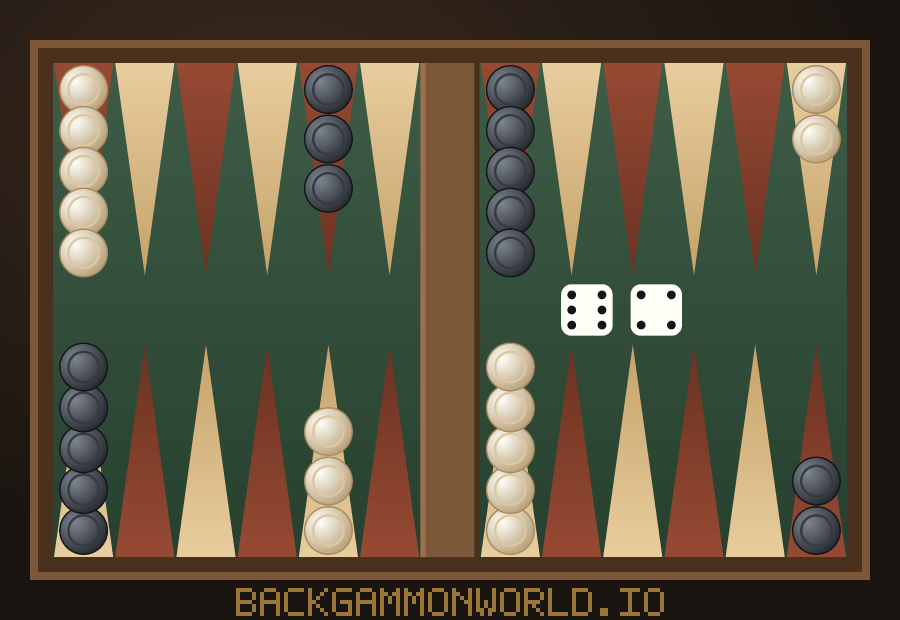
🎲 Dice You Can Trust
Nothing about the dice happens in your browser. The server rolls every throw with a cryptographic random generator and pushes the same result to both players at once, so no one can peek ahead, re-roll, or nudge the odds. Doubles give you four moves, and an unplayable roll is passed on automatically.
🤖 Play vs the Computer
Practice any time against the built-in engine. Choose Easy while you are learning, Medium for a fair fight, or Hard, which weighs every possible reply to all 21 dice combinations before committing. It understands the pip race, blots, primes and anchors — it will punish a loose checker.
🌍 Challenge a Friend Anywhere
Click Invite a Friend and you get a private game link. Send it over any chat app — when your friend opens it, you are instantly at the same board, even on different continents. If a connection drops, the game waits and lets the player rejoin right where the dice left off.
⚔️ Live Opponent Search
Find Opponent opens the live lobby: a list of real players waiting for a game, each with their name and rating. Join one with a single click — or start a search yourself: you appear in the list right away, and the moment another player searches, the two of you are paired automatically.
👥 Friends List
Add friends by searching their username — or tap the + next to your opponent's name right at the board. You'll see who is online, and one click on Challenge sends them an instant popup invitation. Perfect for ongoing rivalries with players you enjoyed facing.
🏆 Elo Ratings & Leaderboard
Every online game is rated with the same Elo system chess uses. You start at 1200 — beat stronger opponents to climb faster. Guests keep their rating in the browser; a free account keeps it on every device, tracks your record, and can put you in the public Top 25 leaderboard.
Four Ways to Start a Game
Every mode below is free and none of them needs an app. The one that suits you depends on a single question: who do you want to play against, and are they available right now?
| Way to play | Opponent | Account needed | Rated | How soon you are playing |
|---|---|---|---|---|
| Against the computer | Built-in engine, three levels | No | No | Immediately — no waiting at all |
| Private invite link | Someone you know | No — for either of you | Yes | The moment they open the link; the link stays valid for 24 hours |
| Find Opponent | Whoever is on the site right now | No | Yes | Depends on who is online — the lobby shows you exactly who that is |
| Standing challenge | Whoever turns up later | Yes, to post one | Yes | Up to 24 hours later — you get notified when somebody takes it |
One honest note, because it matters more than any feature list: this site is young, so at a quiet hour the lobby can be empty. That is exactly why the private link exists and why standing challenges wait a full day for you. If you want a game right now and nobody is around, the computer is always there — and if somebody starts searching while you are playing it, the board tells you and hands you straight over.
How to Play Backgammon Online With Friends
Playing a friend is the part most backgammon sites make hardest: they want both of you registered, both online at the same time, and often both on the same app. Here it takes one click and a link. There are three ways, and none of them requires your friend to sign up for anything.
1. Send a private link — no account, no app
Click Invite a Friend and you get a private game link. Copy it, or use the share button to hand it straight to WhatsApp, Telegram, Signal or any other chat app. When your friend opens it, the two of you are at the same board — on different devices, different browsers, different continents. Neither of you needs an account, and there is nothing to install.
The link survives you closing the tab. Invitations are normally sent through a chat and opened later, so a link that died the moment you walked away would be useless: yours stays valid for 24 hours. If your friend opens it after you have gone, the board is rebuilt and you are called back — and if you do not come, the invitation simply becomes open again instead of being used up.
2. Add friends and challenge them directly
With a free account you get a friends list. Add people by username, or tap the + beside your opponent's name at the board after a good game. The list shows who is online right now, and one click on Challenge puts an instant invitation on their screen — they accept, and the game starts. Ideal for a rivalry you want to keep going rather than a one-off match.
3. Leave a standing challenge for later
Nobody around and you would rather not wait? Post a standing challenge: an offer that stays in the lobby for 24 hours even after you close the browser. When somebody accepts, your seat is held for ten minutes and you get a notification — so you can go and do something else and come back to a game that is ready. Posting one needs a free account, for a simple technical reason: we have to be able to reach you when it is taken. Accepting one does not.
All three of these carry your board and match length with them. If you pick Nackgammon, Hypergammon or Acey-Deucey and set a match to 3 or 5 points, that is what your friend gets when they arrive — they can see what they are joining before they say yes.
Play Backgammon Against the Computer
Free online backgammon against the computer, with no limit on how many games you play and no account at any point. The engine is built into the page and runs in your browser, so it answers instantly and works even on a shaky connection. There are three levels, and they are genuinely different opponents rather than the same engine with a handicap:
- Easy — plays a reasonable move most of the time, but often takes the second or third best one. A forgiving sparring partner while you are still learning which checker to move.
- Medium — always plays the best move its judgement can find. In our own testing it beats Easy in about 92 % of games.
- Hard — looks a move ahead and weighs its best candidate plays against all 21 dice combinations your reply could bring, then picks the one that holds up worst-case. It beats Medium in roughly 54 % of games — a real edge, and about what one extra ply of search is worth.
What it actually understands is the same handful of things a decent human player watches: the pip race, how exposed each blot is (it counts precisely how many of the 36 dice rolls would hit it, including combination and double shots and whether the path is blocked), primes that trap checkers, anchors in your opponent's home board, and how tidily it is bearing off. It will punish a loose checker, and on Hard it will double you when it is ahead and drop when it is not.
The computer plays all four boards, so you can practise the variants against it before taking one to a friend, and it will play a full match to 3 or 5 points with the doubling cube rather than just single games.
Four Boards, Not Just One
Most online backgammon is one board and one set of rules. Here the tab above the board switches between four, and every one of them is playable against the computer, over an invite link or as a full match. The pip counts below are the starting distance each side has to travel — they are read straight from the game engine, so they are what you will actually see on the board.
- Backgammon — the standard game. 15 checkers, 167 pips. If you are not sure, this is the one you want.
- Nackgammon — 15 checkers, 194 pips. Nack Ballard's setup moves two checkers back so both sides start with four runners instead of two. Same rules, longer games, far more positional play — he invented it to stop his students winning by attack alone.
- Hypergammon — 3 checkers, 69 pips. A sprint: one hit costs a third of your army, a prime is impossible, and in our own measurements 69% of wins are gammons or backgammons against 29% in the standard game.
- Acey-Deucey — the American navy game. All 15 checkers start off the board (375 pips), you enter them like coming off the bar, and rolling a 1-2 buys you any double you like plus another roll. No cube, no gammons — every win is one point.
Your choice travels with an invite link and a friend challenge, so you can take a variant to somebody who has never seen it — they will see which board they are joining before they accept. The variants guide compares all four side by side, with measured game lengths and hit rates.
Free, No Signup, No Download
Free means free: every board, every mode, every level, unlimited games, no trial, no premium tier, no advert interrupting a match. There is nothing to download — no app store, no plugin, no Flash, no Java. It is a web page, so it runs on Windows, Mac, Linux, Android, iPhone and iPad, and the board resizes itself to whatever screen you opened it on, including turning your phone sideways.
You never have to register. As a guest you get a name, an Elo rating and access to every mode including rated online games. An account is optional, free and takes about ten seconds — a username and a password, no email address required. What it adds is continuity: your rating follows you to other devices, your record and recent games are kept, you can appear on the public Top 25 leaderboard, and you unlock the friends list and standing challenges. Nothing is taken away if you never make one.
Ratings, Accounts and the Leaderboard
BackgammonWorld uses a hybrid identity model inspired by the big chess sites: you can play every single mode without registering. As a guest you still get a name and an Elo rating — it simply lives in your browser. Creating an account is optional, free, and takes ten seconds: pick a username and a password, no email needed. Your existing guest rating and game history come with you, work on any device you sign in from, and registered players appear in the Top 25 leaderboard with their full win/loss record. An account also unlocks the friends list, online-status indicators, and direct friend challenges.
Backgammon Rules Used on This Site
BackgammonWorld follows the standard rules. Each player starts with fifteen checkers spread over the twenty-four points and races them home in opposite directions, moving one checker per die. A point held by two or more enemy checkers is blocked; a lone checker is a blot and can be hit, sending it to the bar to start its journey again. While you have a checker on the bar you must bring it in before anything else may move. Roll doubles and you play that number four times.
You must use as much of your roll as possible: if only one number can be played but either would be legal on its own, the higher one is compulsory. Once all fifteen checkers are in your home board you may bear off — an exact roll takes a checker from that point, and a roll higher than your highest occupied point bears off from that point. The first player to bear off all fifteen wins: a plain win if the loser bore off at least one checker, a gammon (double game) if they bore off none, and a backgammon (triple game) if they also still have a checker on the bar or in the winner's home board. Play a quick single game, or a match to 3 or 5 points complete with the doubling cube and the Crawford rule — and remember, backgammon has no draws.
New to the game, or want to sharpen up? Read our full guide on how to play backgammon, learn how to set up a backgammon board, look up the complete backgammon rules, the best opening moves with diagrams, and our backgammon strategy guide with the four game plans, priming, anchors, and winning tips. Playing a match? The doubling cube guide explains when to double, when to take and what the Crawford rule is for. Want a stiffer challenge? Try one of the other backgammon variants, starting with Nackgammon — the same rules from a starting position with four back checkers instead of two, selectable under “Board”.
Frequently Asked Questions
- Is BackgammonWorld really free?
- Yes — completely free, with no download and no hidden fees. Every mode is playable without an account.
- Do I need to download an app or install anything?
- No. It runs in your web browser, so there is no app store, no plugin and nothing to install. It works on Windows, Mac, Linux, Android, iPhone and iPad.
- Do I need an account?
- No. An account is optional and free (no email needed) — it keeps your rating across devices, unlocks the friends list, and puts you on the Top 25 leaderboard.
- How do I play backgammon online with friends?
- Click Invite a Friend and send the private link over any chat app — when your friend opens it, you are both at the same board. It works without any account, and the link stays valid for 24 hours, so they can open it later. You can also add each other to your friends lists and challenge directly.
- Does my friend need an account to play with me?
- No. Anyone who opens your private invite link can play straight away as a guest, with no signup and no download.
- What if my friend cannot play right now?
- Your invite link stays valid for 24 hours, so they can open it whenever they get to it — even after you have closed the tab. If you would rather play whoever turns up, post a standing challenge: it waits in the lobby for a day and notifies you when somebody takes it.
- Can I play backgammon against the computer for free?
- Yes — unlimited games against the built-in engine on three levels, with no account and no download. It plays all four boards and will play a full match with the doubling cube.
- How strong is the computer opponent?
- Easy often plays the second or third best move on purpose. Medium always plays the best move it can find and beats Easy in about 92% of games in our own testing. Hard looks a move ahead, weighing its candidate plays against all 21 dice combinations you could reply with, and beats Medium in roughly 54% of games.
- Who rolls the dice, and can they be manipulated?
- The server rolls every die with a cryptographic random generator and sends the result to both players at the same time. No browser, and neither player, can influence or predict a roll.
- How does the rating system work?
- Every online game is rated with the Elo system. Everyone starts at 1200; winning gains points, losing costs points, and beating a stronger opponent gains more. Your wins, losses and recent games are tracked in your profile.
- Are gammons and backgammons counted?
- Yes. If you bear off all fifteen checkers before your opponent bears off a single one, you win a gammon (double game); if they also still have a checker on the bar or in your home board, it is a backgammon (triple game). The result is shown on the final screen.
- Can I play on my phone?
- Yes. The board adapts to any screen size and works in every modern mobile browser, in portrait or landscape.
- What happens if my opponent stops moving?
- Each turn has a two-minute clock. If a player runs out of time or leaves, the other player wins.