The Backgammon Doubling Cube, Explained
How it works, why the take point is 25 percent, and what cube mistakes actually cost
Last updated
The doubling cube is the piece that turns backgammon from a race into a game of judgement. It is not part of the ancient game at all — it was added in New York in the 1920s — and yet every serious player will tell you the same thing: most matches are decided by the cube, not by the checkers. This page covers the rules exactly, the arithmetic behind the famous 25 percent take point, when to double and when you are too good to, the Crawford rule and the rest of match play, and a measurement of our own: what it costs to play the cube badly, over 1,500 matches. When you want to try it, start a free match — the cube is live in every match to 3 or 5 points.
What the doubling cube is
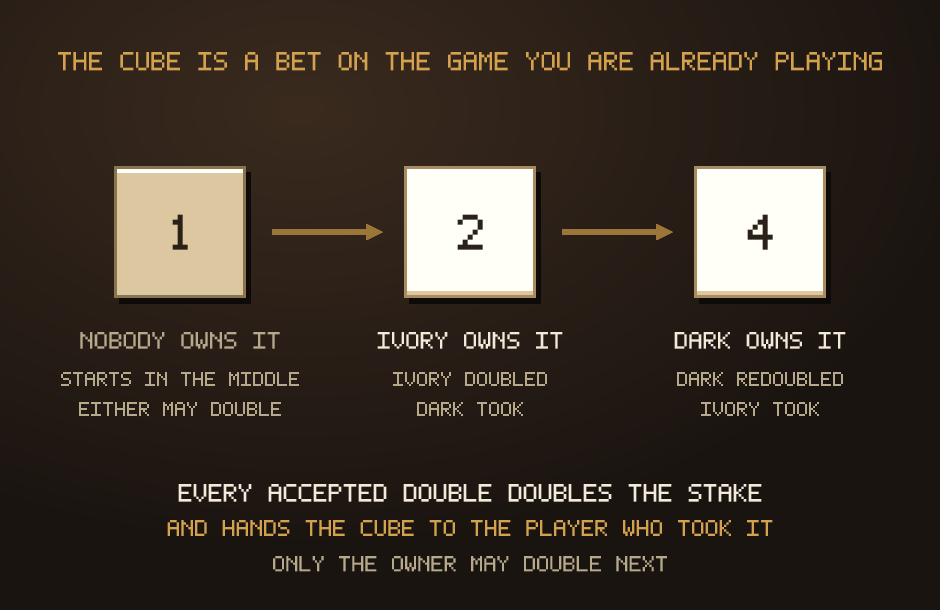
It is a six-sided block, larger than a die, with the numbers 2, 4, 8, 16, 32 and 64 on its faces. It is not rolled. It is a marker that records what the current game is worth, and which player is allowed to raise that number next.
At the start of a game the cube sits on the bar or at the side of the board, showing no owner. The game is worth one point. There is no “1” face on a real cube — the 64 face is traditionally used to mean one, which confuses every beginner exactly once.
The cube was invented in New York in the 1920s, when someone in a backgammon club decided the game needed a way to raise the stakes mid-game. Everything else about backgammon is thousands of years old. This one piece is barely a hundred, and it is the reason the modern game rewards judgement rather than dice.
How doubling works, step by step
- You may only double on your own turn, before you roll. Once the dice are in the air the offer has to wait for your next turn. This is the single rule beginners break most often.
- You say “double” and turn the cube to the next number. Nothing else on the board changes. Your turn is suspended until the offer is answered.
- Your opponent takes or drops. There is no third option and no negotiating.
- If they drop, the game ends immediately. You win the value the cube had before you turned it. Doubling from 1 and getting a drop wins you one point, not two.
- If they take, the game continues at the new value, and they take the cube. From now on only they may offer the next double.
- Then you roll and the turn carries on as normal.
A game that is doubled and taken twice — doubled to 2, redoubled to 4 — is worth four points, and a gammon in that game is worth eight. That is how a single game can decide a five-point match.
▶ Play a free match with the cubeWho owns the cube — and why it matters
Cube ownership is the part that beginners skip and strong players think about constantly. When you take a double, you do not just accept a bigger stake — you acquire the exclusive right to make the next offer. Your opponent has spent theirs.
That right is worth real points. It means a position that turns around is a position you can cash. It is why taking is more attractive than the raw winning chances suggest, and why a player who doubles too early hands over a weapon for nothing. There is a name for the sequence where this goes wrong: you double, they take, the game swings, and they double you back at four. That is a market loss in reverse, and it is the most expensive kind of cube error there is.
One consequence worth naming: because only the owner may double, the cube can shuttle back and forth several times in one game. In practice it very rarely gets past 4. Each turn needs one player clearly ahead and the other still willing to play on, and those two conditions stop overlapping quickly.
The take point: why 25 percent
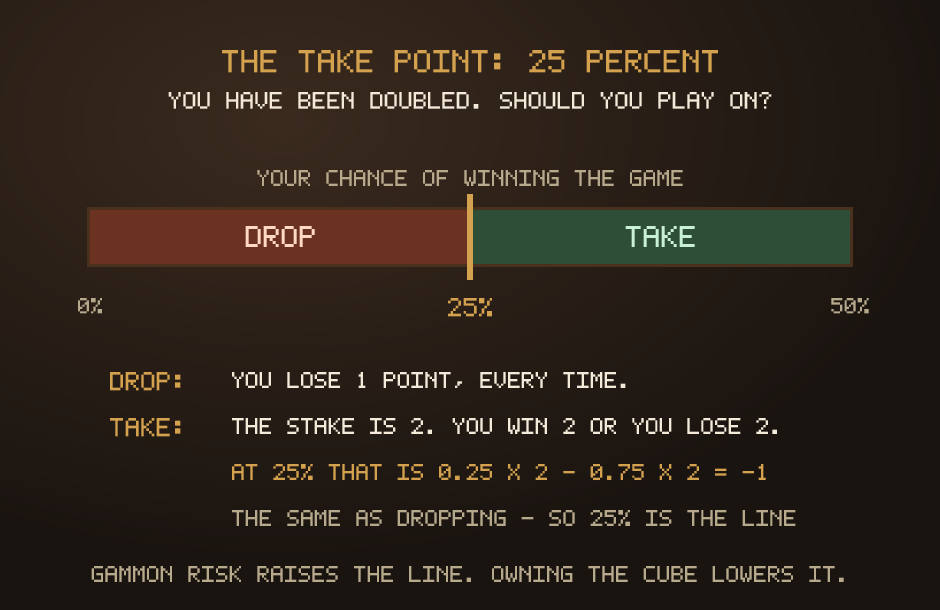
You have been doubled. Should you play on? Here is the whole calculation, and it takes ten seconds.
Dropping costs you one point. Not on average — exactly one point, every time, guaranteed.
Taking means the game is now worth two. If your chance of winning is p, you expect to gain 2p and lose 2(1 − p), so your expected result is 2p − 2(1 − p) = 4p − 2 points.
Set that equal to the cost of dropping and solve: 4p − 2 = −1, so p = 0.25. At exactly 25 percent, taking and dropping are worth the same. Above it, taking is better; below it, dropping is. That is the whole derivation, and it works at every cube value, because doubling both the win and the loss cancels out.
This is why “I might still win” is not a reason to take. You will still win one game in eight from some positions — and taking them costs you a point and a half of every eight games compared with dropping. A drop is not surrender. It is a purchase: you pay one point to stop a worse loss.
What moves the take point
Twenty-five percent is the clean-room figure: no gammons, no future doubling. Two forces move it, and they move it in opposite directions.
Gammon risk pushes it up
If you take at 2 and then lose a gammon, you lose four points, not two. Any position where you might get shut out, or fail to bear a single checker off, is one where taking is far more expensive than the raw win percentage suggests. In a position with real gammon danger the take point climbs from 25 percent towards 30 and beyond. This is the single biggest correction beginners fail to make: a bad take is more expensive than a bad drop, because the bad take loses the doubled stake and the gammon on top of it.
Owning the cube afterwards pushes it down
After you take, the cube is yours. If the game swings your way you can double back, and your opponent then has to find 25 percent of their own or hand you the game. That option has value, and it means the practical take point in a fluid position — a game with contact and plenty left to happen — sits nearer 20 to 22 percent than 25. In a dead position where nothing can change, such as a straight race that is already decided, the full 25 percent applies because there is nothing left to redouble about.
Rule of thumb worth memorising: take at 25 percent in a race, take a bit lower than that in a game with contact, and take a good deal higher when a gammon is in the air.
When to double
The take point tells you what your opponent should do. Your own decision is the mirror of it, plus one extra idea.
Roughly speaking you have a double when you are around 65 to 70 percent to win, and it becomes clear-cut somewhere above that. But the real trigger is not a percentage — it is a question:
“What can happen before my next turn that would make my opponent stop taking?”
Those events are called market losers. If a good roll for you would leave your opponent with an easy drop, then waiting costs you their take. You will have doubled one turn too late and cashed one point instead of playing a doubled game you were going to win. The classic guidance follows directly: double when you have a real number of market losers, not when you feel safe. Feeling safe usually means you are already past the point where they would have taken.
This is also why a double that gets an instant, obvious drop is usually a double you made too late. A perfect double is one your opponent has to think about — and then takes.
Too good to double
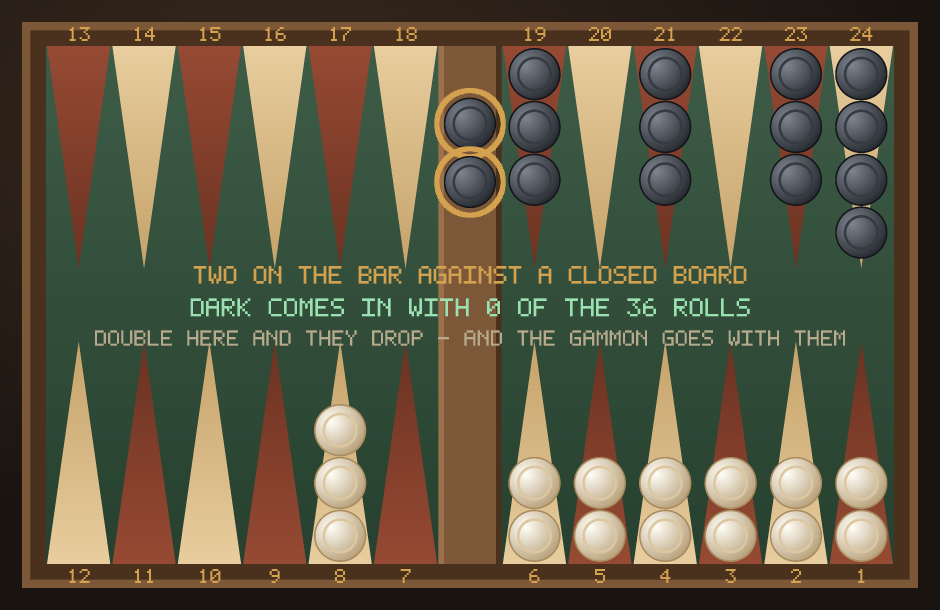
There is a zone above the doubling window where doubling becomes wrong, and it catches everyone at first. If your opponent is certain to drop, then doubling earns you exactly one point and ends the game on the spot. But if you are also close to winning a gammon, that gammon is worth two points, or three for a backgammon. Cashing one point throws the rest away.
The position above is the clearest case there is. Dark has two checkers on the bar and every point in the ivory home board is closed, so dark cannot move at all — zero of the 36 rolls bring a checker in, and that stays true until ivory is forced to open a point while bearing off. Meanwhile ivory keeps playing. Most of the time this ends as a gammon.
So the full picture is a window, not a threshold: too weak to double, then the doubling window, then too good to double. The window is where almost all of the cube's value lives, and it is narrower than beginners expect — often only a roll or two wide.
A practical test: if you are ahead and there is no realistic gammon, cash. If you are ahead and the gammon is live, play on. The mistake is doubling with a live gammon, because that is the one case where you are choosing the smaller prize.
Doubling in a race
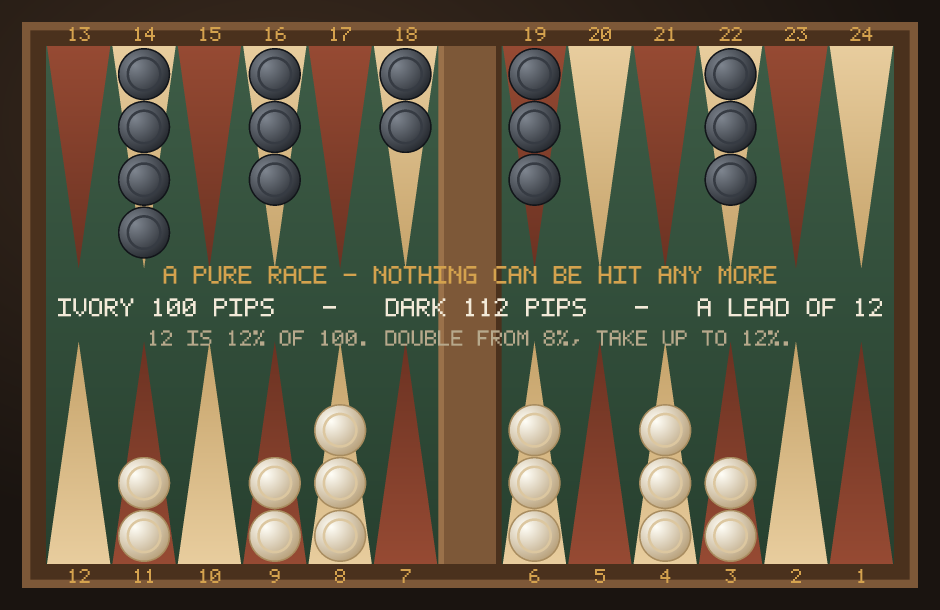
When contact is broken and neither side can be hit again, the game is a pure race and the dice odds stop mattering except through the pip count. This is the one part of cube handling that reduces to a formula you can actually use at the board, and it is called the 8-9-12 rule:
| Your lead, as a share of your own pip count | Cube action |
|---|---|
| 8% | you are in doubling range |
| 9% | a clear double |
| 12% | the last point at which your opponent can take |
In the position above, ivory is on 100 pips and dark on 112. The lead of 12 pips is 12 percent of 100 — right on the take/drop line. Ivory has a clear double; dark has a decision so close it barely matters which way it goes.
Two details make the rule work in practice. First, the percentage is measured against the leader's count, not the trailer's or the total. Second, being on roll is worth about four pips by itself, which is why a race that looks dead level is not: the player about to throw is a small favourite. In a short race that advantage is large — at 30 pips it is worth several percent of the whole game — and it shrinks steadily as the race gets longer.
Quick arithmetic at the board: divide your pip count by 10, then subtract 2 for the doubling threshold and add 2 for the take point. On 100 pips that gives 8 and 12 without any real thinking.
The cube in match play
A match is played to a target score — 3, 5, 7 points and so on — and this changes cube strategy completely, because points beyond the target are worthless. Winning 5–0 and winning 5–4 are the same result.
Match length is also the single biggest factor in whether the better player actually wins: we measured the same two engines across seven lengths and the stronger side's win rate climbed from 55% over one game to 70% over a match to 25. Is backgammon luck or skill? has the full curve — including what the cube itself does to it.
The Crawford rule
The moment either player reaches one point short of the match, the very next game is played without the cube. That game is the Crawford game.
The reason is simple. A player trailing 4–2 in a match to 5 must win two games regardless, so they lose nothing by doubling immediately in every game — they would double at their first turn, every time, for free. The Crawford rule takes away exactly one of those free doubles. It applies once per match; from the game after it, doubling is allowed again, and a trailing player normally does double at the first opportunity. Those later games are called post-Crawford.
The dead cube
A double that cannot change the outcome is not allowed to be offered, because it would be meaningless. If you are at 3 points in a match to 5, a game worth 2 already wins the match for you; doubling to 4 adds nothing. On this site the board simply does not offer the cube in that situation — the rule is enforced rather than left to etiquette.
The free drop
A subtlety worth knowing once the rest is comfortable. Post-Crawford, if the trailing player needs an odd number of points, the leader can sometimes drop the first double for free: the point they concede does not change how many games the trailer still has to win. The leader gives up one point to throw away a game they had no reason to play. This is not a rule — it is a consequence of the scoring, and it is the most commonly missed edge in a match.
Match equity
In a match your take point is no longer 25 percent — it depends on the score. Trailing badly, you should take doubles that would be clear drops for money, because you need volatility. Leading, you should drop marginal takes, because you do not need the points and cannot afford to hand over a doubled game. Serious players learn a match equity table for this. For a casual match to 5, the useful version is one sentence: when you are behind, take more; when you are ahead, take less.
What cube mistakes cost: our measurement
Everything above is standard theory. This part is ours, and it exists because “the cube matters” is easy to say and hard to feel. So we measured it.
The method. Two identical opponents play matches to 5 points against each other. Both use the same engine and the same playing strength, so every checker is moved by the same judgement on both sides of the board. The only difference is one side's cube policy. Seats are swapped so neither colour has an advantage, and a control run of the normal policy against itself is included — without a known quantity in the experiment, a number like this is worthless.
| Cube policy | Matches won against the normal player |
|---|---|
| Never doubles at all | 36.6% |
| Doubles at the first legal opportunity, every game | 40.0% |
| Accepts every double, never drops | 49.4% |
| Drops every double, never takes | 65.9% |
| Control: the normal player against itself | 50.5% |
1,500 matches per row, so each figure is accurate to about ±2.5 points at 95 percent confidence. The control came out at 50.5 percent, which is what it has to be — a measurement like this is worthless without a known quantity running alongside it.
Never doubling costs thirteen points of match win rate
Identical players, identical checker play, one difference: a side that refuses to touch the cube wins only 36.6 percent of matches. It loses nearly two matches in three to a version of itself that doubles. Nothing else on this page is worth as much as the simple habit of turning the cube at all — every game you win undoubled is a game you won for the minimum while your opponent collected the maximum from theirs.
Doubling blindly is almost as expensive
Offering at the first legal opportunity in every game wins 40.0 percent. That is the other half of the lesson: the cube is not a button to press on principle. A double thrown out at random is usually either declined for one point in a game you would have won properly, or accepted by an opponent who is happy to own the cube from then on.
The last two lines say something about our computer opponent
Dropping every single double wins 65.9 percent. That obviously cannot be general advice — if refusing everything were right, the cube would be broken. What the number actually measures is a weakness in the reference player: it doubles too late. It waits until it is comfortably ahead, by which point its offers are ones you should refuse, and it has thrown away the doubled games it was going to win. That is exactly the market-loser idea seen from the receiving end, and it is a mistake humans make constantly.
Accepting every double, meanwhile, scores 49.4 percent against a control of 50.5 — statistically the same as the reference's own take rule. So that rule is effectively “take almost anything”, which is the other classic error: it walks into gammons at twice the stake. Our computer opponent is a heuristic, not a world-class bot, and it is beatable in precisely these two ways. You are welcome to use that.
Why this measurement is allowed and a probability table would not be. Both sides here move their checkers with the same engine, so playing strength cancels out completely and only the cube policy is being compared. An absolute table — “this race is won 71 percent of the time” — would depend on how well the engine plays, and ours is not strong enough in the bear-off for that. A controlled comparison is a question our engine can answer honestly; a reference table is not.
Optional rules, and where sources disagree
Almost every argument about the cube is really an argument about house rules. These four are common enough that you will meet them, and no two websites list the same set as “standard”. Here is what each one is, and what applies here.
| Rule | What it does | Where it is used | On this site |
|---|---|---|---|
| Jacoby rule | Gammons and backgammons only count double or triple if the cube has been turned at least once in that game. | Money play, common. Never in match play. | Not used |
| Beaver | The player accepting a double may immediately redouble to the next level and keep the cube. | Money play, by agreement. | Not used |
| Raccoon | The original doubler may respond to a beaver with another redouble, taking the cube back. | Money play, rarer still. | Not used |
| Automatic double | If the two opening dice are equal, the stake doubles and the cube stays in the middle, usually limited to once per game. | Money play, by agreement. | Not used — the opening roll is re-thrown instead |
| Crawford rule | One cube-less game when a player reaches match point. | Standard in all match play. | Applied automatically |
The pattern is easy to remember: the Crawford rule belongs to matches, everything else on that list belongs to money play. A site that offers matches and quietly applies the Jacoby rule is mixing two different games. We do not, and neither should any tournament you enter.
The mistakes people actually make
Never touching it
By far the most expensive habit, and the measurement above puts a number on it. A player who never doubles has volunteered to play every game for its minimum value while their opponent collects the maximum from theirs.
Doubling because the position feels good
“I am clearly better here” is not the test. The test is whether your opponent can still take. Double the moment they can only just take, not when the game already looks over.
Taking because it feels weak to drop
Dropping is a positive action that costs a known, small amount. Marginal takes in gammonish positions are how good players are beaten by better ones.
Forgetting the score
A take that is right for money can be badly wrong at 4–1 in a match to 5, and the reverse. Look at the score before the board.
Doubling with a live gammon
See too good to double. If they are on the bar against a closed board, do not cash — play it out.
Trying to double after rolling
Not a strategy error, just the rule people forget. Once you have thrown, the offer waits for your next turn. Online, the button simply disappears — which is a good way to learn it.
Playing with the cube on this site
Everything on this page is implemented in the board you can play right now, so you can test any of it without a physical set.
- The cube is live in matches to 3 and 5 points. Pick the length before the game starts. A single game has nothing to multiply, so it has no cube.
- Double, Take and Drop are buttons that appear only when the rule allows them — before your roll, on your turn, and only if you own the cube or it is still in the middle.
- The Crawford game is applied automatically and the cube is hidden for it.
- A dead cube is not offered. If the current value already wins you the match, the Double button does not appear.
- An unanswered double is a drop, not a forfeit. If your opponent's clock runs out while a double is pending, they concede that game at the pre-double value and the match continues.
- The computer opponent uses the cube too, and will double you and drop you. It is a heuristic player rather than a world-class one — as the measurement above shows, it doubles later than it should.
- Acey-deucey has no cube in any format, because that variant scores every win as a single point. Nackgammon and hypergammon use it exactly like the standard game.
Questions people ask
What is the doubling cube in backgammon?
It is a six-sided block marked 2, 4, 8, 16, 32 and 64 that records what the game is currently worth. At the start it sits in the middle and the game is worth one point. A player who thinks they are ahead may offer to double the stake before rolling; the opponent either accepts and plays on for twice as much, or refuses and loses the smaller amount straight away.
When can you double in backgammon?
Only on your own turn, and only before you roll. At the start of a game either player may double. After that, only the player who accepted the last double may offer the next one, because taking a double also takes ownership of the cube.
What is the take point in backgammon?
Twenty-five percent. Dropping costs you one point for certain. Taking puts two points at risk, so it breaks even when you win a quarter of the time: 0.25 times 2 minus 0.75 times 2 equals minus 1, exactly what dropping costs. Above 25 percent taking is better, below it dropping is.
Should I take or drop when I am doubled?
Take if you will win at least a quarter of the games from that position, drop if you will not. Two things shift the line: the risk of losing a gammon pushes it up, because a gammon at the doubled stake costs four points instead of two, and owning the cube afterwards pushes it down, because you can double back later.
Can you be too good to double?
Yes. If your opponent would certainly drop, doubling wins you exactly one point and ends the game. When you are close to winning a gammon, that gammon is worth two points or more, so playing on without doubling is worth more than cashing. This is the position players call too good to double.
What is the Crawford rule?
In a match, the first game played after either player reaches one point short of victory is played without the cube. It stops the trailing player from doubling immediately in a game they must win anyway. It applies once per match; from the game after it, doubling is allowed again.
What is the Jacoby rule?
A money-play convention: gammons and backgammons only count double or triple if the cube has been turned at least once during the game. It exists to stop players grinding out long undoubled gammons. It is not used in match play, and it is not used on this site.
How high can the doubling cube go?
The cube itself shows 2, 4, 8, 16, 32 and 64, and 64 is where it stops here. In practice it almost never leaves 2 or 4, because each turn requires one player to be well ahead and the other to still be willing to play on.
Does the doubling cube work in a single game?
On this site the cube is only live in matches to 3 or 5 points. A single game is scored as one point, so there is nothing for the cube to multiply. Acey-deucey has no cube at all, in either format, because that variant scores every win as one point.
Next: the complete rules cover everything the checkers can do, the odds page has the hit numbers behind every take decision, and strategy turns both into a plan. In a pure race you can skip the estimating: the bear-off calculator gives the exact winning chance and the cube answer that follows from it. And if you want to know how much any of this decides, luck or skill measures it. Or just start a match and turn the cube.