Backgammon Rules Explained
Setup, movement, hitting and bearing off — every rule, in plain English
Last updated
Backgammon is a game for two players, and the whole of it fits on one page. Each player has fifteen checkers that travel around 24 points in opposite directions; the dice say how far, the opponent's checkers get in the way, and the first player to bring all fifteen home and remove them wins. Everything below is the complete rulebook — and you can play it here free against the computer or a friend, with every rule enforced for you.
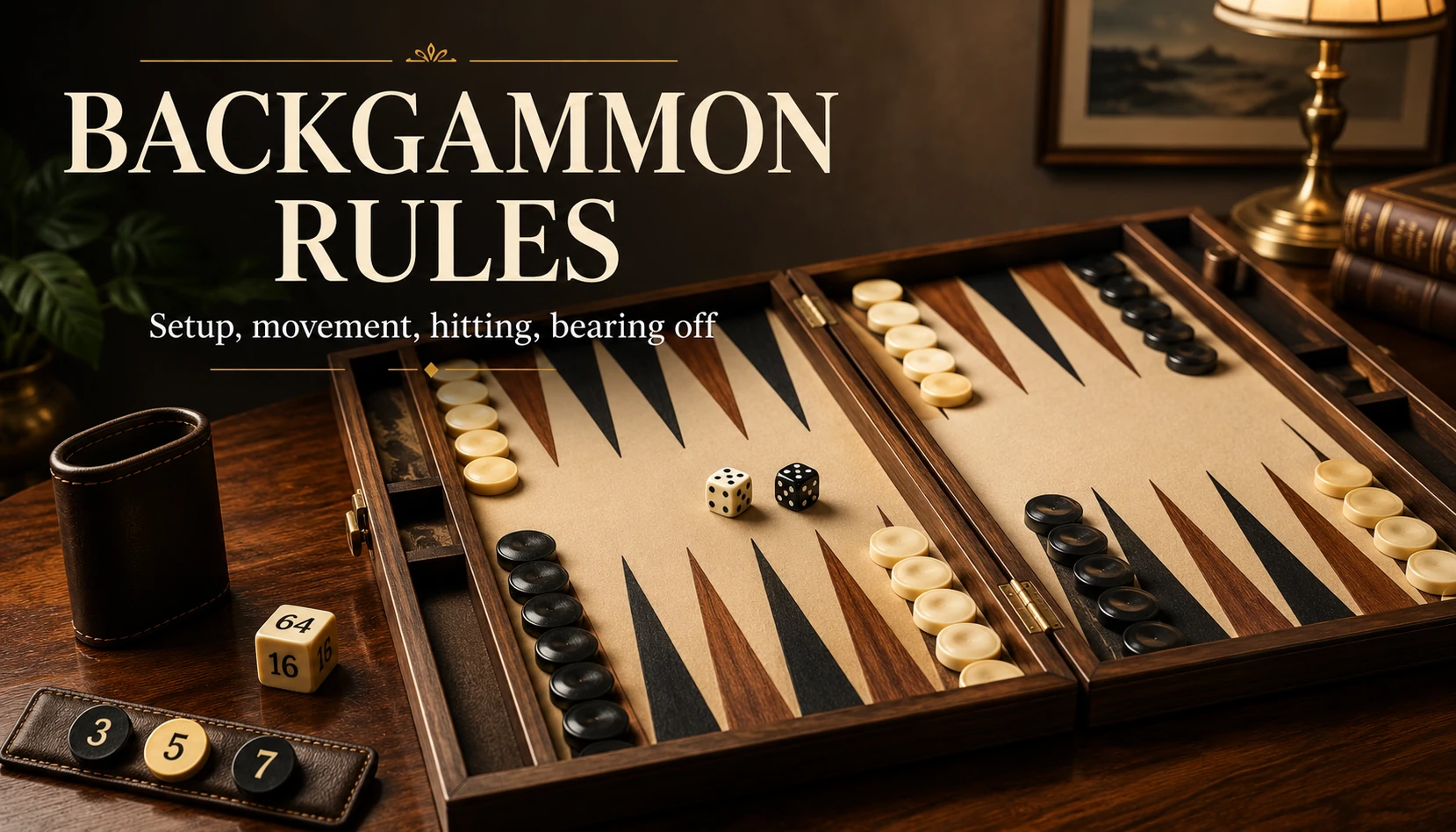
The object of the game
Backgammon is played by two players. Each has fifteen checkers that move around a board of 24 points, and the two players move in opposite directions, each toward their own home board. The first player to bring all fifteen checkers into their home board and then remove them from the board — bearing off — wins the game.
That is the whole objective. Everything else in these rules is about what the dice let you do and what your opponent is allowed to do about it.
What you need
- A board with 24 points in four quadrants of six.
- 30 checkers, fifteen of each colour.
- Two dice — traditionally a pair each, with a dice cup.
- A doubling cube marked 2, 4, 8, 16, 32, 64, for games played for stakes or in a match.
Playing online you need none of it: the board, the dice and the cube are on the screen, and the rules are enforced, so you cannot make an illegal move by accident.
Setup: the starting position
Counting each player's own points from 1 (their nearest home point) to 24 (the far corner), each side starts with:
- Two checkers on the 24-point,
- Five checkers on the 13-point,
- Three checkers on the 8-point,
- Five checkers on the 6-point.
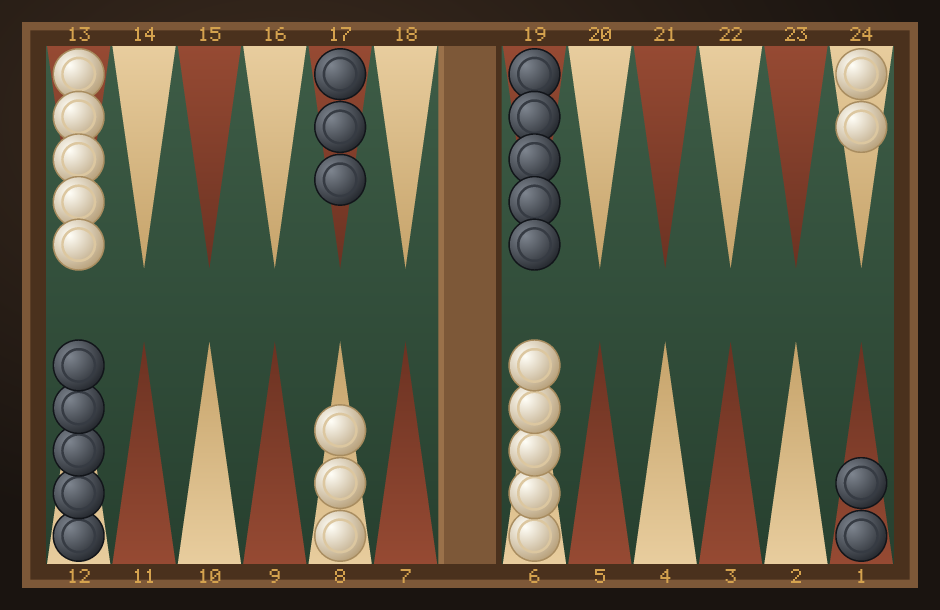
The two setups are mirror images, so whichever side of the board you sit on, your position looks the same to you as your opponent's does to them. If you would like the board itself explained first — quadrants, the bar, which corner is home — see the backgammon setup guide.
Which way you move
Each player moves from their 24-point toward their 1-point — always toward their own home board, and always in the opposite direction to their opponent. The two armies walk the same C-shaped path around the board, passing straight through each other.
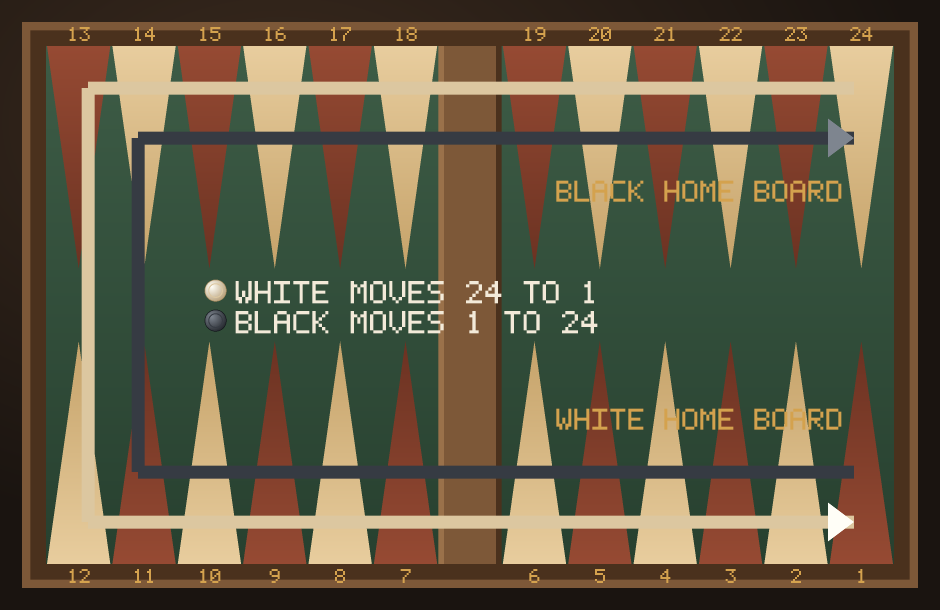
Your home board is the quadrant holding your 1- to 6-points; your outer board is the one next to it. The raised divider down the middle is the bar, where hit checkers wait.
Starting the game
Each player rolls one die. The higher number starts, and plays those two dice as their first move — so the opening roll is never a double. If both players roll the same number, both roll again.
After that, players alternate turns, rolling both dice at the start of each turn. Dice must land flat on the right-hand side of the board; a die that lands cocked, on a checker or outside the board is rolled again.
Moving the checkers
What the dice mean
The two dice are two separate moves, not one total. A roll of 6-3 lets you move one checker six points and another three, or the same checker six and then three — but if you move one checker the whole way, both intermediate points must be open to you. There is no such thing as moving one checker "nine".
Where you may land
A checker may move to a point that is:
- empty,
- occupied by your own checkers, any number of them,
- occupied by exactly one enemy checker — you hit it (see below).
A point holding two or more enemy checkers is closed: you may not land there, and you may not use it as the intermediate stop of a two-part move either.
Doubles
Rolling the same number on both dice gives you four moves of that number instead of two. A 5-5 is four moves of five pips, spread over one, two, three or four checkers as you like.
You must use both dice if you can
This is the rule most beginners miss. You are obliged to play both numbers if there is any legal way to do so — you may not decline the half you dislike. Two consequences:
- If only one of the two numbers can be played, you must play that one.
- If either number could be played alone but there is no way to play both, you must play the higher one.
- With doubles, you play as many of the four moves as you legally can.
When you cannot move at all
If neither number can be played, your turn is simply forfeited and the dice pass to your opponent. Nothing else happens: you do not skip a later turn, and you do not owe anything.
Blots, hitting and the bar
A single checker alone on a point is a blot. When an opposing checker lands on it, the blot is hit: it comes off the board and goes onto the bar. How exposed a blot really is depends on its distance from the nearest enemy checker: see the complete odds table.
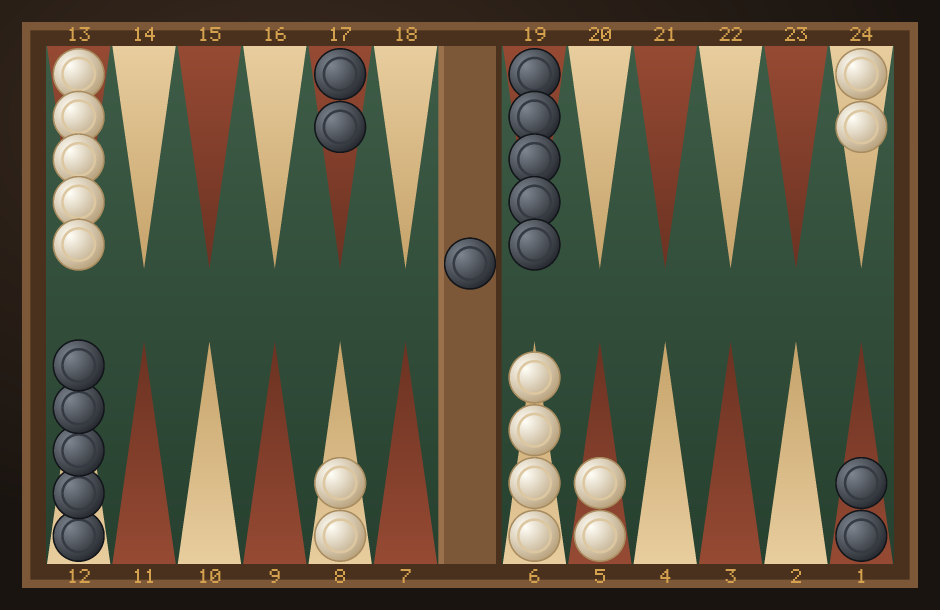
Being hit is expensive because the checker restarts its journey: it re-enters at the far end of the board and has the whole distance to travel again. Nothing else is lost — there is no capture in backgammon, only delay.
Entering from the bar
A checker on the bar re-enters in the opponent's home board, on the point matching one of your dice: a 3 enters on their 3-point, a 5 on their 5-point. Points held by two or more enemy checkers are closed to you, exactly as anywhere else — and if the point holds a single enemy checker, entering there hits it.
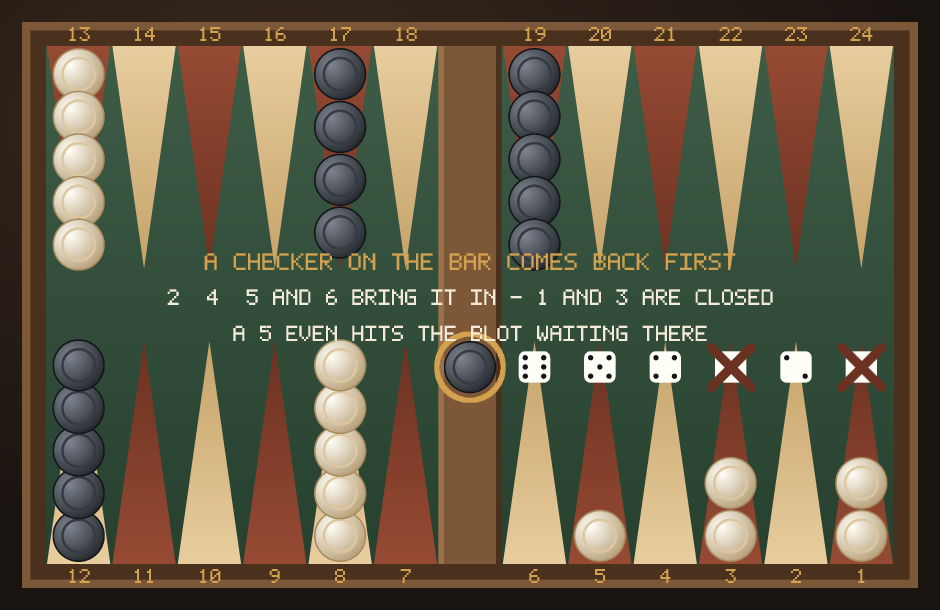
Nothing else until you are in
While you have a checker on the bar you may not move anything else. If both your numbers are blocked, you forfeit the turn and try again next time. If your opponent has all six home-board points made — a closed board — you cannot enter at all, and you sit out turns until they are forced to open a point.
Bearing off
When you may start
Once all fifteen of your checkers are in your home board, you may begin taking them off the board. A checker on the 4-point is borne off with a 4, one on the 6-point with a 6, and so on.
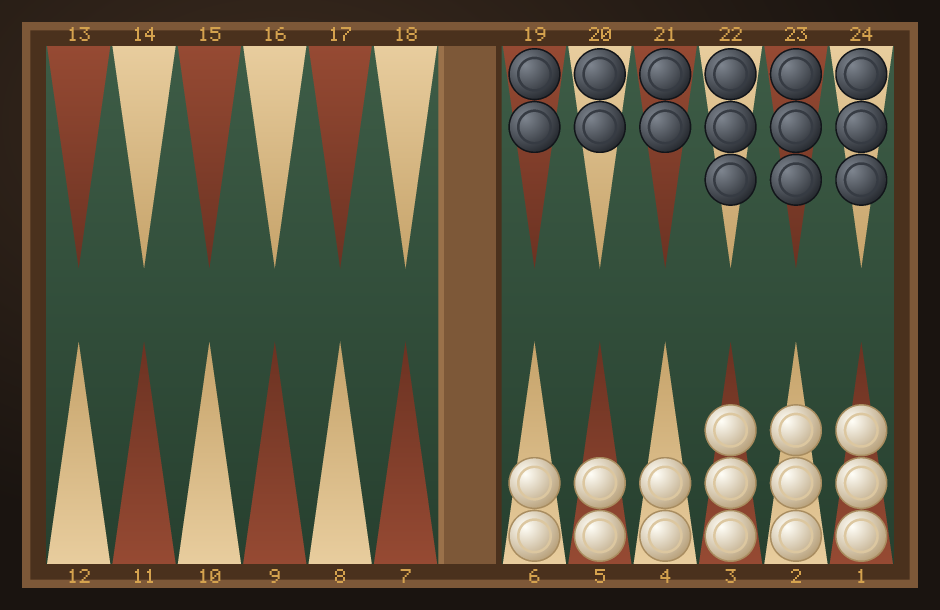
Exact numbers and overshooting
You may always play a number as an ordinary move inside your home board instead of bearing off. If the number is higher than your highest occupied point, it bears a checker off from that highest point — but only then. With a checker still on the 6-point, a 5 cannot take one off the 4-point; it has to be played as a move.
If you are hit during the bear-off
A checker sent to the bar while you are bearing off must re-enter and travel all the way home again before you may take any more checkers off. That is why leaving a blot in the home board matters right up to the last roll.
Winning: single, gammon, backgammon
The first player to bear off all fifteen checkers wins. How much the win is worth depends on how far the loser got:
| Result | When | Worth |
|---|---|---|
| Single game | the loser has borne off at least one checker | 1 point |
| Gammon | the loser has borne off none | 2 points |
| Backgammon | the loser has borne off none AND still has a checker on the bar or in the winner's home board | 3 points |
All three are multiplied by the value of the doubling cube.
The doubling cube
The cube turns backgammon from a dice game into a betting game, and it is where most of the skill of the modern game lives.
Doubling, take and drop
At the start of your turn, before you roll, you may offer to double the stake. Your opponent has two choices:
- Take — the game continues at twice the stake, and the cube passes to them. Only they may double next.
- Drop — the game ends immediately and they lose the current value, before the double.
Redoubles
Whoever holds the cube may later redouble to 4, then the other player to 8, and so on. There is no limit in principle; in practice a game rarely goes past 8. When to turn it, and when to take, is a subject of its own — the doubling cube guide covers the 25 percent take point, being too good to double, and the Crawford rule in full.
Beavers, the Jacoby rule and Crawford
- Beaver (money play): the player taking a double may immediately redouble to four while keeping the cube. A house rule, not part of match play.
- Jacoby rule (money play): gammons and backgammons count as a single game unless the cube has been turned — so nobody plays on for hours hunting an undoubled gammon.
- Crawford rule (match play): when one player first reaches one point short of the match, the next game is played without the cube. After that game, doubling is allowed again.
Match play and scoring
Serious backgammon is played as a match to a fixed number of points — first to 3, 5, 7 and so on. Each game's value (1, 2 or 3 points, multiplied by the cube) is added to the winner's score, and the match ends the moment someone reaches the target. The Crawford rule applies automatically in the last stage.
Played for money instead, each game simply settles at its own value, and the Jacoby rule and beavers are common table conventions.
Rules people get wrong
These are the questions that come up at the board again and again:
- "Can I choose to play only one die?" No — if both can be played, both must be. If only one can, it is the one that has to be played, and if you must choose, the higher.
- "Can I stack as many checkers as I like on one point?" Yes. There is no limit on your own checkers on a point.
- "Can I jump over a blocked point?" Yes, in the sense that a die's move is a single jump — only the landing point matters. But a two-part move with one checker must be able to stop legally in between.
- "Can I hit while I have a checker on the bar?" Only by entering onto the blot. Nothing else may move until every checker of yours is off the bar.
- "Does a hit checker go back to the start?" Effectively, yes: it re-enters in the opponent's home board, which is the far end of its journey.
- "Must I bear off if I can?" No. You may always play the number inside your home board instead, and sometimes you should.
- "Can I double whenever I like?" Only at the start of your turn, before rolling, and only if you own the cube or nobody has doubled yet.
- "Is the opening roll ever a double?" No. Each player rolls one die and equal numbers are re-rolled, so the first move is always two different numbers.
Etiquette and house rules
Two conventions are worth knowing over a real board. A move is complete when you pick up your dice — until then you may rearrange it, and after it your opponent may not ask you to change it. And an illegal move that has already been played may be accepted or corrected at the opponent's discretion.
Most disagreements are about house rules rather than rules: beavers, the Jacoby rule, whether a cocked die is re-rolled or both dice are. Agree them before the first roll and there is nothing left to argue about. Bigger differences than that usually mean you are playing a different game: see the guide to backgammon variants for tavla, plakoto, fevga, narde and the rest.
Variants with different rules
Three of the boards on this site use the rules above unchanged and only differ in where the checkers start; one changes the rules themselves:
- Nackgammon — four back checkers instead of two: longer, more positional games.
- Hypergammon — three checkers a side: a game in a couple of minutes, and mostly gammons.
- Acey-Deucey — the U.S. Navy game: everything starts off the board, a 1-2 roll buys a free double, bearing off needs an exact number, and there is no cube.
Quick reference
| Situation | Rule |
|---|---|
| Opening roll | one die each, higher starts and plays both |
| A normal roll | two separate moves; doubles give four |
| Landing on a point | allowed unless two or more enemy checkers are on it |
| Landing on a lone enemy checker | it goes to the bar |
| Checker on the bar | must re-enter before anything else moves |
| Only one die playable | play it; if you must choose, play the higher |
| No legal move | turn is forfeited |
| Bearing off | only with all fifteen checkers home |
| Higher number than any occupied point | bears off from the highest point |
| Doubling | before your roll; take doubles the stake, drop ends the game |
Questions people ask
What are the basic rules of backgammon?
Two players each have fifteen checkers and move them in opposite directions around 24 points, using the two dice as separate moves. A point held by two or more enemy checkers is closed to you; landing on a single enemy checker sends it to the bar, and it must re-enter before that player does anything else. Once all fifteen of your checkers are in your home board you bear them off, and the first player to bear off all fifteen wins.
How do you set up a backgammon board?
Each player puts two checkers on their 24-point, five on their 13-point, three on their 8-point and five on their 6-point — fifteen checkers, mirrored for both players. The two home boards sit diagonally opposite each other, and each player moves from the 24-point down toward their own 1-point.
Do you have to use both dice in backgammon?
Yes, if there is any legal way to do it. If only one of the two numbers can be played, you must play that one; and if either could be played alone but not both, you must play the higher one. If neither number can be played, you forfeit the turn.
What happens when you roll doubles in backgammon?
You play the number four times instead of twice. A roll of 5-5 gives you four moves of five pips each, which you may spread over one, two, three or four checkers. The same maximum-use rule applies: you play as many of the four as you legally can.
What is a blot in backgammon?
A blot is a single checker alone on a point. An opposing checker landing there hits it: the blot goes to the bar and has to re-enter in the opponent's home board before its owner may make any other move.
How do you get off the bar in backgammon?
You re-enter in your opponent's home board, on the point matching a die: a 3 enters on their 3-point. Points held by two or more enemy checkers are closed to you. Until every one of your checkers is off the bar you may not move anything else, and if neither die can bring you in you lose the turn.
When can you start bearing off in backgammon?
Only when all fifteen of your checkers are in your home board — the last six points. If one of them is hit later and sent to the bar, you must bring it all the way home again before bearing off may continue.
Can you bear off with a higher number than the point?
Yes, but only when no checker sits on a higher point. If your highest occupied point is the 4-point, a 5 or a 6 bears a checker off from there. If you still have a checker on the 6-point, a 5 must be played as a move inside the home board instead.
What is a gammon and a backgammon?
A plain win counts one point. It is a gammon, worth double, if the loser has not borne off a single checker. It is a backgammon, worth triple, if the loser still has a checker on the bar or in the winner's home board.
How does the doubling cube work?
Before rolling, a player may offer to double the stake. The opponent either drops and loses the current value immediately, or takes — the stake doubles and the cube passes to them, so only they may double next. There is no limit to the number of redoubles in a game.
Who goes first in backgammon?
Each player rolls one die and the higher number starts, playing the two dice that were just thrown. If both roll the same number, the dice are rolled again — which is why the opening roll can never be a double.
Where can I play backgammon online for free?
Here. BackgammonWorld runs in your browser against the computer or a friend, with no download and no account, and every rule on this page is enforced automatically — including the ones that are easy to get wrong, like having to use both dice.
Next: a gentler walkthrough in how to play backgammon, the board setup in detail, the best opening moves, our strategy guide — or test yourself with the backgammon quiz.
← Back to the game