Backgammon Variants: Every Version, Explained
Forty named games, five things that actually change — and four boards you can play right now
Last updated
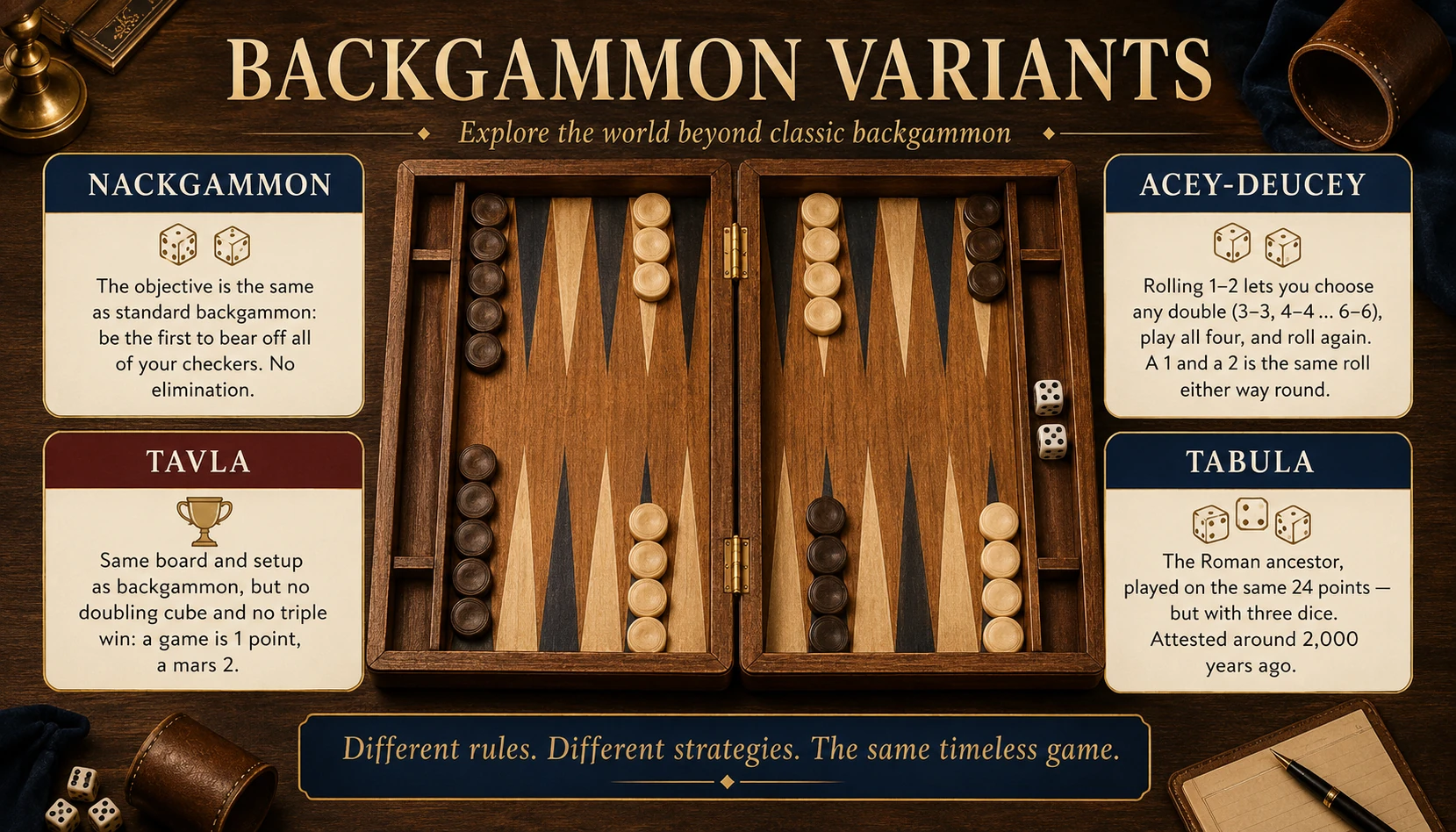
Backgammon is not one game. It is a family of them, played across Greece, Turkey, Iran, Russia, the Balkans and every American aircraft carrier, on the same 24 points with the same two dice. The names are intimidating — tavla, tavli, portes, plakoto, fevga, narde, gul bara, acey-deucey, nackgammon, hypergammon — but the games are not. Nearly every one of them changes something from a very short list, and once you can see that list, a new variant takes about a minute to learn. This page lays out that list, then goes through the variants themselves. Four of them you can play here for free, and for those four we have measured how differently they actually play.
The short answer
It is worth saying which way round the history runs, because it is the opposite of what most people assume. The regional games are not variants of international backgammon. Games on this board are two thousand years old and were played from Rome to Persia long before anybody wrote down a standard. What we now call “backgammon” is one branch of that family, formalised in English-speaking clubs and then fitted with a doubling cube in 1920s New York. Tavla and narde are cousins, not children.
The five things a variant can change
| What changes | In standard backgammon | Variants that change it |
|---|---|---|
| The starting position | 2-5-3-5 across four points | Nackgammon (four back checkers), hypergammon (three checkers), acey-deucey (empty board), plakoto, fevga and narde (all fifteen on one point) |
| Landing on a lone checker | You hit it; it goes to the bar | Plakoto and mahbusa (you pin it where it stands), fevga, narde and gul bara (you cannot land there at all) |
| Direction of travel | The two sides run opposite ways | Fevga, narde and gul bara: both players run the same way round |
| Coming back into play | From the bar, into the enemy home board | Acey-deucey (checkers enter from off the board, but by choice); variants with no hitting have no re-entry at all |
| What a win is worth | 1, 2 for a gammon, 3 for a backgammon, times the cube | Tavla (no triple), acey-deucey (always 1), tavli and narde (no cube), money play (Jacoby rule, beavers) |
Notice what is not on the list. The board is always 24 points. There are always fifteen checkers a side, except in hypergammon. The dice are always two six-sided dice, doubles are always played four times, and you always bear off from your own home board. Those are the constants of the whole family, and they are why a tavla player and a backgammon player can sit down together and settle the differences in one sentence.
▶ Play backgammon free — four boards, no signupThe four boards you can play here
Everything in this section is playable on this site right now, against the computer or against a real opponent. Pick the board from the row of tabs directly above the board before the game starts.
| Board | What is different | Best for |
|---|---|---|
| Backgammon | The standard game | Everything — this is the one the theory is written about |
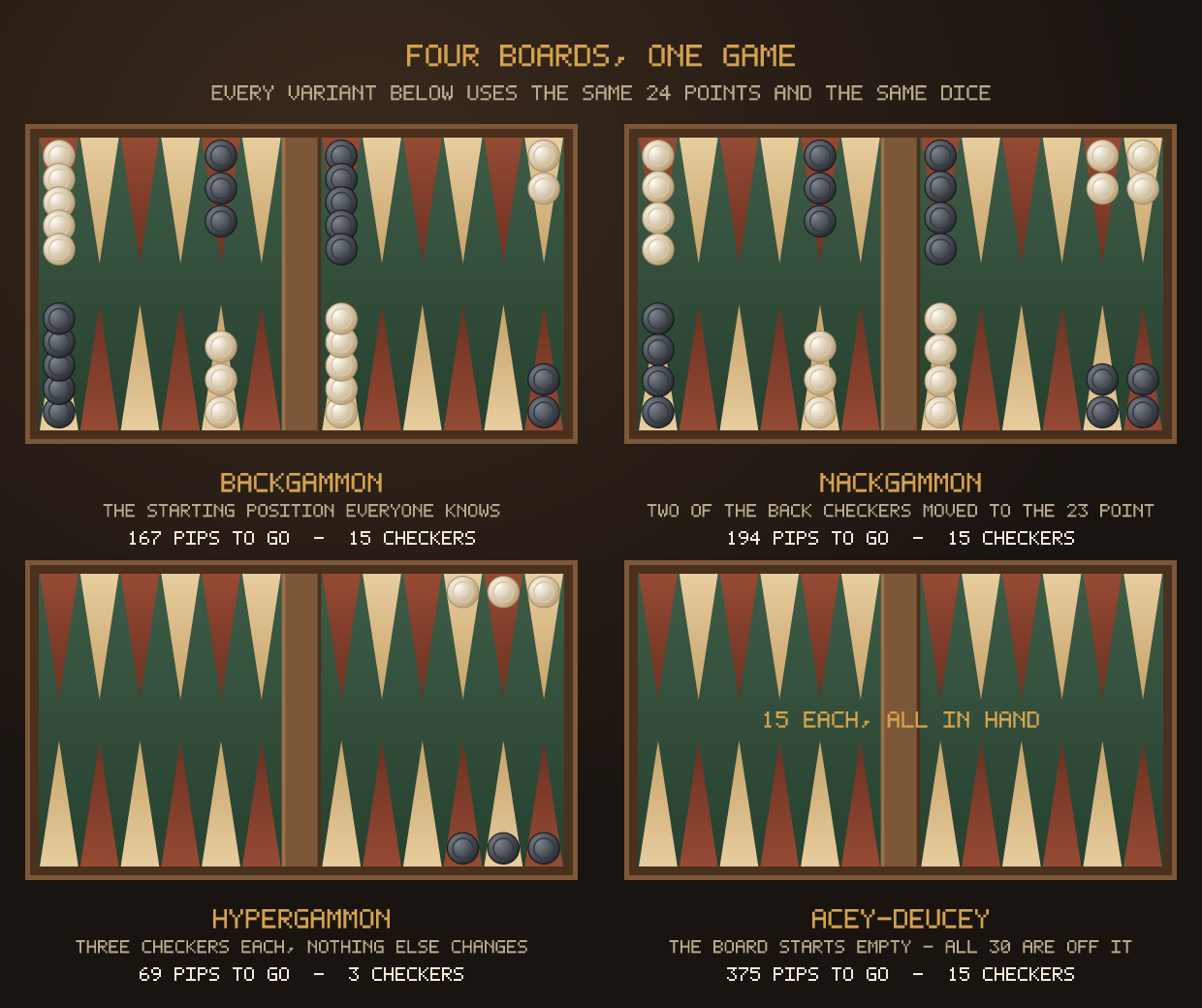
| Nackgammon | Two of the back checkers start on the 23 point instead of the 24 | Players who find standard openings repetitive |
| Hypergammon | Three checkers a side instead of fifteen | Learning the mechanics, and practising the cube |
| Acey-deucey | Empty board, checkers entered from hand, 1-2 buys a double and another roll | A completely different game on the same board |
The other three boards keep every rule of backgammon that is not mentioned in that table. Nackgammon and hypergammon even keep the doubling cube and the gammon scoring; acey-deucey drops both, because it scores every win as a single point.
What the four actually feel like, measured
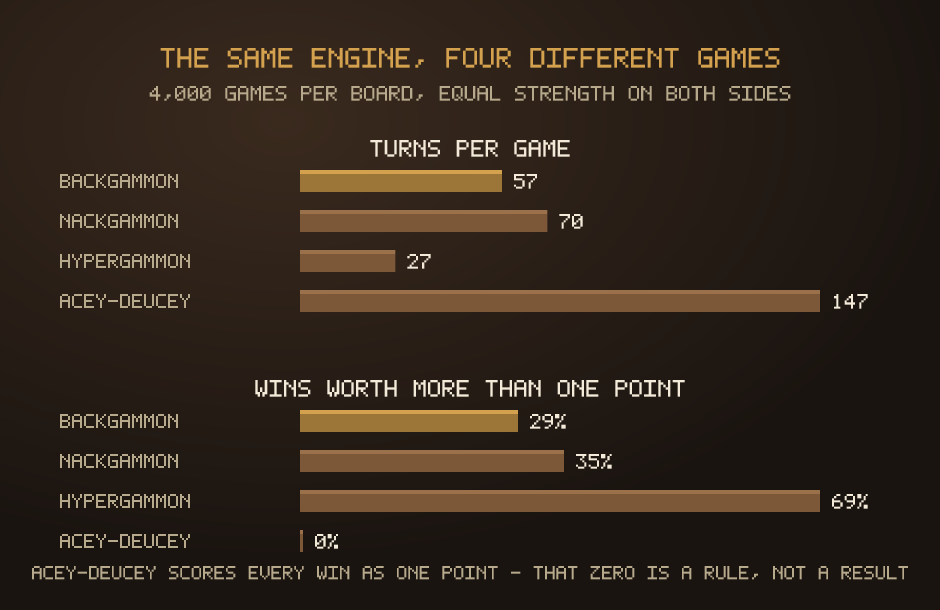
Descriptions of variants tend to say things like “longer” and “more aggressive” without ever putting a number on it. We can, because we run all four. The table below comes from 4,000 games on each board, played by our own engine at the same strength on both sides. Standard backgammon runs alongside as the control.
Read the columns as a comparison, not as constants. The same engine plays all four boards, so the differences between them are real — that is the whole point of running a control. The absolute numbers, though, belong to the level of play. We checked the standard row against wildbg, a tournament-strength engine, playing itself: turns per game came out at 56.0 against our 57, and wins worth more than a point at 28.5% against our 29 — both within a rounding error. Hits per game did not: 5.6 against our 7.6. Stronger players leave fewer blots, so they hit less often. Nackgammon still produces far more contact than backgammon, and that ordering is what the table is for; the count itself would be lower in a room full of experts.
| Board | Start | Turns per game | Hits per game | Wins worth more than 1 point |
|---|---|---|---|---|
| Backgammon | 167 pips, 15 checkers | 57 | 7.6 | 29% |
| Nackgammon | 194 pips, 15 checkers | 70 | 11.6 | 35% |
| Hypergammon | 69 pips, 3 checkers | 27 | 6.9 | 69% |
| Acey-deucey | 375 pips, 15 in hand | 147 | 25.1 | none, by rule |
Four things in that table are worth pausing on.
Nackgammon really is the longer, bloodier game its reputation says it is. Moving two back checkers changes the starting pip count by 27, but it changes the number of hits by more than half — 11.6 against 7.6. That is what Nack Ballard designed it to do: more checkers stuck behind enemy lines means more contact, and contact is where the skill is.
Hypergammon is a gammon machine. Seven wins in ten are worth more than a single point. With three checkers each, one hit is a third of your army and there is rarely time to recover, so games end lopsided. That is also why it is the traditional board for cube practice: the checker play is nearly trivial, so almost every point you win or lose is a cube decision.
Acey-deucey is by far the longest game on the board — 147 turns, two and a half times a standard game, with 25 hits in it. Entering fifteen checkers one at a time past an opponent who is already established is a brutal, hit-filled process, and the 1-2 bonus keeps handing out extra rolls. The zero in the last column is not a measurement, it is the rule: acey-deucey has no gammons.
Almost every game ends as a race. On the standard board, contact breaks before the game does 95 percent of the time, and when it does, it breaks about 80 percent of the way through the game. The other three boards behave the same way within a few points. The last fifth of nearly every game on any of these boards is a pure running race — which is exactly why the pip count and the odds matter as much as the tactics.
What these numbers are and are not. Both sides are played by the same engine at the
same strength, so what varies is the board and nothing else — this is a comparison between variants,
not a set of reference values for backgammon. Our engine is a strong heuristic, not a world-class
bot, and an absolute claim would inherit its weaknesses. You can re-run the measurement yourself:
it is the tool tools/variant-stats.js in our repository, and the chart above is drawn
from the same file it writes.
Nackgammon
Invented by Nack Ballard, one of the strongest players of the modern era, and the smallest possible change to backgammon: take two checkers from your midpoint and 6 point and put them on the 23 point, so you start with four checkers in the enemy home board instead of two.
He did it to make his students play positionally. In standard backgammon a good opening roll can start an attacking game that simply runs; with four back checkers there is too much to extract, so priming, anchors and timing dominate. The starting pip count rises from 167 to 194, the game runs about a fifth longer, and — as the table above shows — you will be hit half again as often.
Everything else is identical, including the cube and the gammon scoring, so all standard theory applies. Most opening moves transfer directly; the ones that do not are the pure running plays, because running one checker out of four accomplishes much less. Full nackgammon guide →
Hypergammon
Three checkers a side, on the 24, 23 and 22 points. Nothing else changes: you hit, you go to the bar, you bear off, gammons and backgammons count, the cube is live. A game takes about 26 turns against 57 for the standard board.
It is not a beginner's toy, although it is excellent for learning the mechanics. Hypergammon has been solved — a complete database of perfect play, cube included, was computed by Hugh Sconyers in the early 1990s — and it has been used for decades as a training board for cube handling, precisely because there is so little checker play to hide behind. Full hypergammon guide →
Acey-deucey
The variant of the US Navy, and the biggest departure of the four. All fifteen checkers start off the board and must be entered like checkers coming off the bar, though entering is a choice rather than an obligation. Rolling a 1-2 is the event the game is named for: play the 1 and the 2, then choose any double you like and play all four of it, then roll again. Bearing off needs the exact number, there are no gammons, and there is no cube.
The result is a much longer, much more violent game — 147 turns and 25 hits in our measurements — and a completely different opening problem, because both players are building a position out of nothing while trying to stop the other doing the same. There are also three incompatible versions in circulation (American, European and Mexican); we run the American one. Full acey-deucey guide →
Greek tavli: portes, plakoto and fevga
In Greece the game is called tavli, and it is not one game but three, played as a set. A match cycles through them — portes, plakoto, fevga — until somebody reaches the target score, usually five or seven points. None of the three uses a doubling cube.
Portes
Mechanically international backgammon: the standard starting position, opposite directions, hitting, the bar. If you can play backgammon you can play portes without being told anything. Wins count single, or double if the loser has borne nothing off.
Plakoto
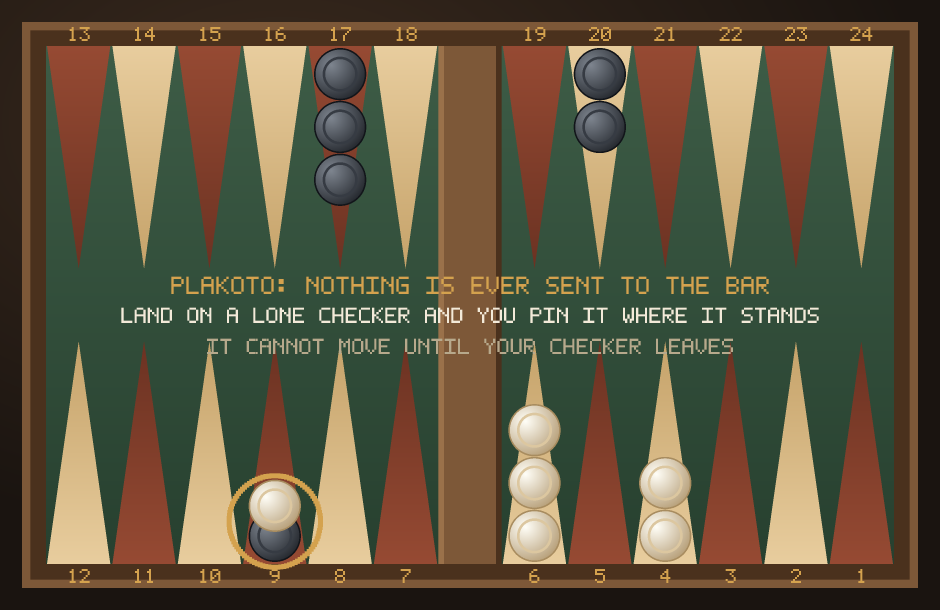
All fifteen checkers start on your 24 point, and nothing is ever hit. Land on a lone enemy checker and you pin it: your checker sits on top, and the trapped one cannot move until you choose to leave. A pinned checker in your own home board is close to a won game, because it cannot escape and cannot be rescued.
Plakoto also has the “mother”: the last checker still sitting on your starting point. If your opponent pins it before it has moved, the game is over at once and they win double. It is the one rule in the tavli set that catches out visiting backgammon players.
Fevga
All fifteen on one point again, but now both players run the same way round the board and there is no hitting and no pinning. A lone checker simply blocks a point. Fevga is a pure blocking race, and it feels less like backgammon than any other game in this article — there is no contact in the backgammon sense at all, only the geometry of who can get past whom. Players may not block the opponent completely.
Turkish tavla
Backgammon is the national game of Turkey, played in every café, and a Turkish board looks exactly like an English one. The setup, the movement, the hitting and the bearing off are the same. What differs is the frame:
- No doubling cube. Traditional tavla is played at a fixed stake per game.
- No backgammon. A win is one point, a mars — the loser has borne off nothing — is two. There is no triple score.
- The opening roll is thrown again. Whoever wins the first cast rolls a fresh pair for their first turn, which means doubles can and do appear on move one. In international backgammon you play the two dice you compared.
- No hit-and-run in your own home board. In tavla a checker that hits inside your own home board is not free to run on in the same turn — a restriction international backgammon does not have, and one that several written sources state differently.
Shesh besh is the same game under a Levantine name — “six five” in Persian and Turkish, after the roll. Mahbusa (also spelled mahbouseh) is the Middle Eastern pinning game, the same idea as plakoto: land on a lone checker and it is imprisoned under yours. Turkish sources sometimes call international backgammon “modern tavla” to distinguish the two.
If you have played tavla in a café and want to play the international game, the practical advice is short: learn the doubling cube. It is the only part that will be genuinely new, and it is the part that decides matches.
Narde, long nardy and gul bara
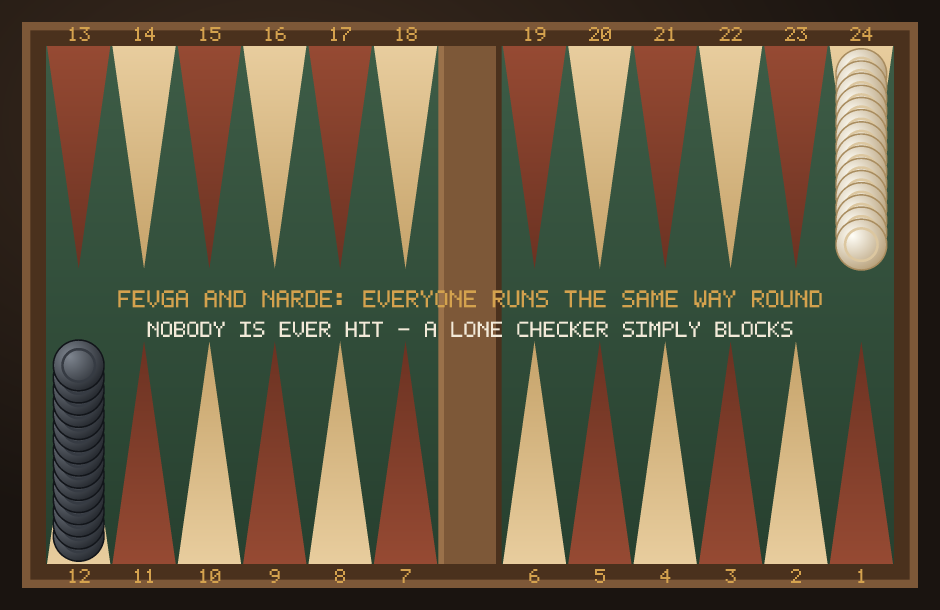
Narde — long nardy in Russian, and essentially the same game as Greek fevga — is the other great branch of the family, played across Russia, the Caucasus and Central Asia. All fifteen checkers start on one point, both players travel the same way round, and nothing is ever hit. A single checker holds a point.
That sounds tame and is not. Because a lone checker blocks, the whole game is about building walls and timing when to break them. Two rules do most of the work:
- The head rule. You may take only one checker off your starting point per turn — with an exception on the very first roll. Without it, the game would open by dumping the whole stack.
- You may not block completely. Six consecutive points is a wall the opponent cannot pass, and it is legal to build one only if the opponent still has at least one checker ahead of it. Shutting them out entirely is forbidden.
Gul bara — also called crazy narde or rosespring backgammon — is narde with one spectacular addition. After the first three rolls, a double is not played four times and finished: you play four of the number you rolled, then four of the next number up, then the next, all the way to four sixes. A single 2-2 can move twenty checkers. It is played across Bulgaria, North Macedonia, Azerbaijan, Greece and Turkey, usually as the third game in a set alongside tavla and plakoto — the same three-games-to-a-match structure the Greeks use.
Other variants worth knowing
| Variant | What it changes |
|---|---|
| Dutch backgammon | All checkers start off the board and are entered as in acey-deucey, and you may not hit until you have got at least one checker all the way home. |
| Russian backgammon | Both players enter into the same table, run the same way round and bear off from the same table. Doubles are enormous: you play the numbers on top of the dice twice each, then the numbers on the bottom twice each. |
| Misère backgammon | Backgammon to lose. The last player to bear off wins, which inverts every judgement in the game — being hit is a gift. |
| Snake | A deliberately lopsided setup: one side begins with nine checkers on the bar and six in the opponent's home board. Working out which side is actually better is most of the entertainment. |
| Roll-over | Each player may, once per game, refuse a roll and throw again — one mulligan, and choosing when to spend it is the whole game. |
| Trictrac | Not really a backgammon variant at all: a French game on the same board with a completely different scoring system, once the dominant table game in Europe. |
| Tabula | The Greco-Roman ancestor, played with three dice on the same 24 points. A game the Byzantine emperor Zeno lost in 480 AD survives in an epigram by Agathias — he threw 2-5-6, was forced to break three points into blots, and ruined a winning position. It is the earliest recorded position from any game in this family. |
Which one should you play?
- You are learning the game. Standard backgammon, and if the fifteen-checker board feels like too much at once, a few games of hypergammon to get the mechanics into your hands.
- You know backgammon and it feels repetitive. Nackgammon. Same theory, different problems, and it will expose whether you actually understand priming.
- You want to get better at the cube. Hypergammon, deliberately. When the checker play is nearly forced, every point you win or lose is a cube decision.
- You want something that is not backgammon at all. Acey-deucey, or fevga if you can find someone to play it with.
- You grew up on tavla or narde. Play what you know, but learn the cube — it is the one thing the international game has that the traditional ones do not, and it is worth more than any checker rule on this page.
Where the sources disagree
Regional games are transmitted by playing them, not by reading them, so written rules for the same game contradict each other constantly. These are the disagreements you are most likely to run into. Where a page on this site states one of them as settled, it says which version it means.
| The question | The disagreement |
|---|---|
| Does tavla have a triple win? | Most sources say no — one point, or two for a mars. A minority describe a backgammon score borrowed from the international game. |
| Plakoto's “mother” | Widely described, but the penalty varies: a double loss in most accounts, a plain loss in some, absent from others entirely. |
| The narde head rule | Everyone agrees one checker per turn leaves the starting point. The exception on the first roll — which rolls qualify, and whether it allows one extra checker or two — varies by region. |
| Acey-deucey's bonus double | American acey-deucey lets you pick any double. The European and Mexican versions force the complement of the roll, which changes the game a great deal — we wrote a whole page on it. |
| Whether a variant uses the cube | Online implementations frequently bolt a doubling cube onto games that have never traditionally had one. That is a design choice, not a rule. |
The honest summary: agree the rules before the first roll. Every experienced player of these games does it, and nobody considers it rude.
Where this page describes a game we do not run, it follows the standard reference sources — Tom Keith's variant collection at bkgm.com and the Wikipedia articles on tavli, tavla, long nardy and gul bara — and says so rather than presenting one regional tradition as the rule. The four boards we do run are described from our own implementation, and the numbers from our own games.
Questions people ask
How many backgammon variants are there?
Dozens are named and played, and no list is complete because most are regional house traditions. But they are not dozens of different games: nearly all of them change one or more of five things — the starting position, what happens when you land on a lone checker, which way the checkers travel, how a checker comes back into play, and what a win is worth. Learn those five and any variant takes a minute to pick up.
What is the difference between backgammon and tavla?
Turkish tavla uses the same board, the same starting position and the same movement as international backgammon. The differences are in the frame around the game: there is no doubling cube, a win is worth one point or two for a gammon with no triple backgammon score, and the winner of the opening roll throws again rather than playing the two opening dice.
What is plakoto?
A Greek variant in which nothing is ever hit. Landing on a lone enemy checker pins it: your checker sits on top and the trapped one cannot move until you leave. Both players start with all fifteen checkers on their 24 point. It is one of the three games of tavli, played alongside portes and fevga.
What is fevga?
The Greek running game, essentially the same as Russian narde. All fifteen checkers start on one point, both players travel the same way round the board, and there is no hitting and no pinning at all — a single checker simply blocks a point. It is a pure blocking race, and it plays nothing like backgammon despite using the same board.
Which backgammon variant is hardest?
Nackgammon is generally considered the most demanding of the mainstream variants. Nack Ballard designed it to force positional play: four back checkers instead of two mean more contact, longer games and fewer chances to win by simply running. In our own measurements a nackgammon game runs about 70 turns against 57 for standard backgammon, with half as many hits again.
What is the easiest backgammon variant for beginners?
Hypergammon. Each side has only three checkers, so a game lasts about 27 turns instead of 57 and every rule of backgammon still applies — hitting, the bar, bearing off, gammons. It teaches the mechanics quickly, at the cost of most of the strategy.
Do all backgammon variants use the doubling cube?
No, and most do not. The cube belongs to modern international backgammon and its offshoots. Tavla, the three tavli games and narde are traditionally played without it, and acey-deucey has no use for one because every win counts as a single point.
Which backgammon variants can I play online for free?
On this site you can play standard backgammon, nackgammon, hypergammon and acey-deucey, against the computer or against a real opponent, with no signup. Pick the board from the row of tabs above the board before the game starts.
Is acey-deucey the same as backgammon?
No. It shares the board and the movement, but all fifteen checkers start off the board and must be entered, rolling a 1-2 buys any double you like plus another roll, bearing off needs the exact number, and every win is worth one point with no gammons and no cube. It is the widest departure of the variants we run.
Next: the complete rules of the standard game, the doubling cube guide for the one thing the traditional variants do not have, and how to set the board up in the first place. Or just pick a board and play.