Backgammon Bear-Off Calculator
Exact race odds, expected rolls and the cube decision — solved, not estimated.
Last updated
Rebuild a bear-off or race position on the board below and get the answer: how many rolls each side still needs, how often the player to move wins, and what to do with the doubling cube. Nothing is played out and nothing is estimated. A bear-off is small enough to solve completely — all 54,264 of its positions — and that is what happens in your browser while you look at the board.
An example position is set up for you. Change it, or start from .
What the calculator answers
Four questions, all about the part of backgammon where the checkers can no longer touch each other:
- How many rolls do I still need? The exact average, for the position on the board — not a formula's estimate of it.
- Who wins this race? The winning chance for the player on roll, with the answer labelled as either solved outright or accurate to about a percentage point.
- Double, take or drop? The cube action that follows from that number, with the take point named rather than assumed.
- What is the best play for this roll? In a bear-off, the play that finishes soonest — which is the best play there is.
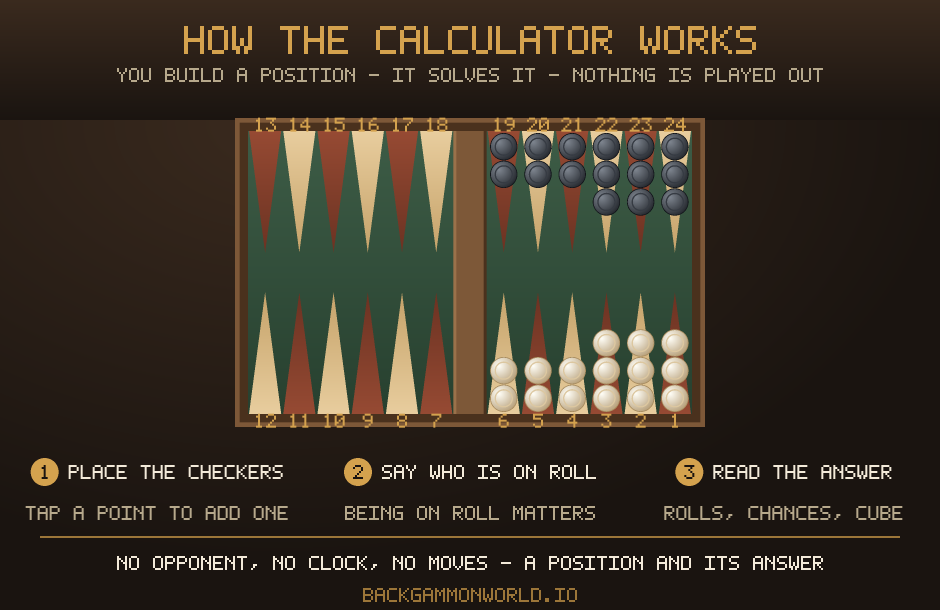
How to use it, in three steps
1. Put the checkers where they stand
Pick a brush — a white checker, a dark checker or remove one — and tap the points. The numbers around the edge are the point numbers as White sees them, so White's home board is the bottom right and Dark's is the top right, exactly as on the game board. Checkers already borne off go in the tray on the far right; a checker on the bar goes on the middle bar. If a point is held by the other side, clear it first: a point cannot hold both colours.
In a hurry, start from a typical bear-off and edit that instead of building fifteen checkers a side by hand.
2. Say whose turn it is
This is not a formality. In an even race the player about to throw wins roughly two games in three — the single biggest term in the whole calculation. If the answer looks wrong by a wide margin, this is usually why.
3. Read the answer, and share it if you like
The answer appears under the board and updates as you edit. Every change also rewrites the page address, so the link under the board always points at the position on screen: bookmark it, or paste it to the person you are arguing with.
What "exact" means here — and where it stops
Most backgammon analysis is an estimate. A neural network looks at a position and gives an opinion; a rollout plays it out thousands of times and averages the results. Both are good, and both are approximations of a number nobody has actually computed.
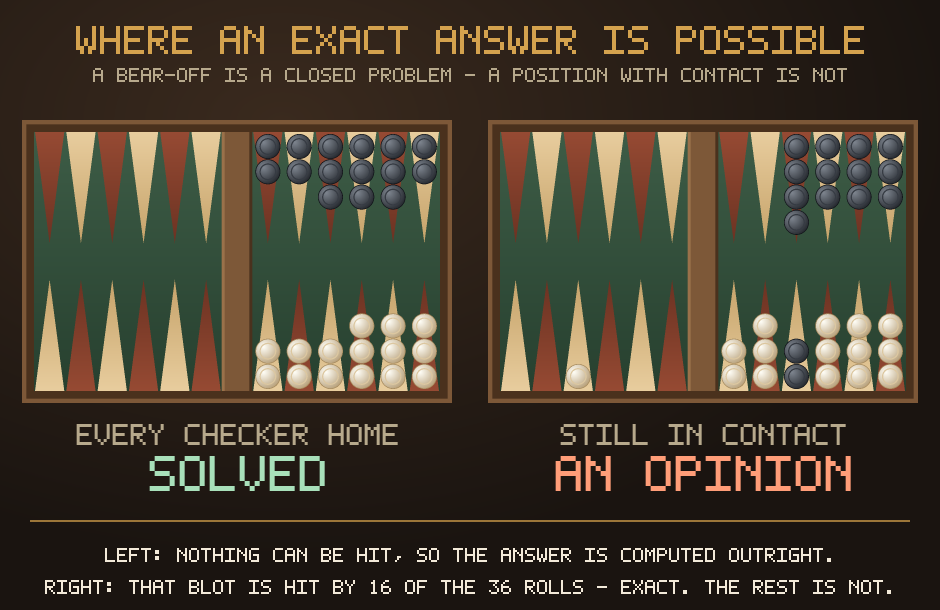
A bear-off is different. Once every checker is home, nothing can be hit and nothing can be blocked, so the opponent has stopped mattering. A position is then only how many checkers sit on each of the six points — and with at most fifteen checkers there are only 54,264 of those. Small enough to work out completely:
E(no checkers left) = 0
E(position) = 1 + the average over all 21 rolls of the best play's E
Read that as: the rolls you still need are one for this throw, plus whatever the position you leave behind needs. Work through the positions in order of pip count and every one of them is known by the time you reach it. It takes about two seconds in a browser tab, and after that every question is answered instantly from the finished table.
| What you ask | How good the answer is |
|---|---|
| Rolls needed to bear off | Exact. Nothing here is uncertain. |
| Best play for a roll | Exact. The play the table was built on. |
| Winning chance, up to six checkers a side | Exact. The whole two-sided race is solved as well. |
| Winning chance in a bigger race | From exact roll distributions. Measured against solved races: at worst 1.4 percentage points out, on average 0.004. |
| Gammon chances | Not answered. The calculator says whether one is still possible and gives no number. |
| Anything with contact | Not a bear-off. The shot count is still exact — that is counting, not judgement. |
The gammon line is worth a sentence, because leaving a number out is unusual. A gammon in a bear-off asks something different — how long until the trailing side's first checker comes off — and it needs a different way of playing, since a player facing a gammon plays to get one checker off rather than to finish fastest. An answer computed under the wrong assumption would look just as confident as a right one, so there isn't one.
How many rolls does a bear-off take?
Every figure in this table came out of the solver. You can reproduce any of them by building the position on the board above.
| Position | Pips | Rolls to bear off |
|---|---|---|
| All fifteen checkers on the 6-point | 90 | 12.27 |
| Three on each of the 2- to 6-points | 60 | 8.46 |
| An even fifteen across all six points | 48 | 7.56 |
| Three checkers on the 1-point | 3 | 1.83 |
| Two checkers on the 1-point | 2 | 1.00 |
The last two rows show what the solver is doing. Two checkers on the ace point always come off in one roll, so the answer is exactly 1 — no rounding, no sample. Three take one roll, plus one more unless that roll was a double: 1 + 30/36 = 1.83. You can check that on paper, and the same machinery produces the 12.27 that you cannot.
Twelve and a quarter rolls for the classic fifteen-on-the-six-point start is a number worth carrying around. It is the yardstick for every "am I ahead in this race?" question you will ever ask.
Why the pip count is not the answer
Every guide to races tells you to count pips, and then to double at an eight percent lead and take until twelve. Those rules exist because nobody can solve a bear-off at the board. They are useful — and they are throwing information away, because a pip count cannot see the board it came from.
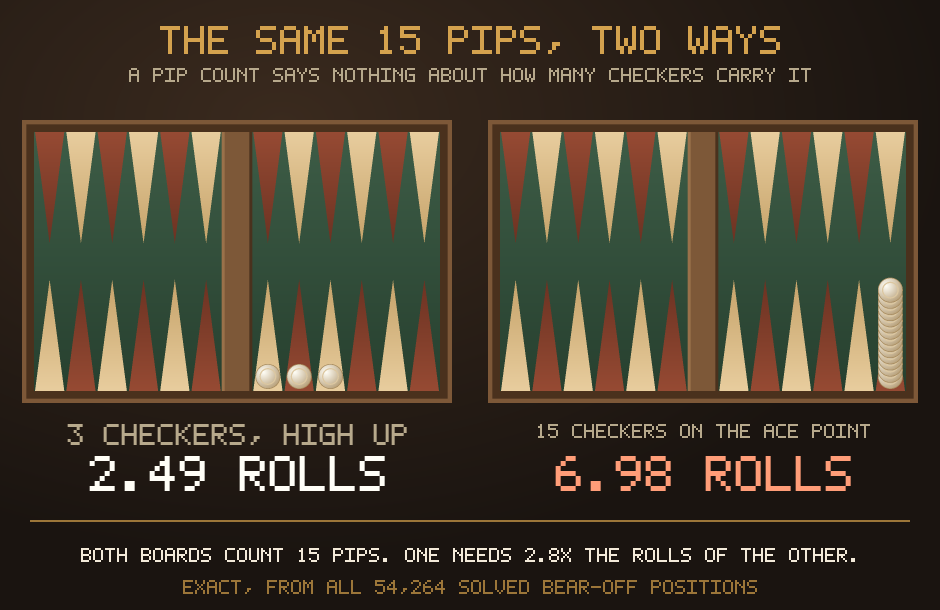
Fifteen pips can be three checkers on the 4-, 5- and 6-points — 2.49 rolls — or fifteen checkers stacked on the ace point, which is 6.98 rolls, because you can only ever take two of them off at a time. Same count, nearly three times the work. That is an extreme case, chosen by asking the solver which pip count hides the widest gap, but the effect is everywhere: a pip lead is a summary, and summaries lose things.
The shape of your home board
Hold the checker count equal as well, and the gap does not disappear — it just gets subtler, which is exactly why it costs games. Fifteen checkers and 48 pips can be arranged well or badly:
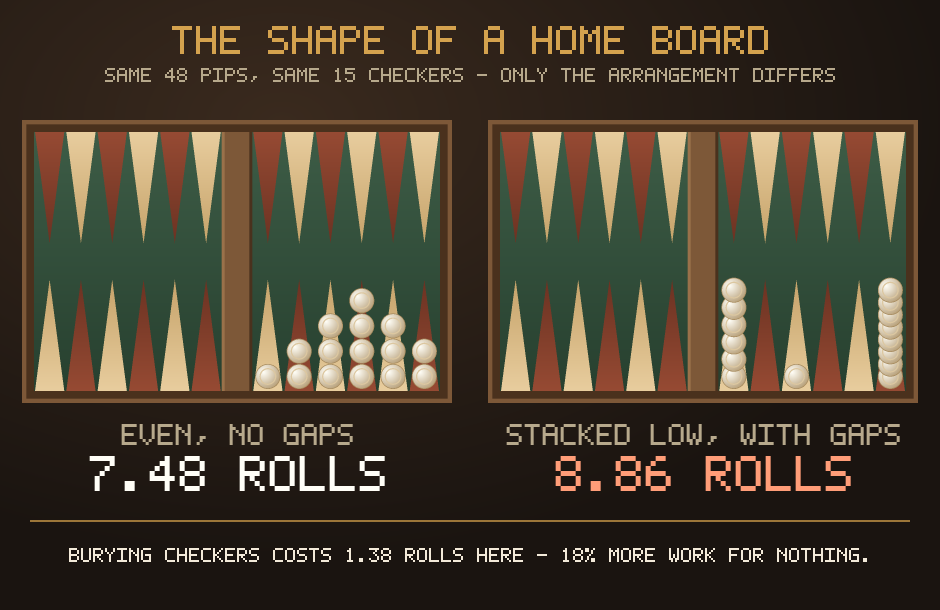
1.38 rolls, or 18% more work, bought with nothing. Two things cause it, and both are avoidable while you are bringing the checkers home:
- Gaps. An empty point in the middle of your home board means the die that would have borne a checker off from it has to move one down instead. You paid the pips and got no checker off.
- Stacks on the low points. A checker on the ace point can only ever be taken off by one roll's worth of one die. Five of them are five rolls' worth of work that a six could have done in one.
The practical version is short: while you still have a choice, fill the gaps and spread the checkers, rather than piling them on the 1- and 2-points because those moves are "safe". Backgammon strategy has the same advice for the phase before this one.
What a pip lead is really worth
Since the solver can answer any bear-off, it can answer a great many and say what a lead is actually worth. The table below comes from tens of thousands of random bear-off positions where both sides hold a similar number of checkers, with the exact winning chance computed for each. The lead is given the way the rules of thumb give it: as a percentage of your own pip count.
| Your pip lead | You win, on average | Range across positions |
|---|---|---|
| 12% behind | 55.1% | 30% – 86% |
| 6% behind | 61.7% | 35% – 90% |
| Level | 66.3% | 41% – 90% |
| 6% ahead | 71.9% | 44% – 94% |
| 9% ahead | 74.1% | 47% – 94% |
| 12% ahead | 76.1% | 46% – 90% |
| 20% ahead | 82.7% | 54% – 96% |
Two things fall out of this, and the second is the reason this page exists.
Being on roll is worth a fortune. Level on pips, the player about to throw wins two races in three. Not because of any subtlety — they simply get to go first, and in a race that never stops mattering.
The average hides an enormous spread. A nine percent lead is a 74% game on average, and anything from 47% to 94% in particular. The pip count picks up the trend and misses the position. That is not an argument against counting pips at the board, where it is the only tool you have — it is an argument for looking the answer up when you can.
The cube in a race
A race is the one part of backgammon where the cube maths is clean. Taking a double risks four points to gain two, so it breaks even at 25 percent: below roughly a quarter the right answer is to drop, above it to take, however uncomfortable that feels.
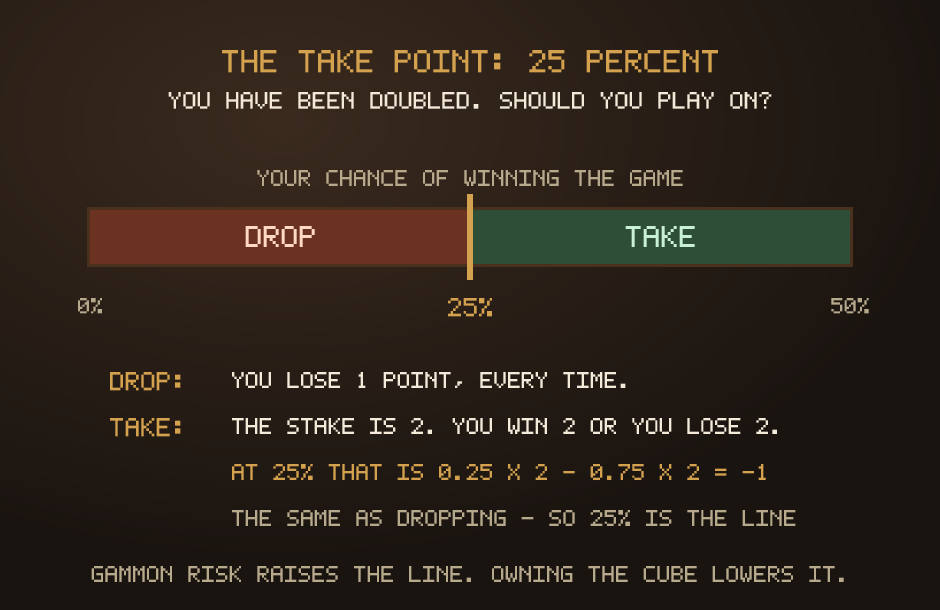
That is why the calculator can name a cube action without hedging. Once both sides have a checker off there are no gammons to spoil the arithmetic, and with no contact left the odds cannot swing on the next roll — the only thing left to know is the winning chance, and it knows that. Everything about beavers, the Jacoby rule, Crawford and market losers lives on the doubling cube page.
Reading the answer, line by line
The panel under the board says four things, in this order:
- Pip count — both sides, and who is on roll. If this line does not match the board in front of you, nothing below it will either.
- The winning chance, with a badge: exact means the whole race was solved, ±1.4 pp means it came from the roll distributions and can be off by about a percentage point in the worst case.
- Rolls to bear off for each side — the number that tells you why the chance is what it is.
- Cube — double, take, drop, or "not yet", with the reason attached.
If a blot is on the board, one more line appears: how many of the 36 rolls hit it. That one is exact even in the middle of a game, because counting shots is combinatorics rather than judgement. The full table of those numbers, for every distance from 1 to 20 pips, is on the backgammon odds page.
When the calculator cannot help
It will not answer a middlegame. If either side still has a checker outside their home board, the position is not a bear-off, and there is no exact answer to be had — the opponent can hit, block or dance, and every one of those turns the arithmetic into a judgement. In that case the calculator says so, gives you the pip counts and the shot count, and stops.
That restraint is the point. Elsewhere on this site the engine offers opinions, clearly labelled as opinions. Here it only speaks where it can prove what it says.
A worked example
You are on roll with three checkers each on your 6-, 5- and 4-points and two each on the 3-, 2- and 1-points — the even fifteen from the table above, 48 pips, 7.56 rolls to go. Your opponent has exactly the same. What is going on?
- The race is level, so the pip count says nothing.
- You are on roll, which by the table above is worth about two thirds of the game.
- The cube: at roughly 66% you are not yet at the point where a double is clearly right, and your opponent has a comfortable take — they are far above the 25% take point.
- Now bury three checkers on your ace point instead of spreading them, and the same 48 pips takes 8.86 rolls instead of 7.48. You have handed back more than the whole value of being on roll — without moving a single pip.
Build both versions on the board above and watch the winning chance move. That is the fastest way to feel what "shape" means in a race.
How these numbers were computed
No sampling, no rollouts, no network. The bear-off table is built by working through every one of the 54,264 positions in order of pip count, so that when a position is reached, every position it can lead to is already solved. The winning chance for a race combines the two sides' exact roll distributions; for races small enough to solve outright — six checkers a side or fewer — the calculator solves the real two-sided game instead and says so.
The approximation was not assumed to be small, it was measured: across 852,000 races with up to six checkers a side, the largest deviation from the solved answer was 1.4 percentage points, and the average 0.004. Our own test suite recomputes that comparison against an independent solver on every run, and the same suite checks the calculator's move generation against the engine the games on this site are played with — 400 random positions, both engines producing the same plays.
Everything runs in your browser. No position is sent anywhere.
Questions people ask
What does "exact" mean on this page?
A bear-off is a closed problem: nothing can be hit or blocked, so a position is only how many checkers sit on each of the six home points. That is at most 54,264 positions, few enough to solve outright rather than estimate. The expected number of rolls and the best play are therefore exact. For races with up to six checkers a side the winning chance is exact too, because the whole two-sided race can be solved. Above that it is computed from exact roll distributions, which we measured against solved races: the largest deviation found was 1.4 percentage points, and the average 0.004.
How many rolls does it take to bear off fifteen checkers?
From the classic bear-off with all fifteen on the six-point, exactly 12.27 rolls on average with perfect play. A more usual, spread-out home board of fifteen checkers takes about 7.5.
When should I double in a race?
The take point in a plain race is 25 percent: the taker risks four points to gain two, which breaks even at one win in four. So an opponent should drop once their chances fall below about a quarter, and a double is normally right somewhere above two thirds. This calculator gives the actual number for your position rather than a rule of thumb.
Is a pip lead enough to decide a race?
It gets you close and no further. Measured over tens of thousands of solved bear-offs, a nine percent lead is worth 74% on average — but between 47% and 94% depending on how the two home boards are arranged. The lead tells you the trend; the shape decides the game.
How much is being on roll worth?
In a level race, about two games in three: 66% for the player about to throw, measured across solved bear-off positions with similar checker counts on both sides. It is the largest single term in a race, which is why the calculator asks whose turn it is before anything else.
Why does my home board shape matter if the pips are the same?
Because pips are not the thing you spend — rolls are. A checker on the ace point can only be taken off by one die, however large that die is, and a gap in your board turns a die that could have borne a checker off into one that merely shuffles. The same fifteen checkers and the same 48 pips take 7.48 rolls spread evenly and 8.86 rolls stacked low: 18% more work.
Does the calculator count gammons?
No, and it says so instead of guessing. A gammon in a bear-off needs a different question — how long until the loser's first checker comes off — and a different way of playing, because a player facing a gammon plays to get one checker off rather than to finish fastest. The calculator reports whether a gammon is still possible and leaves the number out.
Can I use it for a position that still has contact?
Only for the shot count, which stays exact: how many of the 36 rolls hit a blot is counting, not judgement. The race numbers need every checker home on both sides. If yours are not, the calculator tells you rather than inventing an answer.
Is this the same as a pip counter?
It includes one, but a pip counter stops where this starts. The pip count is a single number that ignores how your checkers are arranged; the calculator solves the position itself, which is why two boards with the same count can come back with very different answers.
How do I share a position?
Every edit rewrites the page address, so the link under the board is always the position on screen. Copy it into a chat and your opponent opens the same board. Nothing is stored on our side — the whole position travels in the link.
Does it work on a phone?
Yes. Tapping a point places a checker exactly as clicking does, and the board scales to the screen. The one thing to know is that the table of positions takes a second or two to build the first time you open the page; after that every answer is instant.
Is my position sent to a server?
No. Everything is computed in your browser, and the position lives in the page address so you can bookmark it or paste it to someone else.
Next: backgammon odds and probabilities has the full hit table computed the same way, the doubling cube explains take points and market losers, and the complete rules cover bearing off itself — including the cases people get wrong. Or play a game: the same engine deals the board.