Backgammon Puzzle of the Day
Last updated
A real position from a real game, one roll, and two plays that both look reasonable — but one is measurably better. Play your move on the board and the solution shows both, what each is worth, and what the difference costs. Same puzzle for everybody, every day.
New here? It is your turn in a real game. Two plays look reasonable, one is measurably better — tap a checker, tap where it should go, then submit. The line under the roll tells you what to do next at every step.
Loading…
Loading the puzzle…
Your roll: –
| Best play | ||
|---|---|---|
| Runner-up | ||
| Difference | equity | |
How to solve today's puzzle
Tap one of your checkers and the points it can reach light up; tap one of those to move it. The dice sit on the board itself, and each one dims as you use it, so you can always see what is left to play. Undo takes a move back and Submit ends the turn. You have to play both numbers if the position allows it — the board will not let you do otherwise, exactly as in a real game.
There is no time limit and no scoring beyond right or wrong. Take as long as you like: the whole point of a daily backgammon puzzle is that you get to think about one decision properly, which is the one thing you never do while a clock is running.
What equity means, and why the gap matters
Every solution prints two numbers and the difference between them. Those numbers are equity: what the position is worth in points if you played it out from there many times, counting gammons. A plain win is +1, a gammon +2, a backgammon +3, and the same figures negative for the losses. Zero means the two sides are level.
So a gap of 0.150 means the weaker play throws away about a seventh of a point. That sounds like nothing, and in one game it nearly is — you will usually still win. It is not nothing over a match, and it is certainly not nothing over a year: the difference between a decent club player and a strong one is not made of blunders, it is made of eighths of a point given away in positions that felt fine at the time. That is exactly what a backgammon puzzle is for.
For scale, the median gap across this set is 0.131 and the largest is 0.725 — that last one is a genuine blunder, the kind that decides a game on its own. Nothing flatter than 0.08 is published at all.
Where the puzzles come from
The positions are taken from complete games, so they are ordinary positions rather than composed studies. This matters more than it sounds. A composed backgammon problem can be built around a trick — a position engineered so that one clever idea works — and after a few dozen of them you get good at spotting compositions rather than at playing backgammon. A position that actually turned up in a game has no such tell.
Each candidate is then filtered. There must be at least three legal ways to play the roll, the two best plays must reach visibly different positions, and the second-best must be measurably worse — a puzzle whose wrong answer costs nothing teaches nothing. Of 2230 candidate positions, 1451 were dropped because the top two plays were worth almost the same, and a further 544 because our own engine already finds the best play, which makes them too easy to be worth anybody's time. 200 survived.
Who decides what is best. Not our own engine. It plays a decent game, but it is a heuristic, and publishing its opinion as the answer would be passing off a guess as a fact. The equities come from wildbg, an open-source neural-network engine at tournament strength, queried once for every legal play while the puzzles were generated. None of it is shipped to your browser — what you download is the finished set of positions, which is why the page loads instantly and works offline once opened.
What the puzzles actually ask
Every backgammon training site says it will sharpen your judgement, and none of them says which judgement. We can say, because the whole set is here and every puzzle has two scored plays: the difference between them can be classified.
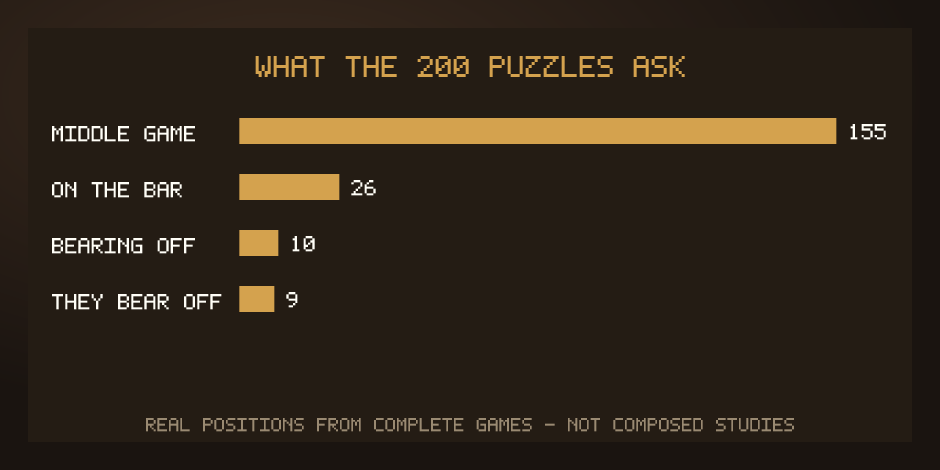
It is overwhelmingly checker play in the middle game — the phase where you have the most choices and the least guidance. Bear-offs are rare here on purpose: a race is a calculation rather than a judgement, and the bear-off calculator already solves those exactly.
| The best play… | Share | What that tells you |
|---|---|---|
| neither play hits anything | 89% | These are not hitting problems. Hitting is the loud decision; it is almost never the one being tested. |
| leaves more shots than the runner-up | 42.5% | The better play is more often the one that exposes you. |
| leaves fewer shots | 35.5% | Safety wins less than half the time here — see the section below for why that is a fact about the puzzles, not about backgammon. |
| makes more points | 18% | Nearly the same as the share that makes fewer (19%). "Make a point" is not the answer either. |
Read the table again and notice what is missing: no single rule accounts for even half of the answers. Not hitting, not safety, not point-making. What is left is timing, distribution and what the position will look like in three rolls' time — the part of backgammon that has no slogan, which is precisely why it is worth practising one position at a time.
A worked example
Here is a real puzzle from the set, with the roll already thrown. White has two checkers back on the 24-point and rolls 1-6. Two plays suggest themselves.
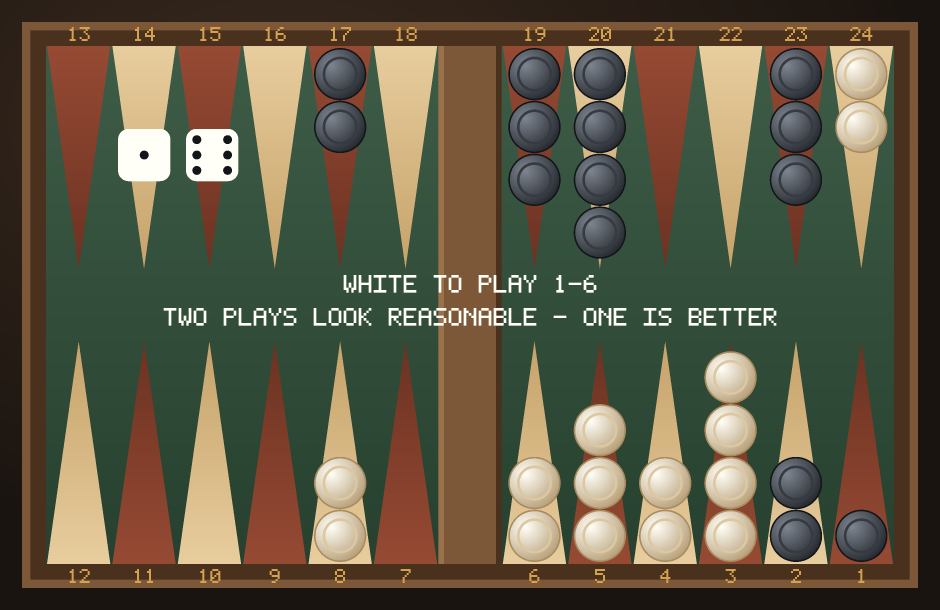
The obvious safe play keeps everything covered. The better play runs a back checker out and accepts being shot at:
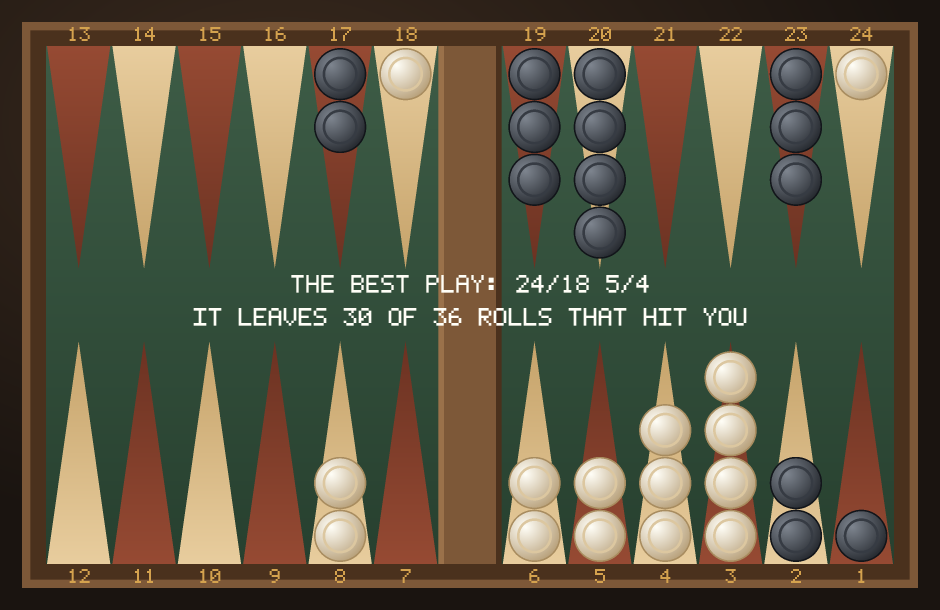
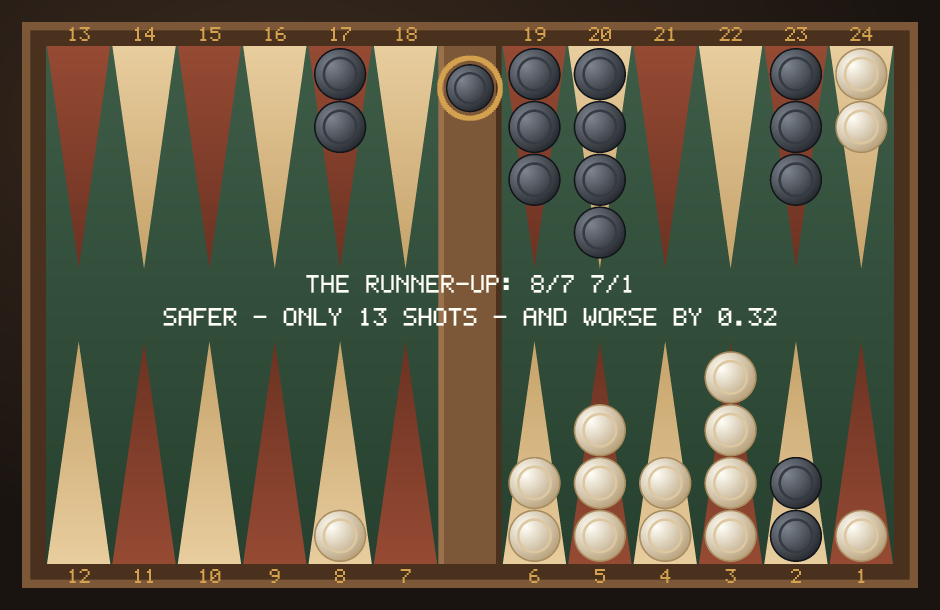
This is the shape of most puzzles in the set. The safe play is not a blunder; it is the play almost everybody makes. It is simply worth a little less, because sitting still with two checkers behind a wall costs more, slowly, than one exposed checker costs quickly.
The finding: the best play is often the riskier one
Across these puzzles the best play leaves 17.8 of 36 hitting numbers against the runner-up's 13. Which sounds like a discovery about backgammon: be braver. It is not, and the honest thing is to show why.
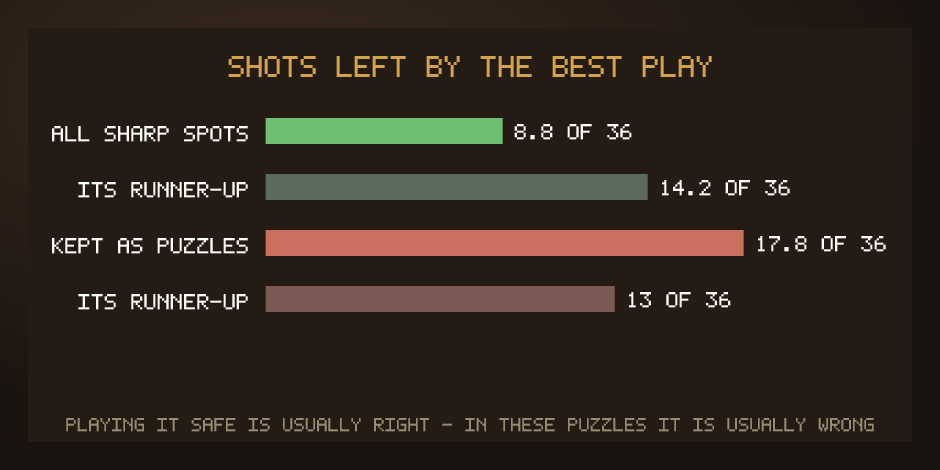
Measured over every sharp decision in a sample of games — not just the ones we kept — the best play leaves 8.8 shots and the runner-up 14.2. In general, in other words, the best play is the safer one, comfortably. The puzzles say the opposite because of how they were selected: we keep what our own engine gets wrong, and our engine is blot-averse, so it fails hardest on exactly those positions where boldness is correct. Among the positions it solves correctly, the best play leaves only 5.5 shots.
So the finding is real, but it is a finding about this set of puzzles: they are biased towards positions where playing safe is wrong, and that bias is a feature — those are the decisions most players get wrong too. What you should not take away is "always run". What you can take away is that if your instinct is safety every single time, these puzzles will hurt, and that is the point of doing them.
How to practise backgammon on your own
The hard part of getting better at backgammon alone is that the game hides its feedback. You make a slightly wrong play on move nine, the dice go your way, you win, and nothing tells you anything. Play a hundred games against a computer and you will learn the opening, the bear-off and very little in between, because the middle game never sends a receipt.
A puzzle removes exactly that problem: one decision, an answer immediately, and a number for how much it was worth. Three habits make the practice count:
- Decide before you move. Say the play out loud, or at least fix it in your head, before you touch a checker. Shuffling pieces around until something looks right trains recognition, not judgement.
- Name your reason. "I am making my 5-point", "I do not want to leave a direct shot". When you are wrong, the reason is the thing that was wrong — not the move.
- Read the losing play too. The solution shows both. The interesting question is rarely "what is best" but "why is the natural one worse", and that answer is the one that transfers to a game.
Twenty puzzles with a stated reason each will teach you more than two hundred clicked through at speed. If you want the underlying ideas rather than single positions, the strategy guide covers priming, timing and back games, and the rules quiz covers the things that are simply worth knowing.
Where else to find backgammon puzzles
There is not much of this about, and what exists is worth knowing — none of it overlaps completely with what is here.
| Source | How often | Format | Analysis |
|---|---|---|---|
| This page | Daily, plus practice | Play the move on a board | Neural-net equities for both plays, with the gap |
| Backgammon Hub | Daily | Pick from listed answers | Explanation and rollout figures |
| USBGF problem of the week | Weekly | Posted image, answer discussed | Commentary by strong players |
| Backgammon problem blogs | Irregular | Diagram and prose | Written analysis, sometimes rollouts |
| GNU Backgammon | Unlimited | Desktop software | Full analysis of any position you build |
| Puzzle books | Fixed set | Printed diagrams | Author's notes |
Two differences are worth calling out, because they are the reason this page exists. First, you play the move on the board rather than picking from a list — a multiple-choice answer tells you which plays were considered, which is half the problem given away. Second, the set is measured and described: the figures above are not marketing, they are what the positions contain, and you can see the selection bias rather than having to trust that there is none.
Turning puzzle practice into better play
Puzzles are not a substitute for playing; they are a way of making the games count for more. The transfer works best in one direction: solve a puzzle, notice the idea, then look for that idea in your next few games. A back checker that should have run three rolls ago is invisible until somebody shows you one, and then you see it every game.
Two supports are worth having open while you practise. The hitting odds table gives the exact number of rolls that hit from every distance, which turns "that looks dangerous" into a number, and the pip count trainer makes counting the race quick enough to do in a game rather than after it. Those two skills between them decide a surprising share of the puzzles here.
And then play. Against the computer at three strengths, or against a real opponent — free, without an account, in the browser.
Streaks, practice mode and what is stored
Your streak lives in this browser and nowhere else: no account, no server, nothing to sign up for. A second attempt at the same day's puzzle does not change it, so the streak is a record of what you saw first rather than of how patient you are. Clearing your browser data clears it.
Once today's puzzle is answered, Next puzzle keeps going through the rest of the set. Those are practice: they do not count towards the streak and they do not run out for a good while, so you can play as many as you like without the day's result being at stake. There is also a full-screen button, which is worth using on a phone — the board gets the whole screen and the position becomes much easier to read.
Where to go next
If a puzzle turned on counting shots, the odds page has the complete table of how many rolls hit from every distance. If it turned on the race, the pip count trainer teaches counting a board in seconds and the bear-off calculator solves any race position exactly. If it turned on whether to double, the doubling cube guide derives the take point rather than asserting it. New to the game? Start with how to play and the full rules.
Frequently asked questions
- What is the backgammon puzzle of the day?
- It is one real backgammon position with one roll already thrown, and two plays that both look reasonable — only one of them is best. Everybody who visits on the same day gets the same puzzle. You play your answer on the board, and the solution then shows both plays, what each is worth and what the difference costs.
- Is a new backgammon puzzle published every day?
- Yes. The puzzle changes at midnight in your own time zone, and it is the same puzzle for every visitor that day. Once you have answered it you can carry on through the rest of the set as practice, so you are never stopped after one position.
- Do I need an account to solve the daily puzzle?
- No. There is no sign-up, no email and no login. Your streak is stored in your own browser and never leaves it, which also means clearing your browser data clears the streak.
- Who decides which play is best?
- wildbg, an open-source neural-network engine at tournament strength, was asked for every legal play while the puzzles were being generated. Our own engine does not get a vote — it plays a reasonable game, but publishing a heuristic's opinion as the answer would be passing off a guess as a fact.
- What does equity mean in backgammon?
- Equity is what a position is worth in points if you played it out many times, counting gammons. A plain win is +1, a gammon +2, a backgammon +3, and the same figures negative for the losses. Zero means the two sides are level. The gap printed with each solution is the difference in equity between the best play and the second-best.
- How big is the difference between the best and second-best play?
- The median gap across the set is 0.131 of a point and the largest is 0.725. Nothing flatter than 0.08 is published at all, because a puzzle whose wrong answer costs nothing teaches nothing.
- Are these composed problems or positions from real games?
- They are positions from complete games, not composed studies. That is deliberate: a composed position can be built around a trick, while a position that turned up in play is the kind of decision you will actually face.
- What kind of decisions do the puzzles test?
- Mostly middle-game checker play: 155 of the 200 are middle-game positions, 26 start with a checker on the bar, 10 are bear-offs and 9 have the opponent already bearing off. In 89% of them neither play hits anything, so they are questions about structure rather than about hitting.
- Is the safer play usually the right one?
- Across backgammon in general, yes — measured over every sharp decision in a sample of games, the best play leaves 8.8 of the 36 rolls as hitting numbers while the runner-up leaves 14.2. Inside these puzzles it is the other way round (17.8 against 13), because the set is filtered to positions our own blot-averse engine gets wrong.
- Can I practise backgammon on my own with these?
- That is what they are for. A puzzle gives you the one thing a game against a computer does not: the correct answer to a single decision, immediately, without playing another forty moves to find out whether it mattered.
- Does a second attempt at the same puzzle change my streak?
- No. The first answer of the day is the one that counts, so the streak records what you saw first rather than how patient you are. Practice puzzles do not touch it at all.
- How many puzzles are there?
- 200 at the moment, drawn from 2230 candidate positions. Most candidates are thrown out because the top two plays are worth almost the same, and a further 544 because our own engine already finds the best play and they would be too easy to be useful.