Backgammon Pip Count Trainer
Count a real position against the clock — and see the sum you should have done.
Last updated
The pip count is the one number that tells you who is winning a race, and it is the number every doubling decision rests on. It is also pure arithmetic, which means it is a skill you can drill. Below is a board and a stopwatch: count the white checkers, type the total, and find out at once whether you were right — and, either way, how the sum breaks down. The positions are generated fresh every time, so there is nothing to memorise.
What the pip count is
A pip is one point of travel. Your pip count is the total distance all fifteen of your checkers still have to cover to reach your home board and bear off. A checker sitting on your 6-point has six pips to go; one on the 13-point has thirteen. Add them all up and you have the count.
Lower is better, because the count measures distance remaining. At the start of a game both players are on 167, and the number falls with every roll until somebody reaches zero and has borne off. That is the whole race, expressed as one number.
The number that matters is usually not yours but the difference. Being on 120 means nothing on its own; being on 120 against 135 means you are fifteen pips — roughly two rolls — ahead.
How to count: the basic method
Multiply each point number by how many of your checkers stand on it, then add the products. The opening position is the example worth memorising, because you will use it as a reference for the rest of your playing life:
| Point | Checkers | Pips |
|---|---|---|
| 24-point | 2 | 2 × 24 = 48 |
| 13-point | 5 | 5 × 13 = 65 |
| 8-point | 3 | 3 × 8 = 24 |
| 6-point | 5 | 5 × 6 = 30 |
| Total | 15 | 167 |
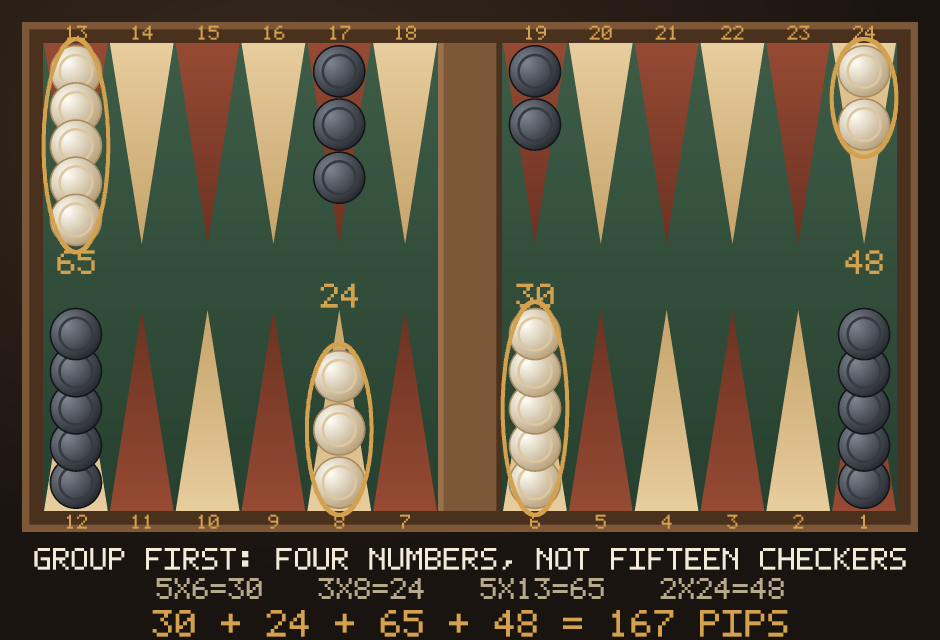
Four groups, four multiplications, one total. That is the whole technique — and it is why grouping matters so much: fifteen checkers become four numbers. Counting checker by checker is fifteen chances to lose your place.
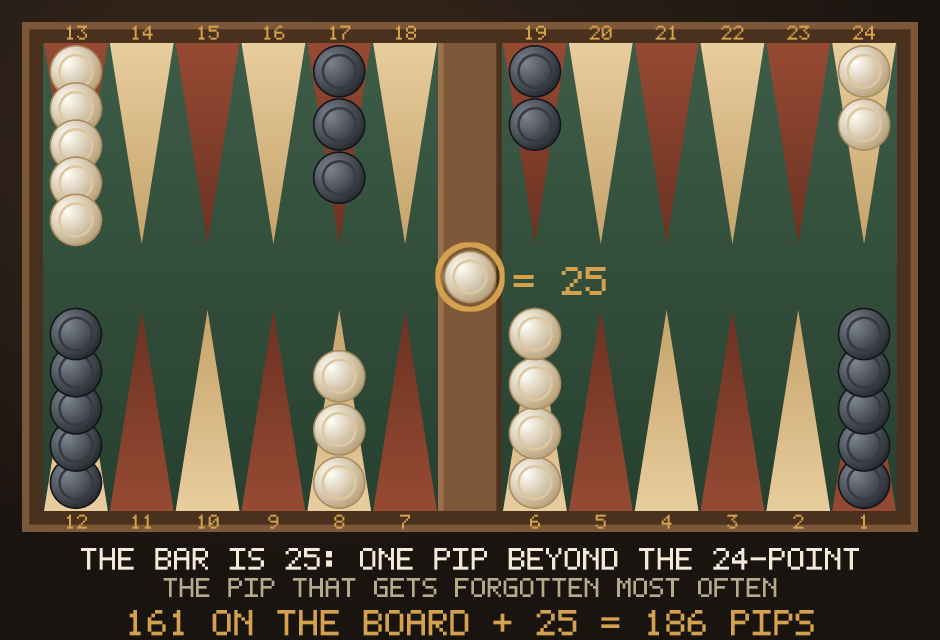
One rule catches everybody out: a checker on the bar counts 25. It is one pip further away than the 24-point, because it must re-enter in the opponent's home board before it can start the journey at all. Miss it and your count is 25 short, which is enough to reverse a cube decision on its own.
Four ways to count faster
Everyone starts by adding groups. These are the methods good players layer on top, roughly in the order they are worth learning.
1. Group before you add
Never add a checker at a time. Five on the 6-point is one number, 30 — not six, six, six, six, six. With a typical position of six or seven occupied points you are adding six or seven numbers, and most of them are easy multiples. This alone roughly halves the time and most of the errors.
2. Count from 167, not from scratch
You know the opening position is 167. Early in a game, rather than recounting the board, count what has changed: every pip you have moved comes off the 167. After an opening 3-1 that makes your 5-point, you have moved four pips, so you are on 163. This is fastest in the first few rolls and gets less practical as the position scrambles — but the first few rolls are exactly where a full recount feels most wasteful.
3. Shifting: rearrange, then add
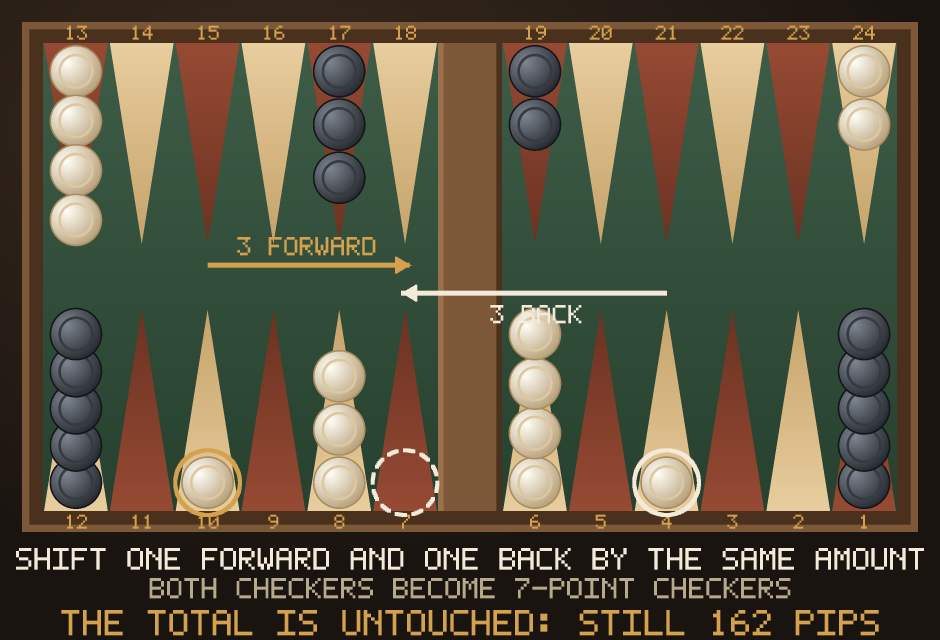
This is the one that feels like a trick and is simply arithmetic. Moving one checker forward two pips and another back two pips leaves the total unchanged. So before you add, you may mentally tidy the position into round, symmetrical shapes — as long as every shift is matched by an equal and opposite one.
A checker on the 4-point and one on the 10-point? Shift both to the 7-point: three pips forward and three back cancel out, and now you have two checkers on one number. Awkward scatters become clean multiples, and clean multiples are what you can add in your head.
4. Half-crossovers, for a quick estimate
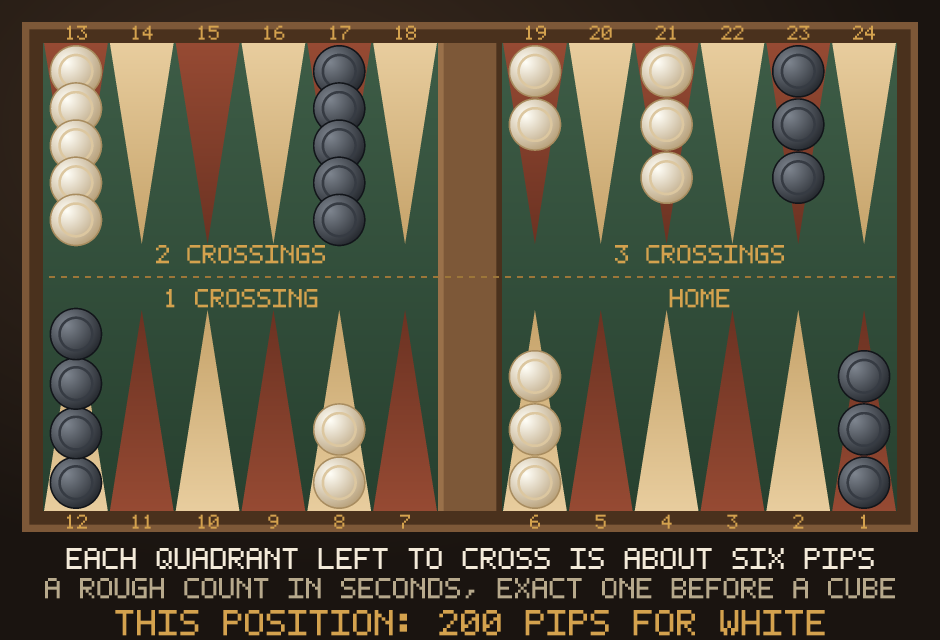
The board divides into four quadrants of six points. Counting how many quadrant boundaries your checkers still have to cross gives you a rough count very quickly — each crossing is about six pips. It is an estimate, useful for deciding whether the position is even worth an exact count. When a cube is involved, do the real thing.
What the number actually tells you
The comparison that makes a lead meaningful is the average roll. Across all 36 dice combinations a roll moves you 8.167 pips — eight and one sixth. The total over all 36 comes to 294 rather than 252 because the six doubles are played four times each:
| Combinations | Pips | |
|---|---|---|
| Non-doubles | 30 | 210 |
| Doubles (played four times) | 6 | 84 |
| All rolls | 36 | 294 → 8.167 average |
So a lead of eight pips is about one roll, and a lead of twenty-five is about three. That is the translation that turns a number into a judgement.
For a pure race, the common rule of thumb is 8-9-12, measured as a percentage of the leader's own count: about 8 per cent ahead is a double, 9 per cent is a strong double, and 12 per cent is usually too much to take. Leading 100 to 112 is roughly the drop point. Treat it as the approximation it is — and note the condition that matters most: it only applies once there is no contact left. Our bear-off calculator gives the exact answer for a specific race rather than a rule of thumb, and the doubling cube guide explains where the take point comes from.
A lower count is not automatically a won game. With contact still on the board, position can outweigh the race completely: three checkers trapped behind a five-prime are losing badly no matter what the arithmetic says. The count is one input among several — see the strategy guide for the rest.
When the count actually decides the game
"Count the pips" is advice every guide gives and none of them quantifies. So we measured it: 3,000 complete games between two equally strong engines, watching for the moment contact breaks — the point where nobody can be hit again and the game becomes a pure race.
| Measured over 3,000 games | |
|---|---|
| Games that reach a pure race at all | 99.9% |
| How far into the game the race begins | 82.1% of the way through |
| The side leading when contact breaks goes on to win | 92.5% |
| Races where the lead changed hands afterwards | 15.2% |
| Median lead that held | 35 pips |
| Median lead that was lost | 7 pips |
Three things follow, and the last pair is the one to remember at the board.
- Almost every game becomes a race. 99.9% of them — so the count is not a specialist skill for endgames, it is a number that will matter in essentially every game you play.
- But it matters late. Contact breaks around 82% of the way through. For the first four fifths of a game the count is one input among several; position, blots and blockades decide more.
- Seven pips is nothing; thirty-five is a game. The leads that were lost had a median of 7 pips — less than one average roll of 8.167, so the dice simply took it back. The leads that held had a median of 35, more than four rolls. That is the practical scale: a single-roll lead is noise, and a four-roll lead is a race you are winning.
What this is not. These are correlations from our own engine's games, not race
equities. We deliberately do not publish a table of "an N-pip lead wins X% of races" — those are
reference values, our evaluation is a heuristic, and a table like that was written and thrown away
when it drifted from published rollouts. What the numbers above describe is the shape of the game
around the count, which is a fact about backgammon rather than a claim about perfect play. Re-run
them with node tools/pipcount-stats.js.
When to count
Counting every turn is a waste of the attention your checker play needs. There are three moments when it genuinely decides something:
- Before any cube decision — offering, taking or dropping. This is the big one: the count is the main evidence you have.
- When contact is about to break, or has just broken. From that moment the game is a race and the count is close to the whole story.
- When choosing a game plan — whether to race for home or play for a hit. If you are forty pips behind, running is not a plan.
The five mistakes
- Forgetting the bar. A checker there is 25, not 24 and not zero. The single most common error, and one of the largest.
- Counting in the wrong direction. The two players' point numbers are mirror images: your opponent's 6-point is your 19-point. Count each side in its own numbering.
- Counting checkers already borne off. They have arrived; they are zero.
- Stopping at "about right". Two pips decide races. Exact or not at all.
- Trusting the count with contact still on. It measures the race, and while checkers can still be hit, the race is not the game.
The last one deserves a number. Our measurement above found that contact does not break until 82% of the way through a game — so for most of a game the count describes a race that is not being run yet. A player forty pips behind with a made anchor and a five-prime is not losing; they are playing a different game, and the count is not measuring it.
Two shortcuts worth the effort
Both of these are ways of counting less, which is the only reliable way of counting faster.
Count only what changed
You know the position starts at 167. If you keep a running total, each turn you subtract the pips you actually moved — an average of 8.167 per roll — instead of recounting fifteen checkers. Doubles are the ones people lose track of: 4-4 is sixteen pips, not eight. This works best in the first ten or fifteen moves, before hits and re-entries make the bookkeeping harder than a fresh count.
Count the difference, not the totals
What decides a cube is not your number but the gap. If both sides have the same shape in the same place — five on the six-point each, say — those checkers cancel and neither needs counting. Look for matching structures, strike them out mentally, and count only the parts that differ. In a symmetric early position that can cut fifteen checkers a side down to three or four differences.
And know what the answer means before you start: 8.167 pips is one roll. A lead of eight is a single roll of the dice, which our games show is no lead at all — the median lead that got taken back was seven pips.
How to practise
Use the trainer above. Start on Race, where the numbers are small and the shapes are the ones that decide cube actions, and move to Middle game when a race count stops feeling like work. Watch the breakdown after each answer even when you were right — it shows the grouping, and copying a good grouping is how the method sticks.
A realistic target is under twenty seconds for a middle-game position, and under ten for a race. Speed is not the point in itself; the point is that a count you can do quickly is a count you will actually do at the table, and the counts people skip are the ones that cost them cubes. When you can count without effort, the numbers on our board while you play a game stop being decoration and start being information.
Questions people ask
- What is the pip count in backgammon?
- The pip count is the total number of points all fifteen of your checkers still have to travel to come home and bear off. A checker on the 6-point counts 6, one on the 13-point counts 13, and the lower count is the one ahead in the race. Both players start on 167.
- How do you calculate the pip count?
- Multiply each point number by the number of your checkers on it, then add the results. Five checkers on the 6-point is 5 × 6 = 30. Adding six or seven groups is far quicker and far less error-prone than adding fifteen separate checkers.
- What does a checker on the bar count?
- 25. The bar sits one pip beyond the 24-point, because the checker has to re-enter on an opponent's home point and then travel the whole board. It is the pip most often forgotten in a count.
- What is the pip count at the start of a backgammon game?
- 167 for each player. It comes from 2 × 24 + 5 × 13 + 3 × 8 + 5 × 6 = 48 + 65 + 24 + 30 = 167. Nackgammon starts on 194 and Hypergammon, with three checkers, on 69.
- How many pips is an average roll?
- 8.167 pips, or 8 and one sixth. Across all 36 dice combinations the total is 294 pips, because the six doubles are played four times each. That is the number to compare a lead against: a lead of eight pips is roughly one roll.
- When should I count the pips?
- Before every doubling-cube decision, and once contact is about to break. Those are the moments the count decides something. Counting every turn is a waste of the concentration you need for the checker play.
- What is the 8-9-12 rule?
- A rule of thumb for pure races, applied to the leader's own count: with a lead of about 8 per cent you have a double, about 9 per cent makes it a strong double, and about 12 per cent is usually too much for the opponent to take. It is an approximation and it only applies once there is no contact left.
- Is a lower or higher pip count better?
- Lower. The count measures the distance still to travel, so the player with the lower count is nearer home and ahead in the race. It says nothing about position, though: a smaller count with three checkers trapped behind a prime is not a lead.
- Does the pip count decide who is winning?
- Only in a pure race. While there is still contact, position matters as much or more: blocked checkers, anchors, blots and the shape of the home boards. The count is one input to the decision, not the decision.
- How accurate does a pip count have to be?
- Exact. A pip count is arithmetic, not an estimate, and a race decision can turn on two or three pips. Being close is how a player talks themselves into a bad take.
- How can I count faster?
- Group before you add, learn the starting position's 167 so you can count changes from it instead of from scratch, and use shifting: moving one checker forward two points and another back two leaves the total unchanged, so you can rearrange an awkward position into round numbers before adding.
- Do I have to count in online backgammon?
- No. This site shows both pip counts beside the board while you play. Counting is still worth learning: over the board there is no display, and knowing what the number means is what makes it useful.