Play Hypergammon Online
Three checkers a side — backgammon's rules, a game in a couple of minutes
Last updated
Hypergammon is backgammon stripped to the bone: each player has three checkers instead of fifteen, one each on the 24-, 23- and 22-points. Every rule is unchanged — you still hit, still enter from the bar, still bear off, still double. What changes is the tempo: a game lasts about 27 turns instead of 57, and most wins are gammons. Pick Hypergammon above the board and play it free against the computer or a friend.
What is Hypergammon?
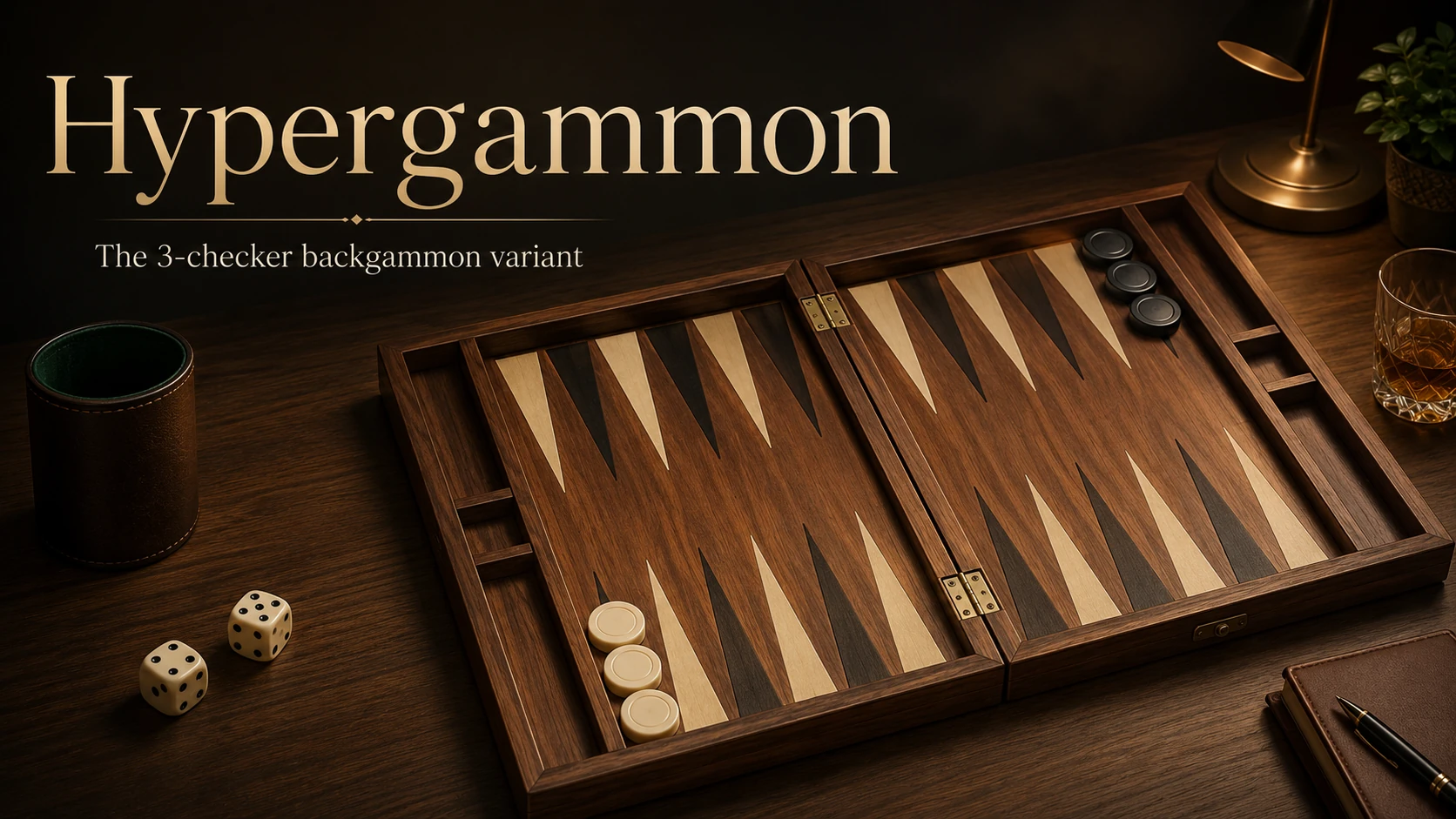
Hypergammon is backgammon with three checkers a side. They start on the three points furthest from home — the 24-, 23- and 22-points — and everything else is the game you already know: the same board, the same dice, the same rules for moving, hitting, entering from the bar, bearing off and doubling. There is nothing new to learn and nothing to look up.
You will also see it written hyper backgammon or simply 3-checker backgammon. It appeared around 1991 and spread through online play, where a game that takes two minutes is worth more than one that takes twenty. Serious players use it for a different reason: with the checker play cut to almost nothing, what is left is the doubling cube — which makes it the best cube-practice game there is.
The starting position
One checker on the 24-point, one on the 23-point, one on the 22-point, mirrored for both players. Six checkers on the board in all. The starting pip count is 69 — that is 24 + 23 + 22 — against 167 in standard backgammon.
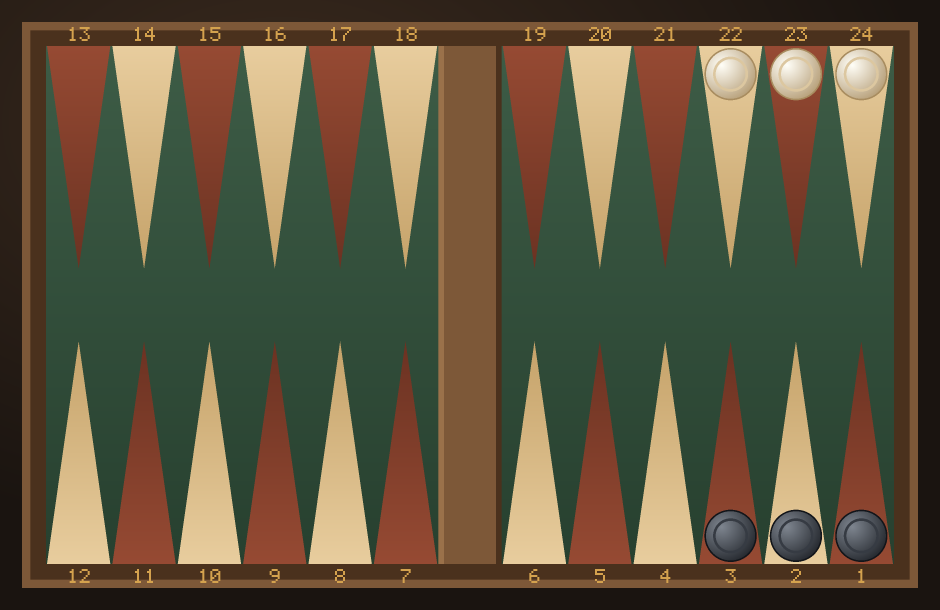
Because they all start in the same corner, every checker has the whole board to cross, and the two armies pass straight through each other. If you are new to the board itself, the setup guide explains the points, the quadrants and the direction of travel — all of it applies here unchanged.
The rules are backgammon's rules
There is no separate rulebook. Everything in our backgammon rules applies:
- Both dice are played, doubles four times, and you must use as many dice as you can.
- A lone checker is a blot and can be hit to the bar; you must enter from the bar first.
- Bearing off begins once all your checkers are home — all three of them.
- Gammons count double and backgammons triple.
- The doubling cube, the Crawford rule and match play all work the same way.
Money play often adds the Jacoby rule here — gammons and backgammons only count once the cube has been turned — precisely because gammons are so common in this variant. It is a table convention rather than part of the game, and it is not used on this site: here a gammon always counts double.
What three checkers do to the game
Cutting fifteen checkers to three does not just make the game shorter. It removes whole plans from the game and sharpens what is left. We played 4,000 games between two equally strong computer opponents on each board to put numbers on it:
| Backgammon | Hypergammon | |
|---|---|---|
| Checkers a side | 15 | 3 |
| Starting pip count | 167 | 69 |
| Turns per game (measured) | 57 | 27 |
| Hits per game (measured) | 7.6 | 6.9 |
| Wins worth more than 1 point | 29% | 69% |
| Primes possible | yes | no |
The hitting number is the one that surprises people: nearly as much hitting as standard backgammon, with a fifth of the checkers. Every checker is a blot most of the time, so the two sides spend the whole game shooting at each other.
No primes, ever
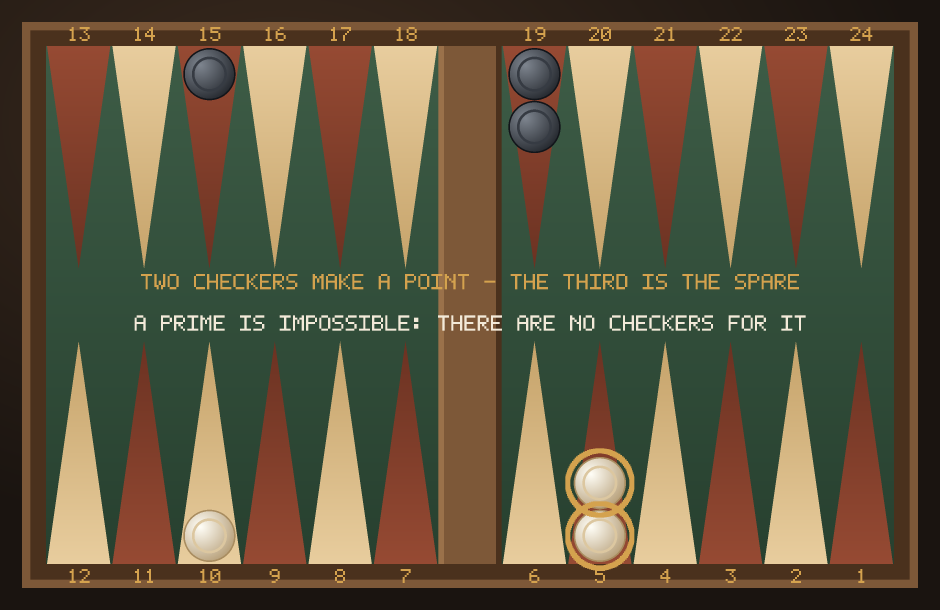
A made point costs two checkers, so with three you can hold one point and have one spare — never a wall. The whole blockading half of backgammon strategy simply does not exist here.
Contact ends early
With three checkers each, the armies pass each other quickly and the game turns into a pure race after a handful of rolls. Once that happens, no skill in the world moves a checker faster — which is exactly why the cube decision before it happens is worth so much.
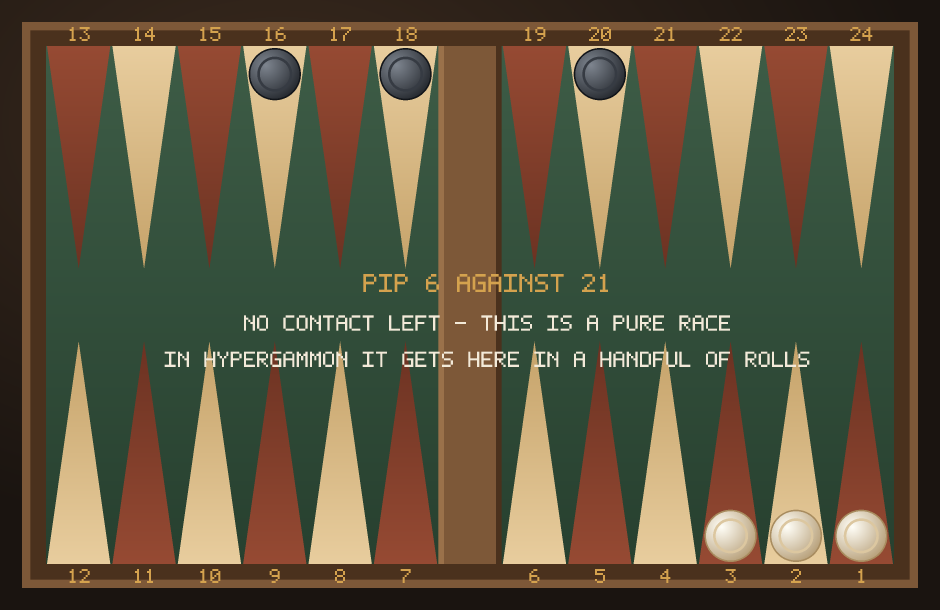
Why most games end in a gammon
A gammon is scored when the loser has not borne off a single checker. In backgammon that takes a rout: the loser has fifteen checkers and only needs one of them home. In Hypergammon there are only three, all of them starting 22 or more pips out — so a loser who gets hit once, or who simply rolls badly, is very often still travelling when the winner finishes.
Our own measurement, 4,000 games between two equally strong computer opponents: 55% of wins were gammons and a further 14% backgammons — about seven wins in ten worth more than a single point. On the standard board the same measurement gives 29%. That single fact drives everything about how the variant is played and doubled.
Strategy: six things that decide games
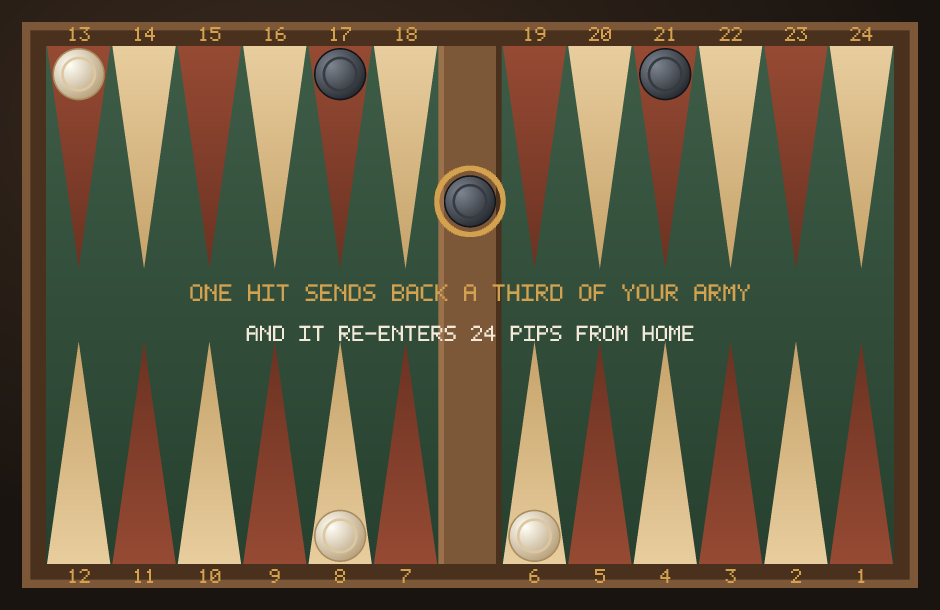
- Hit whenever it does not cost too much. Sending a checker back 24 pips is a third of your opponent's army and roughly a third of their pip count. Almost nothing else you can do with a roll compares.
- Do not fear leaving blots — count them. With three checkers you cannot avoid exposure, so the question is never "is this safe?" but "how many numbers hit me, and what do I get for it?"
- Make the point in front of your opponent's checker when the dice offer it. You only get one made point, so it should be the one that blocks or hits most often.
- Race when you are ahead, hit when you are behind. The pip count is small and easy to keep in your head; use it. Ten pips is a big lead here, not a small one.
- Bring the last checker home early. A single straggler is what turns a win into a loss and a loss into a gammon.
- Double sooner than feels right. Games are short and swings are huge, so the moment when your opponent would still take passes quickly.
The doubling cube is the real game
Take away primes, back games, timing and blitzes, and what is left is a race with hits in it — plus the cube. That is why backgammon software has used Hypergammon for cube training for decades: the checker play is nearly trivial, so every mistake that shows up in your results is a doubling mistake.
Two things make cube decisions here unlike the standard game. First, gammons are everywhere: a position that is worth a double in backgammon may be far past a double here, because the extra point is so often in play. Second, games are short, so a position swings from "too early" to "too good" in one or two rolls. If you keep the cube waiting for the perfect moment, it will still be in the middle of the board when the game ends.
If the cube is new to you, the rules page explains doubling, takes, drops and the Crawford rule. Hypergammon is then the fastest way to get a hundred cube decisions under your belt.
Hypergammon is a solved game
Because there are so few checkers, the whole game fits in a database. In the early 1990s Hugh Sconyers computed perfect play for the three-checker game — over 32 million positions, including every doubling-cube state. In that sense Hypergammon is solved: for any position, the best move and the correct cube action are known exactly.
That has not made it a dead game. Knowing that perfect play exists is not the same as seeing it at the board, and human players still misjudge the same cube decisions today. It does make Hypergammon unusually valuable for study: unlike backgammon, where even the best engines are estimating, here there is a right answer to compare yourself against.
Hypergammon, backgammon and nackgammon
The three boards on this site with backgammon's rules pull in different directions:
| Backgammon | Hypergammon | Nackgammon | |
|---|---|---|---|
| Checkers a side | 15 | 3 | 15 |
| Starting pip count | 167 | 69 | 194 |
| Turns per game | 57 | 26 | longer than backgammon |
| Decided by | race and position | hitting and the cube | priming and position |
| Good for practising | everything | cube decisions | priming and back games |
| Rules | identical — including the doubling cube and gammons | ||
The fourth board here does change the rules: acey-deucey, the U.S. Navy variation where every checker starts off the board and a 1-2 roll buys you a free double.
Who is Hypergammon for?
If you are learning the game, Hypergammon is a fine place to practise the mechanics. A whole game takes minutes, nothing is hidden under a stack of checkers, and you will see hitting, entering from the bar and a bear-off several times in a single sitting. How to play backgammon covers the mechanics themselves.
If you already play, it is the best cube gym available: a hundred doubling decisions in an evening, with almost no checker play in the way.
If you have five minutes, it is simply the fastest real game of backgammon there is — which is how it became popular online in the first place.
Playing Hypergammon here
Choose Hypergammon in the bar above the board and it is dealt immediately. Play against the computer on three levels, or send a friend a private link and play them directly. It runs in the browser on a phone or a computer, with no download and no account, and the board enforces every rule for you — including the ones that catch people out here, like having to enter from the bar before anything else and needing all three checkers home before bearing off.
▶ Play Hypergammon nowQuestions people ask
What is Hypergammon?
Hypergammon is backgammon played with three checkers a side instead of fifteen. Each player starts with one checker on the 24-point, one on the 23-point and one on the 22-point, and every other rule is backgammon's. It is also written hyper backgammon, and it is the fastest of the common variants.
How many checkers do you have in Hypergammon?
Three each, on the 24-, 23- and 22-points. Six checkers on the board in total, against thirty in backgammon.
Are the rules of Hypergammon different from backgammon?
No. Only the starting position changes. Moving, hitting, entering from the bar, bearing off, gammons, backgammons and the doubling cube all work exactly as they do in backgammon — and with three checkers you may bear off as soon as all three are home.
Why do so many Hypergammon games end in a gammon?
A gammon is scored when the loser has not borne off a single checker — and with only three to bring home, the loser is often still travelling when the winner finishes. In 4,000 evenly matched computer games on this site, 55 per cent of wins were gammons and another 14 per cent backgammons: roughly seven wins in ten were worth more than a point.
Is Hypergammon just luck?
There is more luck than in backgammon — fewer checkers means fewer decisions and a shorter game for skill to work in. But the decisions that remain are sharp: when to hit, when to leave a blot, when to run, and above all when to double. That is why strong players use Hypergammon to practise cube handling.
What is the starting pip count in Hypergammon?
69 for each player: 24 + 23 + 22. Standard backgammon starts at 167.
Can you make a prime in Hypergammon?
No. A prime needs several consecutive made points and each made point costs two checkers, so with three checkers the most you can hold is one point plus a spare. Blockading is out; hitting and racing are what is left.
How long does a game of Hypergammon take?
About half as long as backgammon. In 4,000 computer games on this site a Hypergammon game lasted 27 turns on average against 57 for the standard board — a couple of minutes rather than ten.
Has Hypergammon been solved?
Yes. Hugh Sconyers computed a database of perfect play for the three-checker game in the early 1990s — over 32 million positions including the doubling cube. Perfect play being known does not make it easy for humans: the right cube decisions are still hard to see over the board.
Is Hypergammon good for beginners?
It is an excellent way to learn how checkers move, how hitting and the bar work and how a bear-off goes, because a whole game takes minutes and nothing is buried under a stack of fifteen checkers. For learning strategy, the standard game teaches more.
What is the difference between Hypergammon and Nackgammon?
They pull in opposite directions. Hypergammon strips the board down to three checkers a side for a fast, sharp game decided by hitting and the cube. Nackgammon adds two extra back checkers to make the game longer and more positional. Both use backgammon's rules unchanged.
Where can I play Hypergammon online for free?
Here. Pick Hypergammon above the board on BackgammonWorld and play against the computer on three levels or send a friend a private link. It runs in the browser, needs no download and no account, and the board enforces every rule for you.
More boards: Nackgammon and Acey-Deucey, or the full guide to backgammon variants including tavla, plakoto and narde. New to the game? Start with how to play backgammon, the board setup and the complete rules — or test yourself with the backgammon quiz.
← Back to the game