Play Nackgammon Online
Nack Ballard's variant — four back checkers, backgammon's rules, a deeper game
Last updated
Nackgammon is backgammon dealt from a different starting position: each side begins with four checkers in the opponent's home board instead of two. Nothing else changes — the moves, the bar, bearing off, gammons and the doubling cube all work exactly as you know them. The result is a game with far more contact, where the opening roll counts for less and position counts for more. Pick Nackgammon above the board and play it free against the computer or a friend.
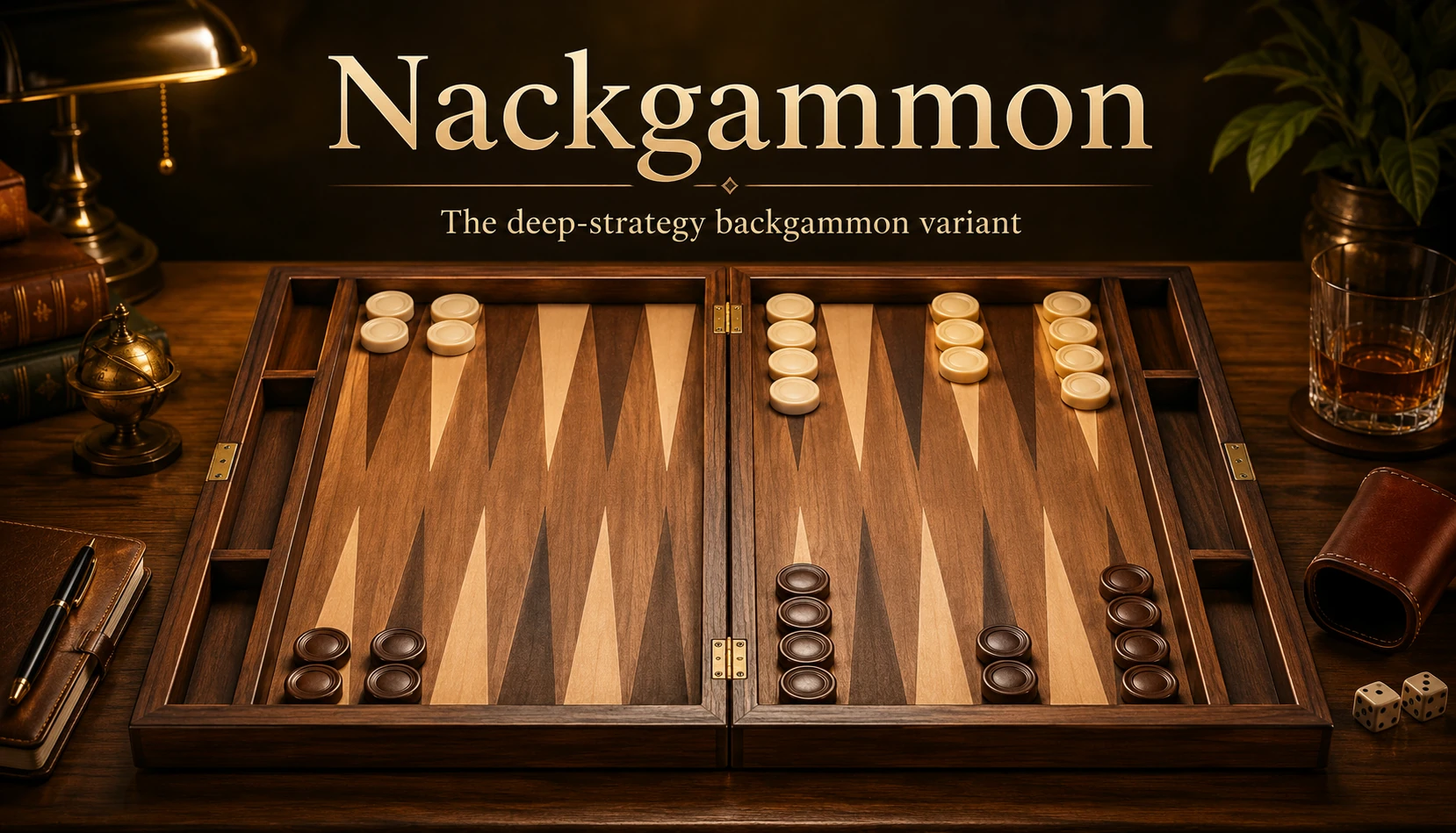
What is Nackgammon?
Nackgammon is backgammon with two extra checkers sent to the far corner. One checker from your 6-point and one from your 13-point start on your 23-point, so you begin the game with four back checkers instead of two. That is the entire difference. There is no new rule to learn, no new equipment, and no separate rulebook — if you can play backgammon, you can play Nackgammon in the next thirty seconds.
The name comes from its inventor, the American champion Nack Ballard: his first name in place of the back in backgammon. You will occasionally see it written Nack gammon or simply "Nackgammon backgammon" — all the same variant. It is one of the few backgammon variants that strong players use as a training game rather than a novelty, because it forces the parts of the game that are hardest to practise.
The Nackgammon starting position
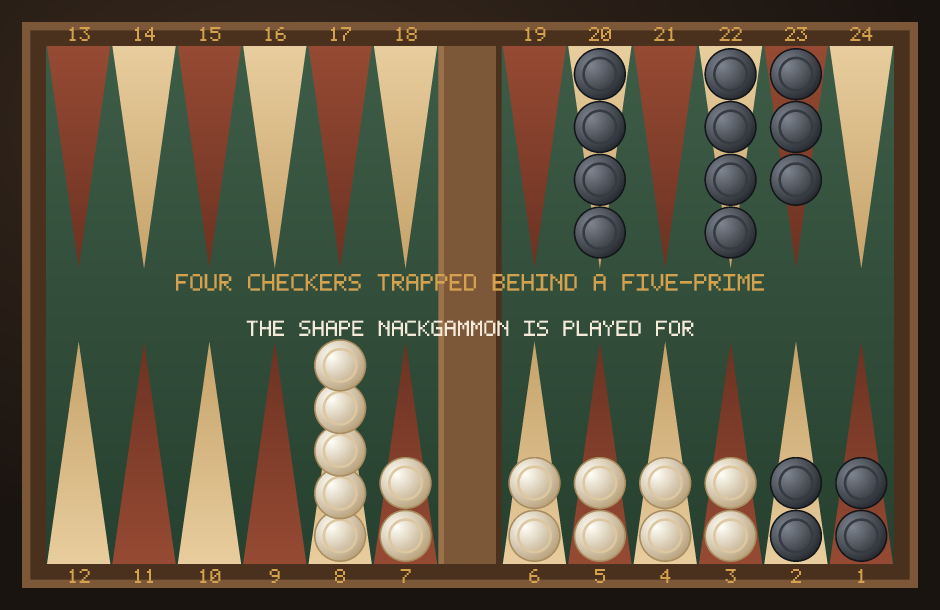
Take a standard board and move one checker from your 6-point and one from your 13-point back to your 23-point. That is the whole change:
| Point | Backgammon | Nackgammon |
|---|---|---|
| 24-point | 2 | 2 |
| 23-point | — | 2 |
| 13-point | 5 | 4 |
| 8-point | 3 | 3 |
| 6-point | 5 | 4 |
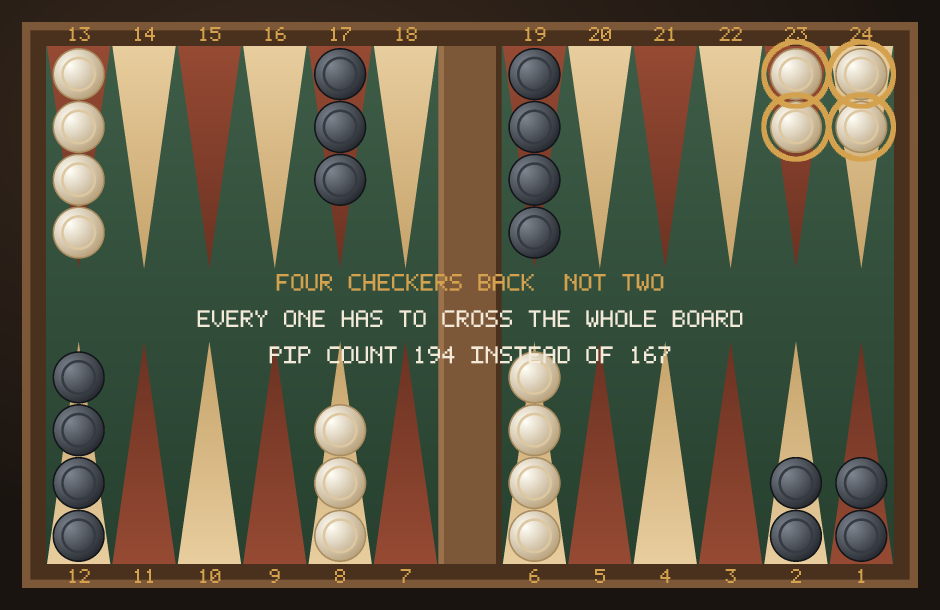
Fifteen checkers each, as always, mirrored on both sides. The starting pip count is 194 instead of 167 — the two checkers sent back to the 23-point add 27 pips to the journey.
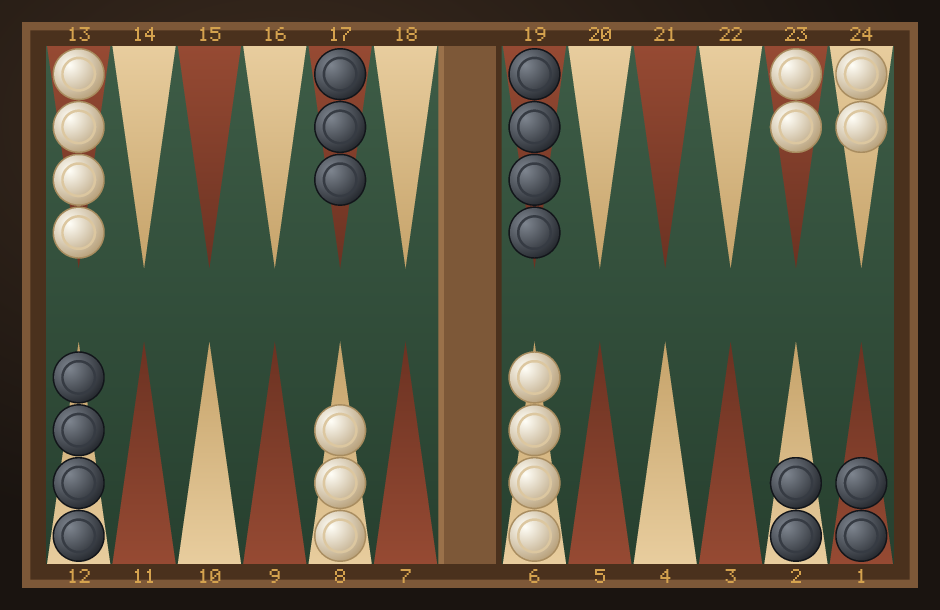
If you are still finding your way around a board, the standard setup guide explains the points, the direction of play and the home boards first — everything there applies here too.
What changed, in one picture
It is easier to see as an edit to the board you already know than as a new position to memorise. Two checkers move, and they move backwards:
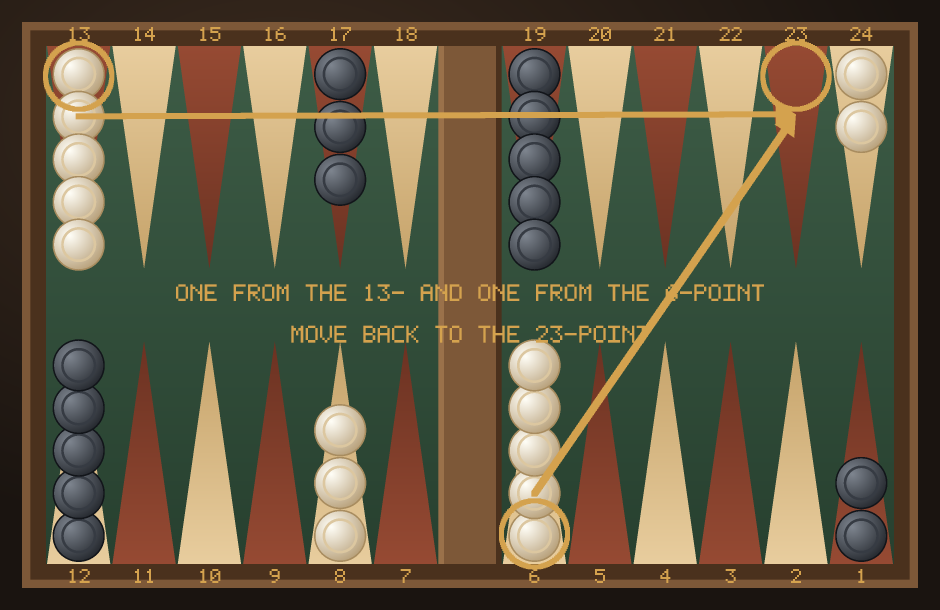
Note what those two checkers were doing before. The 6-point checker was part of your best home board point; the 13-point checker was part of your midpoint stack. Both were useful where they stood. In Nackgammon they start the game as a liability instead — and getting them home is the problem the whole game is built around.
The rules are backgammon's rules
There is no separate rulebook. Everything in our backgammon rules applies without exception:
- Both dice are played, doubles four times, and you must use as many dice as you can.
- A lone checker is a blot and can be hit to the bar; you must enter from the bar first.
- Bearing off begins once all fifteen checkers are home.
- Gammons count double and backgammons triple.
- The doubling cube, the Crawford rule and match play all work the same way.
Money-play conventions travel across unchanged too: if your table plays the Jacoby rule — gammons and backgammons only count once the cube has been turned — it applies here exactly as it would on a standard board. Nothing about the variant touches the scoring.
Why four back checkers change everything
The rules are identical, but the game feels different from the first roll. Two extra checkers in the opponent's home board are not simply 27 more pips to run — they change which plans are available at all.
Pure races are rare
With four checkers stuck behind enemy lines, the two sides stay in contact far longer. In standard backgammon a 6-5 or a couple of big doubles can turn the game into a race before either player has built anything; here that door closes much later, and often never opens at all.
Running solves less
Escaping one back checker still leaves three behind, so the classic "run and hope" plan rarely solves your problem on its own. Plans that need all your checkers to be free — a straight race, a bear-off rush — need three or four good turns rather than one.
Priming decides it
This is the heart of the variant. A wall of consecutive points in front of enemy checkers is worth far more when it traps four of them, and being on the wrong side of one is far worse. The fight is not "can I escape?" but "who builds the better blockade, and who is behind it when it closes?"
The 23-point is a ready-made anchor
You start with a made point deep in the opponent's home board. It is safe — nothing can be hit there — and it is slow, because those checkers are 23 pips from home. Deciding when to give it up and run is one of the recurring judgements of the variant, and getting it wrong in either direction loses games: leave too early and you get attacked, leave too late and you are primed in.
Blots cost more
More enemy checkers in your home board means more numbers that hit, so the cost of a loose play goes up. A blot you would leave without thinking in backgammon can be a losing move here.
Games run longer
All of the above adds up: fewer games are decided early, more are decided in a long middle phase. That is the point. Nackgammon was built to give skill more turns in which to matter.
Strategy: seven things to play for
Every idea from the standard strategy guide still applies — priming, anchors, timing, the four game plans. These are the ones whose weight changes:
- Make points, not distance. A blocking point in front of four checkers earns more than the same point in backgammon. Take the 5-point and the bar point whenever the dice offer them.
- Do not empty the 23-point for nothing. Splitting to it is pointless — you own it. Leaving it should buy something concrete: an escape, a hit, or a better anchor.
- Watch your timing. Holding two anchors is comfortable until you run out of spare pips and have to break your own board. Count the moves you can still afford to waste before you commit to a waiting game.
- Attack later, prime earlier. Blitzing works badly against four back checkers — there is nearly always an anchor to land on. Building a blockade is the plan the position keeps rewarding.
- Escape in pairs. Getting one checker to safety while leaving three is often worse than moving two of them together, because the pair can make a point next turn.
- Respect the back game. With two anchors already made, back games are far more common here than in backgammon — both as a plan for you and as a threat to prepare against.
- Do not double too early. Games are longer and swing more, so an advantage in the first ten rolls is worth less than the same advantage in backgammon.
Do the standard openings still apply?
Partly. Point-making rolls stay strong: 3-1 making the 5-point is still the best thing that can happen to you, and 6-1 making the bar point is still excellent, because a blocking point is worth more here, not less.
What changes is everything built around running and splitting. The famous 6-5 "lover's leap" gets one checker out and leaves three, so it is nowhere near the clean answer it is in backgammon. The splitting plays — 24/23 and friends — do nothing at all, because the 23-point is already yours. Our opening moves guide covers the standard game roll by roll; treat those plays as a starting point in Nackgammon rather than a finished answer, and lean toward the ones that build.
Nackgammon, backgammon and hypergammon
Three boards, one rulebook — and three very different games. If you are choosing what to play, this is the short version:
| Backgammon | Nackgammon | Hypergammon | |
|---|---|---|---|
| Checkers a side | 15 | 15 | 3 |
| Back checkers | 2 | 4 | 3 (all of them) |
| Starting pip count | 167 | 194 | 69 |
| Game length | medium | long | very short |
| Decided by | race and position | position and priming | the dice, mostly |
| Rules | identical — including the doubling cube and gammons | ||
There is one more board on this site that does change the rules: acey-deucey, the U.S. Navy variation where every checker starts off the board.
Who was Nack Ballard?
Nack Ballard is an American player generally counted among the strongest the game has produced: winner of the 1982 World Championship, ranked world number one for several years around the turn of the century, and named on every edition of the Giants of Backgammon list. He is also the co-author of Backgammon Openings, one of the standard works on the first two moves of a game.
His complaint about standard backgammon was simple: the fifteen opening rolls are not equal, and the gap between them is large. Winning the opening cast and throwing 3-1 hands you the 5-point on move one; throwing 2-1 hands you almost nothing. A single die can tilt a short match before either player has made a decision.
Adding two back checkers dilutes that. With four checkers to bring home from the far corner, no single opening roll settles very much, and the game is decided over the long middle phase where skill has room to work. He built the position for his own students, to make them practise exactly what the standard game lets you avoid.
Who is Nackgammon for?
If you are new to backgammon, learn the standard game first — the rules are the same, so nothing is wasted, and the standard opening position is gentler on beginners. How to play backgammon takes about ten minutes.
If you already play and want to get better, Nackgammon is one of the most efficient practice tools there is. Priming battles, anchor decisions, timing and back games — the themes that decide serious games — turn up in nearly every Nackgammon game instead of every fifth one. That is not an accident; it is the reason the variant exists.
If you simply want a longer, less lucky game, it delivers that too. Fewer games are settled by one big roll, and a good position is harder to throw away.
Playing Nackgammon here
Choose Nackgammon in the bar above the board and it is dealt immediately. Play against the computer on three levels, or send a friend a private link and play them directly. It runs in the browser on a phone or a computer, with no download and no account, and the board enforces every rule for you — including the ones that matter most here, like using both dice when a blockade only leaves you one legal sequence.
▶ Play Nackgammon nowQuestions people ask
What is Nackgammon?
Nackgammon is backgammon dealt from a different starting position: one checker from the 6-point and one from the 13-point start on the 23-point instead, so each player begins with four back checkers rather than two. Every rule after that is backgammon's. It was invented by the American champion Nack Ballard to make his students practise positional play.
What is the difference between Nackgammon and backgammon?
Only the starting position. In Nackgammon one checker from the 6-point and one from the 13-point start on the 23-point instead, so each player begins with four back checkers rather than two. Every rule after that — movement, hitting, the bar, bearing off, gammons, the doubling cube — is identical to backgammon.
How do you set up a Nackgammon board?
Set the board up for backgammon, then move one checker from your 6-point and one from your 13-point to your 23-point. Each side ends with two checkers on the 24-point, two on the 23-point, four on the 13-point, three on the 8-point and four on the 6-point — fifteen in all, mirrored for both players.
Who invented Nackgammon?
Nack Ballard, an American player who was ranked world number one and won the 1982 World Championship. He created the position so that his students would have to practise priming and positional play instead of racing, and the variant carries his first name.
Is Nackgammon harder than backgammon?
It is more demanding positionally. Four back checkers mean more contact, longer blocking battles and fewer games that turn into a simple race, so plans have to be made further ahead. The rules themselves are no harder to learn — if you can play backgammon you can play Nackgammon straight away.
What is the starting pip count in Nackgammon?
194 for each player, against 167 in standard backgammon. The two checkers moved back to the 23-point add 27 pips to the journey.
Do the standard opening moves still work in Nackgammon?
Partly. Point-making rolls such as 3-1 making the 5-point remain strong, and are worth more than in backgammon because a blocking point now works against four checkers. Running plays are worth less, because escaping one back checker still leaves three behind, and the splitting plays lose their point when you already own the 23-point.
Does Nackgammon use the doubling cube?
Yes. The cube, gammons, backgammons, the Crawford rule and match play all work exactly as in backgammon. On BackgammonWorld the cube appears in match play, just as it does on the standard board.
Why is it called Nackgammon?
After its inventor, Nack Ballard — his first name in place of the back in backgammon. You will also see it written as Nack gammon or Nackgammon backgammon; it is the same variant.
How long does a game of Nackgammon take?
Longer than backgammon. Four back checkers a side keep the two armies in contact for much of the game, so fewer games end in an early race and more are decided in a long middle phase.
Is Nackgammon good for beginners?
Learn the standard game first — the rules are the same, so nothing is lost by starting there. Once you know how to move, Nackgammon is one of the best ways to practise priming, anchors and back games, which is exactly why it was invented.
Where can I play Nackgammon online for free?
Here. Pick Nackgammon above the board on BackgammonWorld and play against the computer on three levels or send a friend a private link. It runs in the browser, needs no download and no account, and the board enforces every rule for you.
More: every board in one place in our guide to backgammon variants, how to play backgammon, the board setup, the complete rules, the best opening moves, our strategy guide — or test yourself with the backgammon quiz.
← Back to the game