Play American Acey-Deucey Online
The U.S. Navy variation — free, in your browser, no registration
Last updated
Acey-deucey has been played on American ships since the First World War, and it is backgammon with the handbrake off: every checker starts off the board, doubles earn you another roll, and rolling a 1 and a 2 lets you name any double you like, play it, and roll again. Pick Acey-Deucey above the board and play it free against the computer or a friend — start a game.
What is acey-deucey?
Acey-deucey is backgammon played from an empty board, with a bonus for rolling a 1 and a 2. It uses the same 24-point board, the same fifteen checkers a side and the same two dice, and hitting, the bar and blocked points work exactly as you already know them. Four rules make it a different game: everything starts off the board, every double is followed by another roll, the 1-2 buys a free double plus another roll, and bearing off needs an exact number. There is no doubling cube.
The name simply joins ace (a one) and deuce (a two) — the roll the whole game is built around. You will see it written acey-deucey, acey-deucy and acey ducey; they are the same game. The version on this page is American acey-deucey, the one played in the U.S. Navy and the one almost everyone means online.
Setup: an empty board
Nothing is placed on the board at the start. Each player holds their fifteen checkers beside it and brings them in over the course of the game. There is no opening position to memorise, which is the reason acey-deucey is often the first backgammon variant a beginner learns: you only need to know how a checker enters.
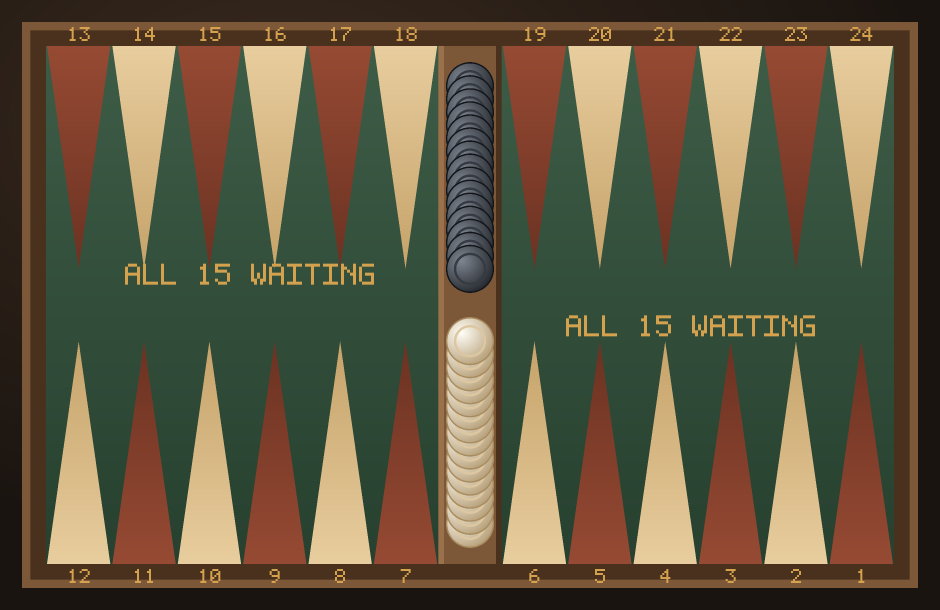
Both players roll one die to decide who starts, as in backgammon; the higher number plays first with the two dice showing. Everything else about the board — the four quadrants, the numbering, the direction each side travels — is unchanged, so the backgammon board setup guide still applies to everything except the checkers themselves.
Entering your checkers
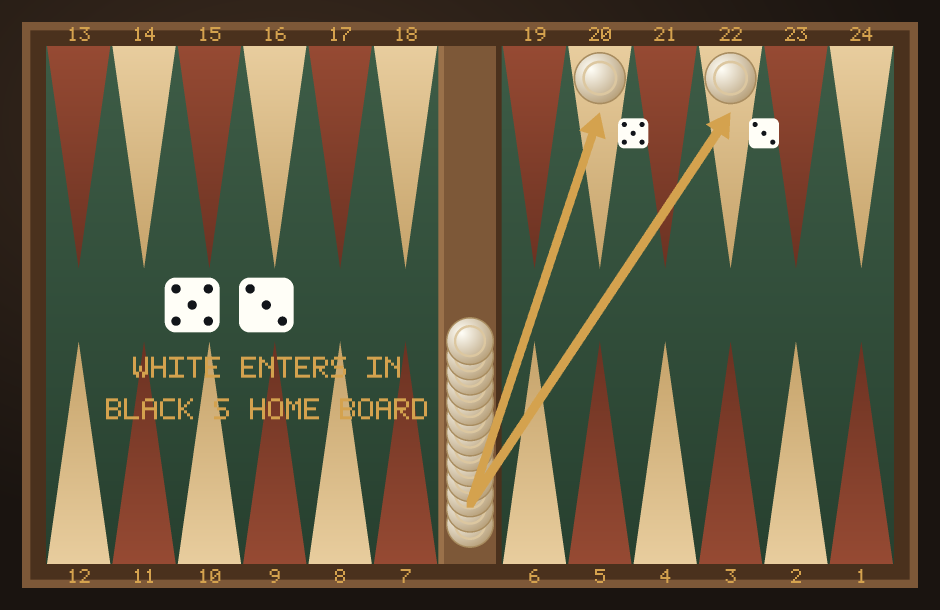
Checkers come in on the opponent's home board, exactly as a checker enters from the bar in backgammon. A die of 3 brings a checker in on the third point of that quarter, a 5 on the fifth, and so on. A point held by two or more enemy checkers is closed to you; a point with a single enemy checker on it is fair game, and landing there hits it.
Entering is not compulsory
This is the rule that surprises backgammon players most. Once a checker is on the board it may move while the rest are still waiting — you are never forced to spend a roll on bringing fresh material in. Every turn is therefore a small decision: build up in the entry quadrant, or run with what you already have?
It also means a bad entry quadrant is not a disaster. If your opponent has closed most of their home board, you can simply play elsewhere and wait for the door to open, which is impossible in standard backgammon when you are sitting on the bar.
The acey-deucey roll (1-2)
Roll a 1 and a 2 — the acey-deucey the game is named after — and three things happen in a row:
- Play the 1 and the 2 as an ordinary roll.
- Name any double from 1-1 to 6-6 and play it four times.
- Roll again.
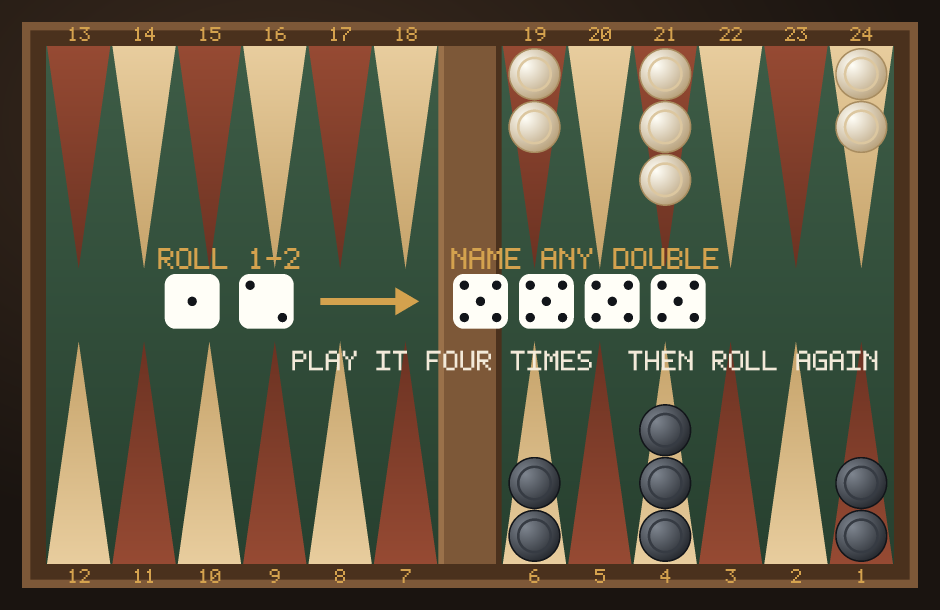
A single 1-2 can therefore be worth 27 pips — three from the roll itself and up to twenty-four from a chosen 6-6 — and a fresh roll on top. It is the biggest swing in the game, and it lands on average once every eighteen turns.
The catch: the bonus is only yours if you can play both the 1 and the 2. If the board blocks one of them, the turn is an ordinary — and rather poor — 1-2 and nothing follows.
Which double should you name?
Not automatically the biggest. Four sixes are 24 pips, but they are useless if your checkers cannot travel that far without landing on closed points. Ask three questions in order:
- Can I make a point? Two builders landing together on an open point is usually worth more than raw distance, especially in the opponent's home board where it blocks their entry.
- Am I stuck on the bar or behind a wall? Then pick the number that gets you out, even if it is small.
- Am I ahead in the race? Take the biggest number you can play in full and run.
Doubles and extra rolls
Every double is played four times, as in backgammon — but in acey-deucey the player then rolls again. And if that roll is another double, they roll again after it too. Two or three doubles in a row are not unusual, and a single turn can run to thirty or forty pips while the opponent watches.
This one rule is why the game feels so different. A player who is hopelessly behind is never really out of it, and a comfortable lead can evaporate in one turn. It also makes the game faster: with roughly one turn in six carrying a bonus roll, a full game of acey-deucey takes noticeably fewer turns than backgammon does.
Hitting and the bar
Hitting works exactly as in backgammon. Land on a point holding a single enemy checker — a blot — and it goes to the bar. From the bar it must re-enter in your home board before that player may make any other move, and here the rule is compulsory: a checker on the bar comes first, always.
So the two ways of being off the board are not the same. Checkers still in hand are patient; a checker on the bar is an emergency. That difference is worth remembering when you decide whether to leave a blot in the entry quadrant.
Bearing off: the exact number
Once all fifteen of your checkers are home you bear off — but acey-deucey wants an exact number. In standard backgammon a 6 takes a checker off your highest occupied point even if that point is the 4. Here it does not: you need a 4.
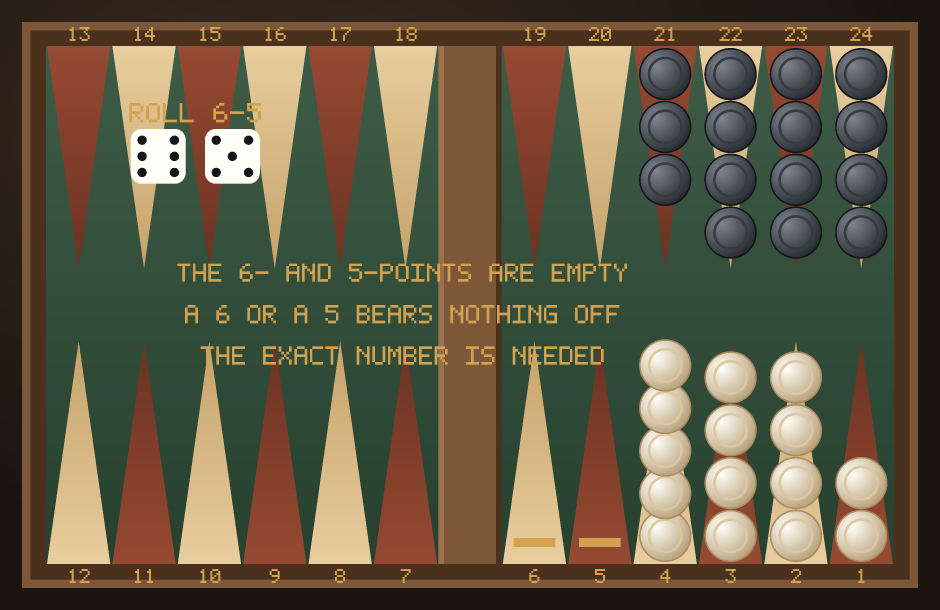
Two consequences follow, and both are worth playing for long before the end:
- An even home board beats a tall one. Fifteen checkers piled on the 1- and 2-points look safe and waste every big number you roll.
- Big rolls can be worth nothing. A 6-6 with an empty 6-point moves checkers within the home board at best — which is why the endgame here rewards tidiness rather than luck.
Scoring and stakes
The winner scores one point. There are no gammons and no backgammons: bearing off first is worth exactly as much whether your opponent has fourteen checkers left or none. That is the version played on this site, and it is the one most online rule sets use.
Aboard ship it was often played for stakes instead, with the loser paying one unit for every checker still on the board. That single change transforms the endgame — every checker you manage to bear off in a lost position saves you money, so nobody resigns. It is a house rule rather than part of the game, and you will not find it here.
Acey-deucey vs backgammon: every difference
| Backgammon | Acey-Deucey | |
|---|---|---|
| Starting position | 15 checkers on four points | all 15 off the board |
| Entering | — | in the opponent's home board, optional |
| 1-2 roll | a weak roll | free double + another roll |
| Doubles | four moves | four moves + another roll |
| Bearing off | higher roll may bear off | exact roll required |
| Doubling cube | yes (match play) | none |
| Gammons | double, triple | every win counts one |
| Typical game length | 50-60 turns | shorter — bonus rolls |
| Hitting, the bar, blocked points | identical | |
Strategy: how to play acey-deucey well
Most backgammon ideas carry over — the value of making points, of primes, of not leaving blots within direct range. Five things are genuinely different:
1. Block the entry quadrant early
Your opponent's checkers all have to come in on your home board. Points you make there do double duty: they are your bear-off structure later and a wall against their entry now. A four-point home board in acey-deucey is worth more than the same board in backgammon, because it is working against fifteen checkers rather than one.
2. Do not rush every checker in
Because entering is optional, checkers in hand are safe. Bringing in more than you can protect creates a row of blots in the most dangerous quarter of the board. Many strong players deliberately keep a few back — the old Navy nickname for the last one held in reserve is "Oscar" — and bring them in once the opponent's home board is committed.
3. Respect the 1-2 that has not happened yet
Any position that looks safe by four or five pips is not safe: one acey-deucey is worth up to 27, and it can arrive on any turn. Play a little more conservatively when you are ahead than the raw pip count suggests, and do not give up when you are behind.
4. Keep the home board even for the bear-off
The exact-number rule punishes lopsided home boards. If you can spend a spare pip late in the game filling the 5- and 6-points rather than stacking the 1-point, do it — that is the difference between a smooth bear-off and three turns where your best die does nothing.
5. Hits hurt more here
A checker sent to the bar must come back before anything else, while everyone else's spare checkers are merely waiting. In a game this fast, one hit at the wrong moment costs more than the pips suggest. If you want to work on the general skills, the backgammon strategy guide covers primes, timing and blot safety in depth.
House rules you may meet
Acey-deucey was carried around the world by crews rather than written down by a federation, so the rules vary from ship to ship and from site to site. If you learned it differently, one of these is probably why:
| House rule | What changes | Here |
|---|---|---|
| All fifteen must enter first | no checker may move until every one is on the board | no — entering is optional |
| One checker home before hitting | you may not hit until a checker has reached your home board | no — you may hit at any time |
| Stakes per checker | the loser pays for every checker not borne off | no — every win scores one |
| The bonus is lost if any part is unplayable | a partly playable 1-2 forfeits the rest of the turn | yes — both numbers must be played |
| European acey-deucey | a different game entirely: the 1-2 is played, then the player rolls again, with no free double | no — this is the American game |
The set on this page follows the American version as it is usually written down: everything off the board, optional entering, a free double plus another roll for a played 1-2, another roll after any double, exact bear-off, no cube, no gammons.
A short history in the Navy
Acey-deucey appears aboard U.S. Navy ships in the early 1900s and became a favourite of the Navy, the Marine Corps and the Merchant Marine around the First World War. Its ancestors are the tables games of the eastern Mediterranean — Greece, Turkey and the Middle East — which sailors would have met in port and brought home with the rules bent into something faster.
It is easy to see the appeal on a ship: a game is short, the swings are large, a run of doubles can turn a hopeless position around, and nothing is lost if a watch change interrupts it. The name has since escaped the game entirely — an Acey-Deucey Club on a naval base is the club for first and second class petty officers, and in horse racing "acey-deucey" means riding with one stirrup lower than the other. We sorted the meanings out in card game, dice game or Navy club?
Playing acey-deucey here
Choose Acey-Deucey in the bar above the board and the game is dealt immediately — an empty board and thirty checkers in hand. Play against the computer at three strengths, or send a friend a private link and play them directly. It runs in the browser on a phone or a computer, with no download and no account, and every rule on this page is enforced for you: the board will not let you make an illegal move, the double buttons appear the moment you earn them, and the bear-off only accepts exact numbers.
▶ Play Acey-Deucey nowQuestions people ask
What is acey-deucey?
A backgammon variation played in the U.S. Navy since the First World War. All fifteen checkers start off the board and must be entered, doubles earn another roll, rolling a 1 and a 2 lets you name any double and play it before rolling again, and bearing off needs an exact number.
How do you play acey-deucey?
Enter your fifteen checkers into the opponent's home board as if coming off the bar, race them around the board and bear them off — the same journey as backgammon. What differs: entering is optional once a checker is on the board, every double is followed by another roll, a 1-2 buys a free double plus another roll, bearing off needs the exact number, and there is no doubling cube.
What happens when you roll an acey-deucey?
You play the 1 and the 2, then choose any double from 1-1 to 6-6 and play it four times, and then you roll again. If you cannot play both the 1 and the 2, the bonus is lost.
How do checkers enter the board in acey-deucey?
Everything starts off the board and enters in the opponent's home board, exactly as a checker enters from the bar: a 3 comes in on the third point of that quarter, and a point held by two or more enemy checkers is closed. Entering is not compulsory — a checker already on the board may move while others are still waiting.
Is there a doubling cube in acey-deucey?
No. The classic Navy game has no doubling cube, and every win counts the same — there are no gammons or backgammons.
Do you need an exact roll to bear off?
Yes. Unlike standard backgammon, a number higher than your highest occupied point does not bear a checker off — you need the exact number, so a big roll can be worth nothing at the end of a game.
How many checkers do you play acey-deucey with?
Fifteen per player, the same as backgammon, on the same 24-point board with two dice. The difference is where they start: off the board rather than on it.
How is acey-deucey scored?
The winner scores one point, and that is the version played here. Many crews played for stakes instead, with the loser paying one unit for every checker they had not yet borne off — which is why a hopeless position is worth playing out at sea and not online.
What is the difference between acey-deucey and backgammon?
The board, the checkers, hitting, the bar and blocked points are identical. Acey-deucey starts with everything off the board, makes entering optional, gives another roll after every double, turns the 1-2 into a bonus roll, requires an exact number to bear off, and drops the doubling cube and gammons.
Is acey-deucey the same as the card game?
No. There is also a betting card game called acey-deucey or in-between, where you bet on whether a third card falls between two others. This page is about the backgammon variation played on a board with dice.
How do you spell acey-deucey?
Acey-deucey is the usual spelling, but acey-deucy and acey ducey are all in use — the name simply joins ace (a one) and deuce (a two), the roll the game is built around.
Can I play acey-deucey online for free?
Yes. Pick Acey-Deucey above the board on BackgammonWorld and play against the computer or send a friend a private link. It runs in the browser, needs no download and no account, and every rule is enforced for you.
More on acey-deucey
Three companion pieces, each one going deeper than this page can:
- Acey-Deucey Strategy — blocking the entry board, holding a checker back ("Oscar"), which double to buy, and playing for the exact bear-off.
- Acey-Deucey Odds — how often a 1-2 comes up, what it is worth in pips, how often it is wasted, and whether more bonuses actually win games. Measured over 500 games.
- The U.S. Navy's Own Backgammon — boards screwed to a rolling deck, the shout that cost you a turn, and the evidence from 1904 to 1951.
- American vs European vs Mexican — three rule sets in one family, the complement rule, Mexican backgammon's five-checker limit — and where the sources contradict each other.
- Your First Game, Step by Step — one real game photographed at the five moments that teach it: entering, a point, a hit, the bonus and the bear-off.
- Card game, dice game or Navy club? — the name covers five different things. Which one you probably meant, and the rules of the In-Between card game that shares it.
More boards: Nackgammon and Hypergammon, or the full guide to backgammon variants and how they differ. New to the game? Start with how to play backgammon, the board setup and the complete rules — or test yourself with the backgammon quiz.
← Back to the game