Backgammon Odds: Every Hit Chance on One Page
The complete shot table, what a blockade does to it, and the numbers behind coming in off the bar
Last updated
Backgammon has exactly 36 possible rolls, and almost every decision in the game comes down to how many of them do something to you. This page has the full table — how many of those 36 hit a blot at every distance from one to twenty pips — plus what changes when points are held against you, what it costs to sit on the bar, and the plain dice odds underneath it all. Every figure here was computed by the engine that runs the games on this site and checked against the published values, not copied from another page. When you are ready to use them, play a free game — the board keeps your pip count for you.
The complete hit table
One enemy checker, one blot, an open board between them. This is how many of the 36 rolls hit it, counting direct shots, combination shots and doubles.
| Distance | Rolls that hit | Chance | How |
|---|---|---|---|
| 1 | 11 | 30.6% | direct only |
| 2 | 12 | 33.3% | direct, plus 1-1 |
| 3 | 14 | 38.9% | direct, plus combinations |
| 4 | 15 | 41.7% | direct, plus combinations |
| 5 | 15 | 41.7% | direct, plus combinations |
| 6 | 17 | 47.2% | the most dangerous distance on the board |
| 7 | 6 | 16.7% | combinations only |
| 8 | 6 | 16.7% | combinations only |
| 9 | 5 | 13.9% | combinations only |
| 10 | 3 | 8.3% | combinations only |
| 11 | 2 | 5.6% | 5-6 and 6-5, nothing else |
| 12 | 3 | 8.3% | 6-6, 4-4 and 3-3 |
| 13 | 0 | — | cannot be hit |
| 14 | 0 | — | cannot be hit |
| 15 | 1 | 2.8% | 5-5 only |
| 16 | 1 | 2.8% | 4-4 only |
| 17 | 0 | — | cannot be hit |
| 18 | 1 | 2.8% | 6-6 only |
| 19 | 0 | — | cannot be hit |
| 20 | 1 | 2.8% | 5-5 only |
Beyond twenty pips a single checker on the board cannot reach a blot at all. These are open-board figures: every number from 7 upwards falls if the points in between are held against the shooter, which is the subject of the blockade section below.
Direct shots: one to six away
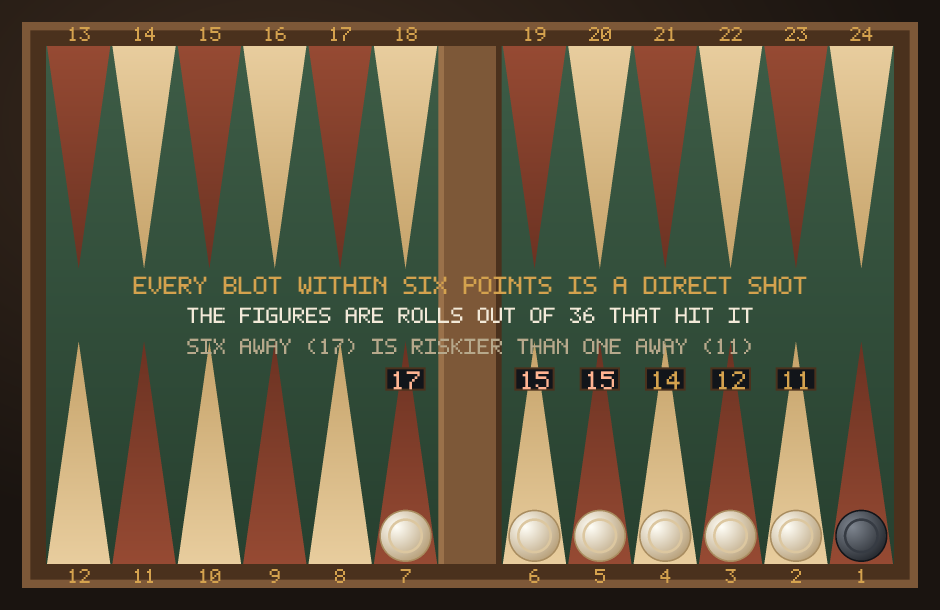
A direct shot is six pips or fewer: a single die reaches it. Eleven of the 36 rolls contain any given number, so every direct shot starts at 11 rolls and goes up from there, because combinations can reach the same point as well.
This produces the single most counter-intuitive fact in the game. Six pips away is the most dangerous distance on the board — 17 rolls in 36, nearly one time in two. One pip away is the safest of the six, at 11 rolls, because only a 1 gets there and nothing else adds to it. Beginners routinely leave a blot six away thinking distance means safety, and lose it half the time.
Between those two extremes the numbers rise steadily: 11, 12, 14, 15, 15, 17. There is no distance inside six that is meaningfully safe. If you must leave a blot in range, the question is not whether it gets hit but what you gain in exchange — which is what the strategy guide is about.
Indirect shots: seven to twelve away
From seven pips, no single die reaches. The shooter needs both dice, which is why these are called indirect or combination shots, and why they are so much rarer. The drop is abrupt: a blot at six is hit by 17 rolls, one at seven by 6.
- 7 away: 6 rolls — 1-6, 6-1, 2-5, 5-2, 3-4, 4-3.
- 8 away: 6 rolls — 2-6, 6-2, 3-5, 5-3, and the doubles 2-2 and 4-4.
- 9 away: 5 rolls — 3-6, 6-3, 4-5, 5-4, and 3-3.
- 10 away: 3 rolls — 4-6, 6-4, and 5-5.
- 11 away: 2 rolls — only 5-6 and 6-5. This is the safest distance you can leave a blot at within any realistic range.
- 12 away: 3 rolls — 6-6, 4-4 and 3-3. Note that it goes back up: twelve is reachable by three different doubles, so it is more dangerous than eleven.
The practical rule that falls out of this: if you cannot be safe, be far. Moving a blot from six away to seven away cuts the chance of being hit from 47% to 17% in a single pip.
The long shots — and the distances nobody can hit
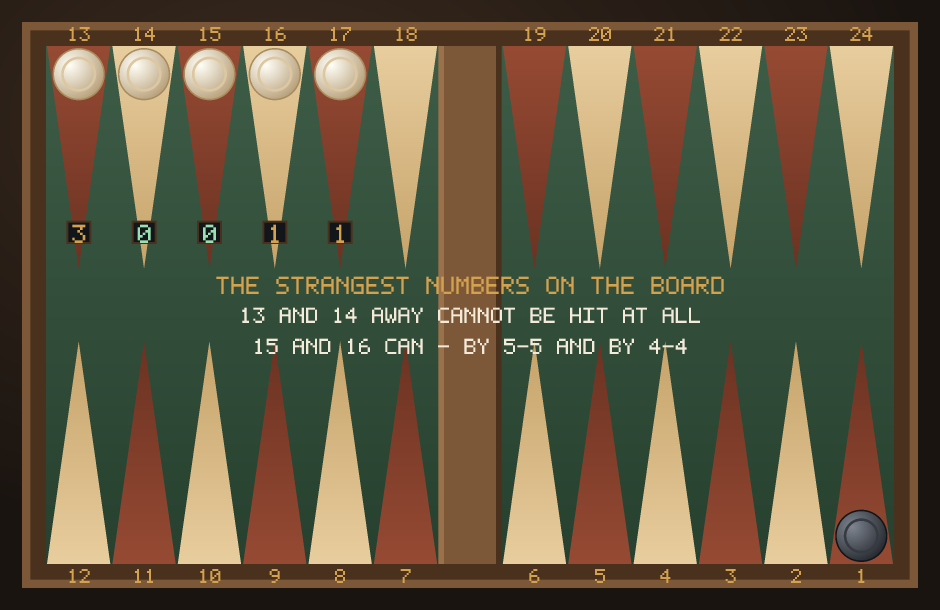
Past twelve, only doubles reach, and doubles land on multiples. That creates gaps in the board that most players have never noticed: a blot 13, 14, 17 or 19 pips from the nearest enemy checker is completely safe — no roll in the game touches it. Meanwhile 15, 16, 18 and 20 are each reachable by exactly one roll: 5-5, 4-4, 6-6 and 5-5 again.
It is worth pausing on how strange that is. A blot fourteen pips away is safer than one sixteen pips away. Distance alone tells you nothing out here; only the arithmetic does. In a long race this occasionally matters — if you are choosing between leaving a checker 14 or 15 pips from a back checker, one of those is free and the other is not.
What a blockade does to the numbers
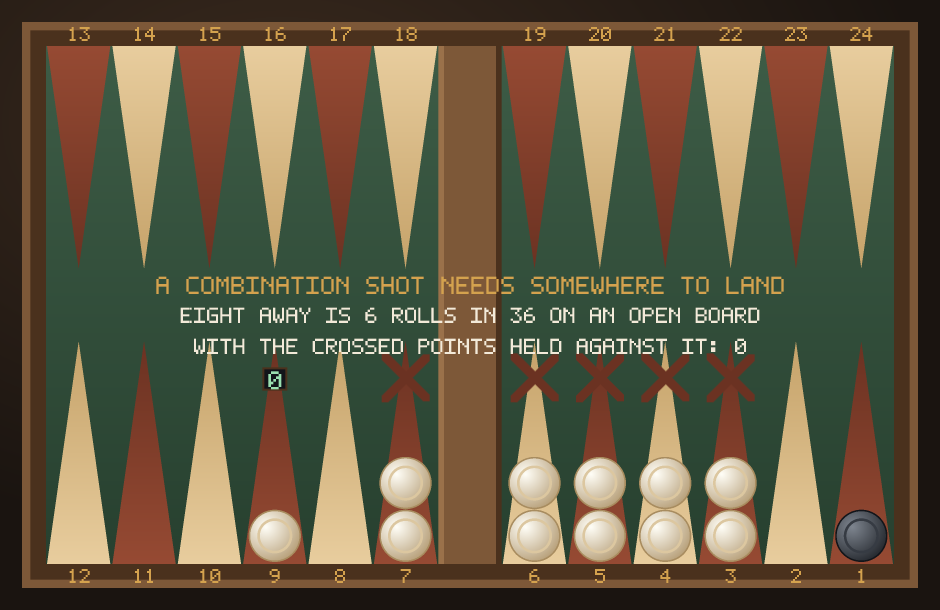
Every table you will find, including the one above, assumes an open board. Real boards are not open, and this is where most published odds stop being true. The rule is simple and it splits the table in two:
- A direct shot cannot be blocked. The checker arrives in one die. Nothing you own in between is even touched, so 11 rolls remain 11 rolls.
- An indirect shot can be blocked completely. It has to land somewhere in the middle, and if you hold every landing point, the shot is gone. An eight-away blot is hit by 6 rolls on an open board and by none at all when the points between are held against the shooter.
Partial blockades matter too. Holding a single landing point in front of a nine-away blot takes it from 5 rolls to 4; in front of a twelve-away blot, holding the point six pips ahead takes it from 3 rolls to 1, because both 6-6 and 3-3 travel through that point and only 4-4 avoids it.
This is the real argument for a prime: a wall of made points does not just trap checkers, it deletes shots. It is also why our computer opponent counts shots against the actual position rather than reading a table — a blot that a chart calls dangerous can be perfectly safe behind the right structure.
Coming in off the bar
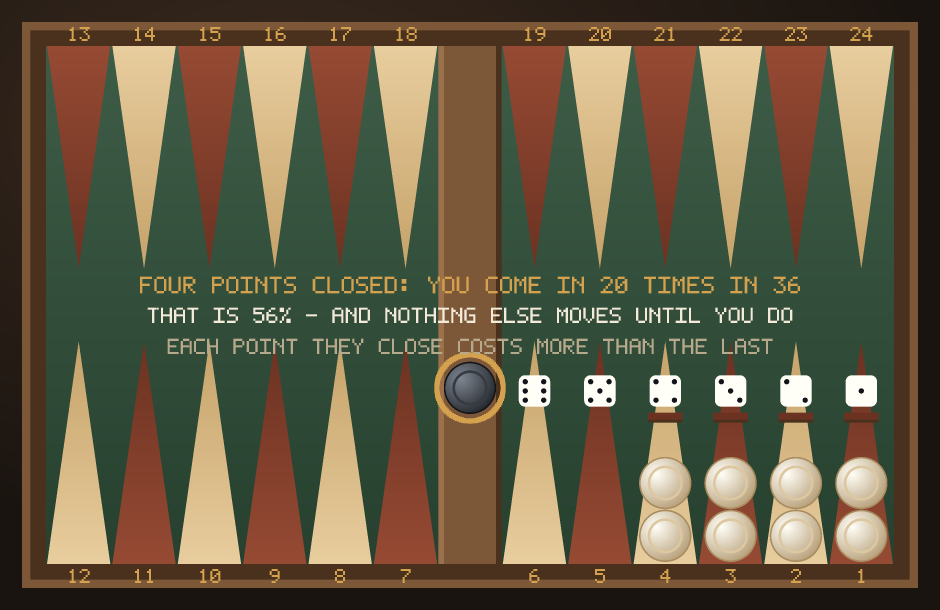
When you are hit, your checker goes to the bar and nothing else moves until it comes back in. It re-enters in the opponent's home board, on the point matching a die, and any point they hold with two or more checkers is shut to you. The odds follow a clean pattern:
| Points closed | Rolls that enter | Chance |
|---|---|---|
| 0 | 36 | 100% |
| 1 | 35 | 97.2% |
| 2 | 32 | 88.9% |
| 3 | 27 | 75.0% |
| 4 | 20 | 55.6% |
| 5 | 11 | 30.6% |
| 6 | 0 | closed out |
The pattern is 36 minus the square of the number of closed points, because you fail only when both dice land on shut numbers. That squaring is why the last point hurts so much more than the first: going from one closed point to two costs you three rolls, but going from four to five costs you nine. A five-point board is not "a bit worse" than a four-point board — it is more than twice as bad.
With two checkers on the bar the arithmetic is harsher still, since both have to come in before you may play anything else. This is the whole point of the blitz: every point you close raises the price of the next one.
The dice themselves
Underneath every table above sit four numbers worth knowing by heart:
| Event | Rolls | Chance |
|---|---|---|
| Any double | 6 of 36 | 16.7% — one roll in six |
| One specific double, e.g. 6-6 | 1 of 36 | 2.8% |
| A specific number appears, e.g. any 6 | 11 of 36 | 30.6% |
| Either of two numbers appears | 20 of 36 | 55.6% |
| Average pips per roll | — | 8.17 |
The average of 8.17 pips is the number that makes a race calculable. A plain roll gives seven pips on average; doubles are played four times, so they drag the average above eight. If you are forty pips behind with twenty rolls left in the game, you are not behind by a little — you are behind by five rolls, and no amount of careful play closes that without a hit.
One warning about the 11-in-36 figure: it is the chance that a number appears, not the chance you can use it. A six on the dice is worth nothing if every six-point landing spot is occupied, which is exactly what a blockade is for.
When two checkers are shooting
Shots do not simply add up. If two enemy checkers both bear on the same blot, the rolls that hit overlap, so the total is always less than the sum of the parts — but it is still a great deal more than either alone:
- From 3 and 6 pips away: 28 of 36 — 77.8%. Individually those are 14 and 17.
- From 4 and 5 pips away: 26 of 36 — 72.2%.
- From 1 and 6 pips away: 24 of 36 — 66.7%.
- From 2 and 4 pips away: 23 of 36 — 63.9%.
Two direct shots on the same blot means it survives roughly one time in three. That is the arithmetic behind the advice to break contact when you are ahead in the race: it is not caution, it is that a blot under double coverage is very nearly a checker you have already lost.
Using the numbers at the board
Nobody plays with a table open. What survives contact with a real game is four rules of thumb, all of which come straight out of the figures above:
- Inside six, closer is safer — but not by much. The spread runs from 11 rolls to 17. If both of your options are direct shots, pick the shorter one, then stop thinking about it and pick by position instead.
- One pip past six is worth a lot. Six to seven takes you from 17 rolls to 6. If you can spend one pip to get out of direct range, spend it.
- Eleven is the quiet spot. Two rolls in 36. Twelve is worse than eleven, and nine is worse than ten — the doubles make the curve bumpy, so do not assume it falls smoothly.
- Count what the blockade removes, not just the distance. An indirect shot over ground you control is often no shot at all.
And one habit worth more than any of them: before you leave a blot, ask what happens if it is hit. A 17-roll shot that costs you eight pips is a far smaller problem than a 6-roll shot that sends you back behind a five-point prime. Probability is only half of a decision; the other half is the size of the loss. Our backgammon quiz has a few positions that turn on exactly that trade-off.
Where these numbers come from
Most odds pages copy the same handful of figures from an older odds page. These were computed, and here is exactly how, so you can decide how much to trust them.
The counts come from the shot-counting function inside the engine that runs the games on this site — the same one our computer opponent uses to decide whether a blot is safe. It walks all 36 rolls and, for each, checks whether the opponent can reach the blot: directly with either die, as a combination through an open intermediate point, or with a double in up to four steps along a clear path. The entering-from-the-bar figures come from the rules engine's own move generator, by asking it for the legal moves of every one of the 36 rolls and counting the answers.
Two independent checks back that up. The shot counter was tested against a brute-force oracle across tens of thousands of positions with no disagreement, and the sixteen values that appear in the published backgammon literature — 11, 12, 14, 15, 15, 17 for the direct shots and 6, 6, 5, 3, 2, 3 for the indirect ones, plus the single-double distances — all match. The entering table reproduces the 36 − n² formula exactly, although it was never given that formula: it was counted from the rules.
The diagrams on this page are generated by the same code, so the figures printed on the boards cannot drift away from the figures in the text, and neither can drift away from the game you actually play here.
Quick reference
| Most dangerous distance | 6 away — 17 rolls, 47.2% |
| Safest direct shot | 1 away — 11 rolls, 30.6% |
| Safest realistic distance | 11 away — 2 rolls, 5.6% |
| Cannot be hit at all | 13, 14, 17, 19, and 21 or more |
| Direct shot | 1–6 pips: one die reaches, cannot be blocked |
| Indirect shot | 7+ pips: needs both dice and an open landing point |
| Entering with 4 points closed | 20 of 36 — 55.6% |
| Any double | 6 of 36 — 16.7% |
| Average roll | 8.17 pips |
Questions people ask
What are the chances of hitting a blot in backgammon?
It depends entirely on the distance. A blot one point away is hit by 11 of the 36 rolls, six points away by 17, and nine points away by only 5. Anything within six points is a direct shot and is hit by at least 11 rolls; beyond six the numbers fall away quickly.
What is the most dangerous distance to leave a blot?
Six pips away, which is hit by 17 of the 36 rolls — 47 percent. That surprises most beginners, who assume that closer is more dangerous. A blot one pip away is hit by only 11 rolls, because a single one is the only die that reaches it.
Can a blot ever be completely safe?
Yes. A blot 13 or 14 pips from the nearest enemy checker cannot be hit at all, and neither can one 17 or 19 away. No combination of two dice makes 13, and no double lands on it either. Oddly, 15 and 16 away can be hit — by 5-5 and 4-4.
What are the odds of rolling doubles in backgammon?
Six of the 36 possible rolls are doubles, so one roll in six, or 16.7 percent. One specific double, such as 6-6, comes up once in 36 rolls, which is 2.8 percent.
How likely am I to come in from the bar?
It depends on how many points your opponent holds in their home board. With one point closed you enter with 35 of 36 rolls, with three closed 27, with four closed 20, and with five closed only 11. If all six are closed you cannot enter at all.
Does a blockade change the hit numbers?
Yes, but only for indirect shots. A direct shot of one to six cannot be blocked, because the checker arrives in a single die. A combination shot needs somewhere to land in between, so holding the points between the checkers can reduce an eight-away shot from 6 rolls to none at all.
How many pips does an average roll give me?
8.17 pips. A non-double roll averages seven pips, and doubles are worth double their face value across four moves, which lifts the overall average above eight.
What is the difference between a direct shot and an indirect shot?
A direct shot is six pips or fewer, so a single die can reach it. An indirect or combination shot is seven or more and needs both dice, which means it also needs an open landing point in between. Direct shots are far more dangerous: the safest direct shot is hit by 11 rolls, the most dangerous indirect one by 6.
Put the odds to work — play a free game
Next: backgammon strategy turns these numbers into plans, the opening moves guide shows the best reply to all 15 first rolls, the doubling cube guide shows what to do with an advantage once you have one, and the complete rules cover everything the dice can do. If knowing the odds still leaves you losing, luck or skill measures how many games it takes before better play actually shows in the score. For the endgame there is no need to estimate at all: the bear-off calculator solves any race outright and tells you how many rolls each side still needs.