How to Set Up a Backgammon Board
The starting position, the direction of play, and the mistakes that catch people out
Last updated
A backgammon board is set up the same way every single game: four stacks per player, fifteen checkers each, mirrored on both sides. This page shows exactly where every checker goes, which way each player moves, how to check in five seconds that you got it right, and why the position looks the way it does. If you want the rest of the game, read the how-to-play guide or the complete backgammon rules — or just play a free game here, where the board sets itself up.
What you need
- A board with 24 narrow triangles, called points, and a raised ridge down the middle called the bar.
- 30 checkers — fifteen per player, in two contrasting colours. They are also called stones, counters, pieces or men; on this site they are ivory (White) and dark (Black).
- Two dice per player, usually with a cup each. Casual players often share one pair and pass it back and forth.
- A doubling cube — a six-sided block marked 2, 4, 8, 16, 32 and 64. It is only used in match and money play, and it is not part of the starting position: it sits on the bar or beside the board, showing 64.
Nothing else is needed. There is no board that requires a different number of checkers for the standard game — if a set came with 24 or 20 pieces, it is either a set for a different game entirely or pieces have gone missing over the years.
The board explained
The 24 points are grouped into four quadrants of six. Each player has a home board (also called the inner board) and an outer board. The bar separates them. Your fifteen checkers travel toward your own home board, and once all fifteen have arrived you start taking them off — that is how a game is won.
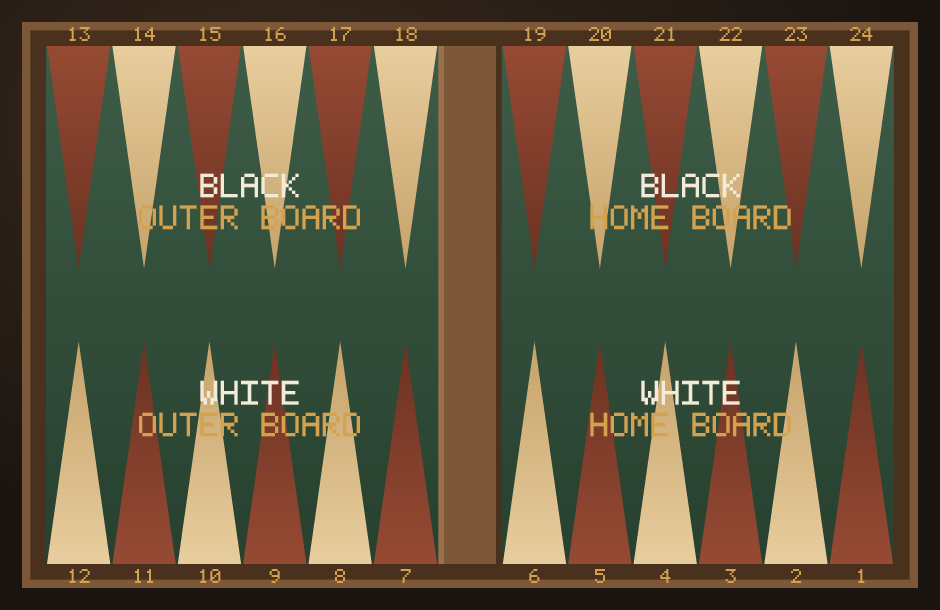
Points are numbered from each player's own point of view: your 1-point is the furthest point inside your home board, and your 24-point is the far corner of the board, deep inside your opponent's home. That means your 1-point is your opponent's 24-point. This sounds confusing written down and becomes obvious the moment you look at a board — every checker of yours is simply counting down toward 1.
That double numbering is the single thing that trips up beginners reading instructions, so it is worth saying plainly: when a guide says “the 13-point” without naming a player, it means each player's own 13-point, and the two are on opposite sides of the board.
The starting position
Each player places their fifteen checkers on four points. The numbers are the same for both players, counted from their own side:
| Point | Checkers | What it is called |
|---|---|---|
| 24-point | 2 | Your back checkers, in the opponent's home board |
| 13-point | 5 | The midpoint — your biggest stack |
| 8-point | 3 | The 8-point, just outside your home board |
| 6-point | 5 | The outer edge of your home board — these are already home |
That is 2 + 5 + 3 + 5 = 15. Most players remember it as the rhythm “two, five, three, five” counting down from 24. Your opponent's checkers sit on the mirror image of those four points, which is why the finished board looks symmetrical when you turn it around.
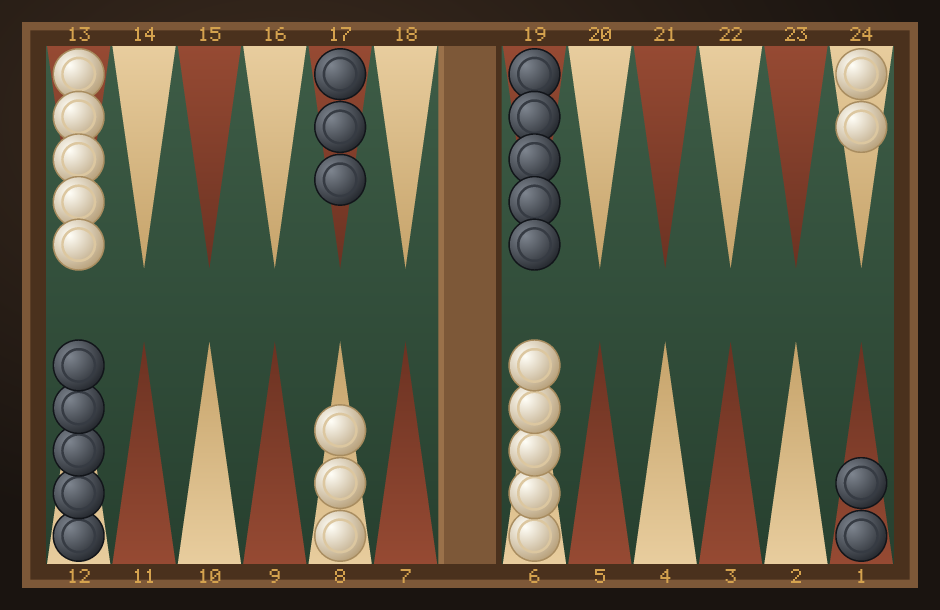
The starting position by the numbers
A pip is one step. A checker's pip number is how many steps it still has to make before it can come off the board, and your pip count is the total for all fifteen. It is the plainest measure of who is ahead in the race, and at the start it is identical for both players. We computed the following straight from the game engine that deals the board on this site, so the figures match the position you are actually shown.
| Stack | Checkers | Pips each | Pips in total |
|---|---|---|---|
| 24-point | 2 | 24 | 48 |
| 13-point | 5 | 13 | 65 |
| 8-point | 3 | 8 | 24 |
| 6-point | 5 | 6 | 30 |
| All fifteen | 15 | — | 167 |
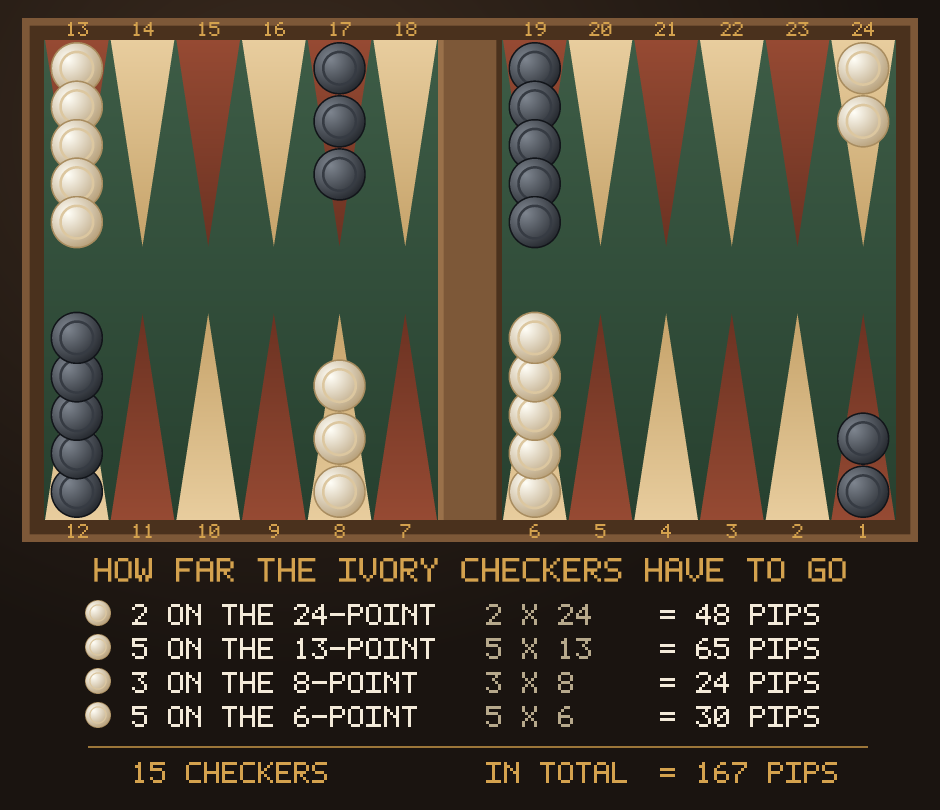
Three things fall out of that table that are worth knowing before your first game:
- The average checker has 11.1 pips to travel, but the spread is enormous: your two back checkers each face 24 pips, while the five on your 6-point need six apiece. Backgammon is not fifteen equal journeys, it is two long ones and thirteen short ones.
- The midpoint is the heaviest single commitment on the board — five checkers at 13 pips is 65 pips, more than a third of your whole count. That is why what you do with the 13-point shapes the entire opening.
- You start with no blots. A blot is a lone checker, which can be hit and sent back to the bar. At the start you have four points held by two or more checkers and not a single one exposed. The very first roll usually changes that.
One more number that surprises people: 20 of the 24 points are empty for you at the start, and you hold only one of the six points in your own home board. A finished home board is six points held. You begin with one.
Which way do you move?
The two players move in opposite directions. Each of you always moves toward your own home board, counting downward: 24 toward 1. Because the two home boards sit in the same quarter of the table, the paths run head-on into each other — which is the whole reason backgammon is a fight and not just a race.
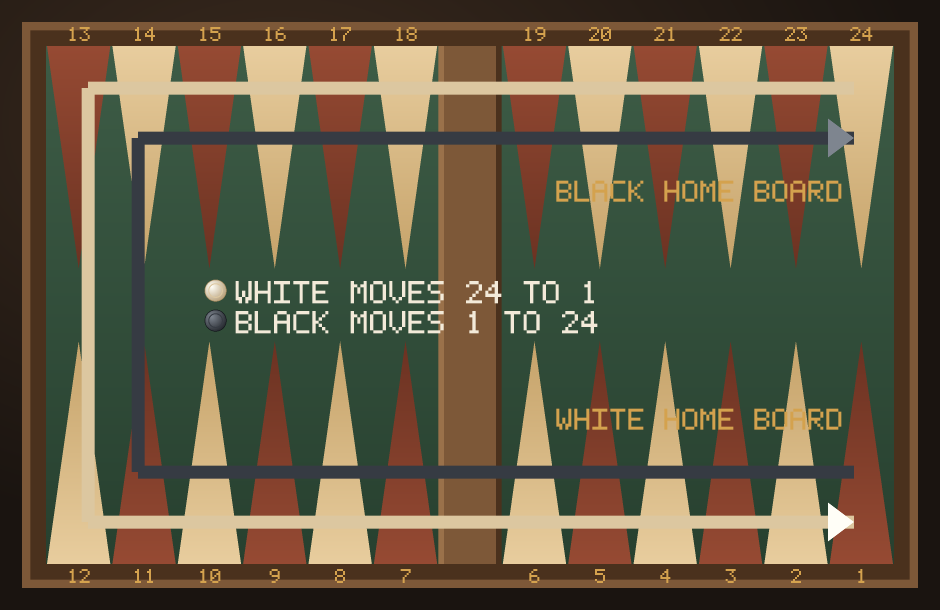
Your two back checkers on the 24-point have the longest journey — they must cross the entire board. The five on your 6-point are already home. This lopsided start is deliberate: it gives both players something to attack and something to defend from move one.
There is no rule about which physical direction that is — clockwise or anticlockwise depends purely on which side of the table you are sitting and which side the home boards are on. What is fixed is the relationship: toward your own home, away from your opponent's.
Set it up in four steps
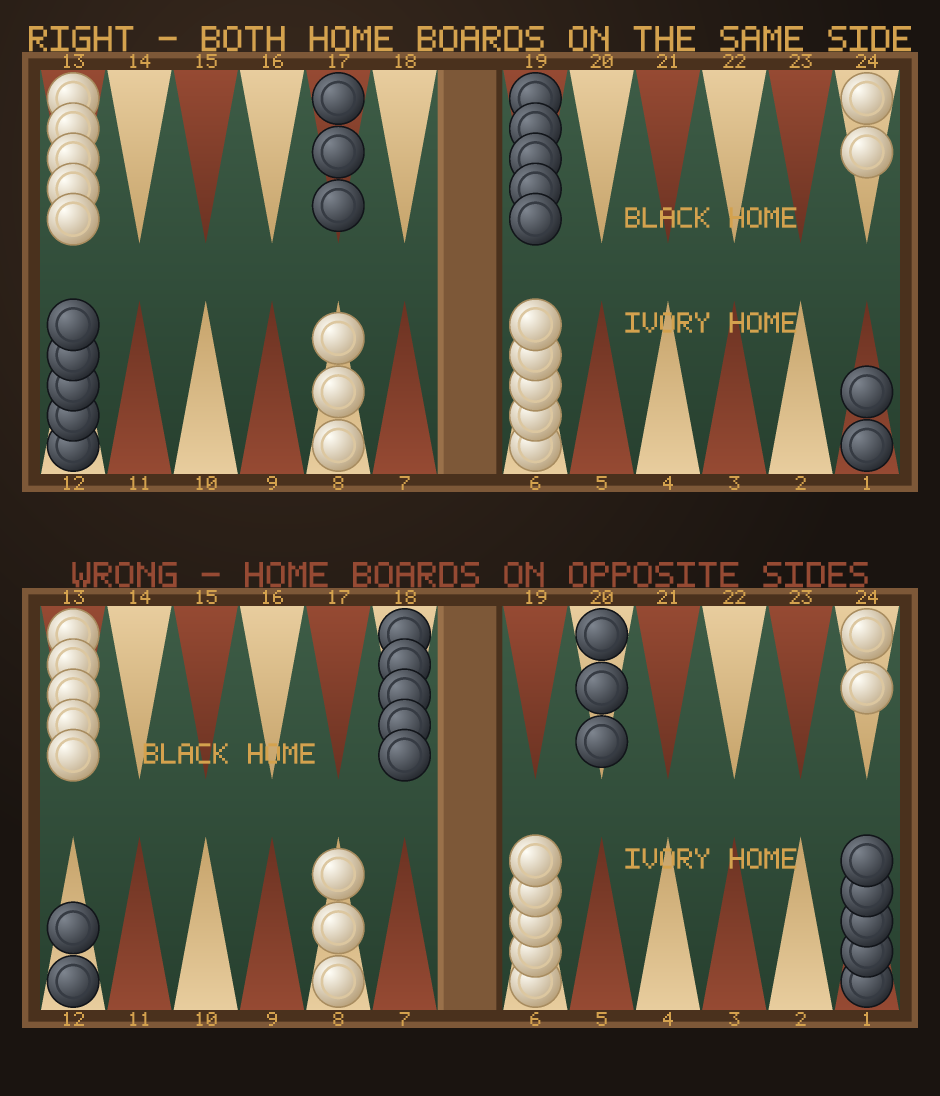
- Place the board between both players with the bar running down the middle. Agree which side holds the home boards — left or right does not matter, but both home boards must be on the same side. Traditionally they face the light.
- Two checkers on your 24-point, the point furthest from your home board. Both players' back checkers end up sitting in the opponent's home board, side by side.
- Five on your 13-point, three on your 8-point. The 13-point is directly opposite your back checkers, on your side of the bar.
- Five on your 6-point. Count that you have used all fifteen, then check that your opponent's stacks mirror yours exactly.
Playing online, none of this is manual: the board is dealt out for you, and every legal move is highlighted while illegal ones are simply refused.
▶ Play backgammon nowHow to check you got it right
Two checks, either of which catches every ordinary setup error in a few seconds.
The mirror check works because the starting position is symmetrical under a half-turn of the board. It catches a swapped stack, a miscount and a checker left in the box. What it does not catch is both players making the same mistake, which is rare, or the home boards being on opposite sides — for that, look at where the two five-stacks nearest each player sit.
The pip check. If you know the pip count, count it: the answer is always 167 before the first roll. Add up each stack as checkers times point number — 2×24 + 5×13 + 3×8 + 5×6 — and you should land on 167 exactly. Any other number means a checker is on the wrong point. This is also the first bit of real backgammon arithmetic most players learn, and it is the same skill you will use to decide races later; the bear-off calculator does it for you on any position you build.
Common setup mistakes
- Home boards on opposite sides. The single most common error, and the only one that makes the game unplayable rather than merely wrong. If your home board is on the right and your opponent's is on the left, both of you will be moving the same way round and your checkers will never meet properly. Fix it by rotating one player's whole setup, as below.
- Swapping the 3 and the 5. Three checkers belong on the 8-point and five on the 6-point, not the other way round. The mirror check catches this instantly.
- Counting from the wrong end. The 24-point is your far corner, not the corner nearest you. If your two back checkers are sitting in your own home board, you counted from the wrong side.
- Fourteen or sixteen checkers. Count the stacks before starting rather than discovering a missing checker at bear-off, when it is too late to do anything about it.
- Placing the doubling cube on a point. It is not a checker. It belongs on the bar or beside the board, showing 64 — which means “still at 1”.
- Rolling both dice to decide who starts. Each player rolls one die, and the winner plays those two numbers as their first move. Rolling two each and comparing totals is a house habit, not the rule, and it changes the opening.
Set up, and now the rules in brief
A lot of people arrive here wanting the setup and enough rules to start playing. Here is the whole game in six lines; the complete backgammon rules cover every case, including the ones that are easy to get wrong.
- Roll and move. The two dice are two separate moves. A 5 and a 3 means moving one checker five points and another three, or one checker five then three. Doubles are played four times, not twice.
- You must use both dice if you legally can, and if only one of the two can be played, you must play the higher one. This is the rule beginners break most often.
- A point with two or more enemy checkers is closed to you. You cannot land there, however you arrange the dice.
- Landing on a lone enemy checker hits it, sending it to the bar. It re-enters in your opponent's home board and starts its journey again — and a player with a checker on the bar must bring it in before moving anything else.
- When all fifteen of your checkers are home, you bear off, taking checkers off with the matching numbers. First player to remove all fifteen wins.
- The doubling cube lets either player offer to double the stake; the opponent either takes it or gives up the game at its current value. It is optional in casual play.
Once those are comfortable, the natural next steps are the best opening moves for all fifteen first rolls and the strategy guide. If you would rather be tested than told, the backgammon quiz covers setup, terms and rules.
Why the position looks like this
The 2-5-3-5 arrangement is not arbitrary and it is not modern. It is the position the game settled on because it produces an interesting first move almost every time, and you can see why in the shape of it: the two most valuable points on the board start empty. Your 5-point and 4-point — the ones that block an opponent trying to escape from your home board — belong to nobody. The opening is a scramble to claim them.
Meanwhile the two back checkers on the 24-point are in trouble from move one: they sit in the opponent's home board, the place their opponent most wants to fill. The whole opening tension is that both players want to build at the front and rescue at the back with the same two dice.
A number that shows how much room the position leaves: counting distinct resulting positions, the opening roll can be played in 7 to 18 different ways depending on the numbers — 4-2 has 18 legal ways to play it, 6-5 has only 7, and the average across the fifteen possible opening rolls is 12.7. Almost none of those are good; that is what makes the opening worth studying. We have worked through all fifteen opening rolls with the standard play for each and the reasoning behind it.
Note that the first roll can never be a double, because it is made of one die from each player and equal numbers mean a re-roll. Doubles only arrive from the second turn onward — and when they do, the position opens right up: from the starting position a 2-2 can be played 75 different ways.
Setting up the other boards
Everything above is standard backgammon. The variants you can play on this site change the starting position and nothing else about how checkers move — except Acey-Deucey, which changes the rules too. All four figures below come from the same engine that deals the boards.
| Game | Checkers | Starting position | Starting pips |
|---|---|---|---|
| Backgammon | 15 | 2 on 24, 5 on 13, 3 on 8, 5 on 6 | 167 |
| Nackgammon | 15 | 2 on 24, 2 on 23, 4 on 13, 3 on 8, 4 on 6 | 194 |
| Hypergammon | 3 | 1 on 24, 1 on 23, 1 on 22 | 69 |
| Acey-Deucey | 15 | Empty board — all fifteen start off to the side | 375 |
Nackgammon moves one checker from your 6-point and one from your 13-point back to the 23-point, giving each player four checkers to rescue instead of two. Those 27 extra pips make for a longer, more positional game — it was invented by the American champion Nack Ballard to force his students to play position rather than race.
Hypergammon gives each player three checkers on the 24-, 23- and 22-points, and almost every game becomes a running fight. Acey-Deucey starts with nothing on the board at all: both players bring fifteen checkers in from the side as the game goes on, which is why its starting pip count is the largest of the four. A full list of the family, including regional games we do not deal such as Plakoto and Fevga, is in the variants guide.
Is the setup the same everywhere?
Yes. The starting position for standard backgammon is identical in the UK, the US, Europe and everywhere else the standard game is played, and it is the same in casual games, in club and tournament play and online. There is no British setup and no American setup.
It is also the same game under other names. If you learned it as shesh besh (from the Persian and Turkish for "six five", common across the Middle East and in Israel) or as tavla in Turkey, tavli in Greece or nardi in the Caucasus and Central Asia, the board and the opening position on this page are the ones you want. Those names sometimes travel with a different game played on the same board — Greek tavli is three games in sequence, and long nardy starts every checker on one point — and where that is the case our variants guide says which is which. For the game most people mean, the setup does not change with the name.
What genuinely does vary between tables is a handful of optional conventions, none of which touch where the checkers start:
| Convention | What it does | Standard? |
|---|---|---|
| Automatic doubles | Tied opening rolls double the stake before play | Money play only, by agreement |
| The Jacoby rule | No gammons or backgammons unless the cube has been turned | Money play only |
| Beavers | A player offered a double may immediately redouble and keep the cube | Money play only |
| The Crawford rule | No doubling in the game after a player reaches match point | Standard in match play |
All of those concern the doubling cube rather than the board. Agree them before you start rather than halfway through; they do not change a single checker's starting point.
What the parts are called
Setup instructions use a small vocabulary, and it is worth having it straight before reading anything else about the game.
| Term | What it means |
|---|---|
| Point | One of the 24 triangles. Also the unit of scoring in a match. |
| Checker | One of your fifteen pieces. Also called a stone, counter, piece or man. |
| Bar | The ridge down the middle. Hit checkers wait here to re-enter. |
| Home board | Points 1 to 6 — the quarter you are moving everything toward. Also called the inner board. |
| Outer board | Points 7 to 12, on your side of the bar. |
| Midpoint | Your 13-point, where five checkers start. |
| Back checkers | The two on your 24-point, deep in the opponent's home board. |
| Blot | A lone checker on a point. It can be hit. |
| Made point | A point held by two or more of your checkers. The opponent cannot land there. |
| Pip | One step. Your pip count is the total distance your fifteen checkers still have to travel — 167 at the start. |
| Bear off | Removing checkers from the board once all fifteen are home. |
Questions people ask
How many checkers does each player have in backgammon?
Fifteen each, thirty on the board in total. They start in four stacks: two on the 24-point, five on the 13-point, three on the 8-point and five on the 6-point. A set sold with a different number is either a variant set or is missing pieces.
How many pieces are in a backgammon set?
A complete set holds 30 playing pieces — the checkers, fifteen a side — plus four dice (two per player), one doubling cube and usually two dice cups: 37 items in all, though only the 30 pieces go on the board. "Pieces" is the everyday word for what the rules call checkers; you will also see them called stones, counters, draughtsmen or men. If you are counting a second-hand set before buying, thirty checkers and a cube are the parts that are actually hard to replace.
How many pieces go on the board at the start?
All thirty. Backgammon has no reserve and nothing is held back — every piece is placed before the first roll, spread over eight of the twenty-four points, four for each player. The other sixteen points start empty.
How do you set up a backgammon board for two players?
Backgammon is always a two-player game, and the two setups are mirror images of each other. Sit opposite your opponent, agree which side the home boards are on — both on the same side, left or right, it only has to match — and each of you places fifteen pieces on your own 24-, 13-, 8- and 6-points. If your stacks face each other in the same pattern, the board is right.
What is the backgammon starting position?
Two checkers on your 24-point, five on your 13-point, three on your 8-point and five on your 6-point. Your opponent mirrors it exactly, so every occupied point faces an identical enemy stack across the board.
Which direction do the checkers move?
Each player moves toward their own home board, so the two players move in opposite directions around the board. White travels from the 24-point down to the 1-point; Black travels the same path the other way.
Does it matter which side the home board is on?
It does not matter whether you both choose the left or the right side, but both home boards must be on the same side of the board. If they are not, the setup is wrong and the two players will be moving the same way round.
Who goes first in backgammon?
Each player rolls a single die. The higher number goes first and plays both dice as the opening move, so the first turn can never be a double. If the numbers are equal, both players roll again.
What is the pip count at the start of a backgammon game?
167 pips for each player. It is the sum of every checker's distance home: two checkers 24 pips away is 48, five at 13 is 65, three at 8 is 24 and five at 6 is 30. Both players start dead level.
Is the backgammon setup the same in the UK and the US?
Yes. The starting position is identical everywhere the standard game is played, and it is the same in tournaments, in casual play and online. Only the variants change it.
Is the starting position the same in every backgammon variant?
No. The 2-5-3-5 position is standard backgammon. Nackgammon starts on 194 pips, Hypergammon gives each player three checkers on 69 pips, and Acey-Deucey starts with an empty board and all fifteen checkers off to the side.
Where does the doubling cube go at the start?
On the bar or beside the board, showing 64. It is not a checker and it never sits on a point. The 64 face means the cube has not been turned yet, so the game is worth one point.
How do I know I set the board up correctly?
Every occupied point should face an identical enemy stack across the board: two against two, five against five, three against three, five against five. If one pair does not match, a stack is on the wrong point.
Which points are empty at the start of a backgammon game?
20 of the 24 points are empty for you at the start. You hold only four points, and just one of them is inside your home board, which is why the opening moves are a race to claim the 5-point and the 4-point.
Do I have to set up the board when playing online?
No. The starting position is dealt automatically, the dice are rolled by the server, and every rule is enforced for you, including the ones that are easy to get wrong, such as having to play the higher die when only one of the two can be played.
Now play a game
Setting up is the easy part; the game itself is where it gets interesting. Play the computer on three levels, invite a friend with a private link, or find a live opponent — free, no signup, and the board is already set up for you.
▶ Play backgammon nowLearn more: the how-to-play walkthrough, the complete backgammon rules, the best opening moves, our strategy guide, and the odds behind every hit.
← Back to the game