American vs European vs Mexican Acey-Deucey
Three rule sets in one family — and where the sources disagree
Last updated
Ask three people how acey-deucey works and you may get three answers. That is not confusion: there really are several rule sets in circulation, and the differences are not cosmetic. This page lays the American, European and Mexican versions side by side, shows what each does with the famous 1-2, and — because it matters — says plainly which points the available sources contradict each other on.
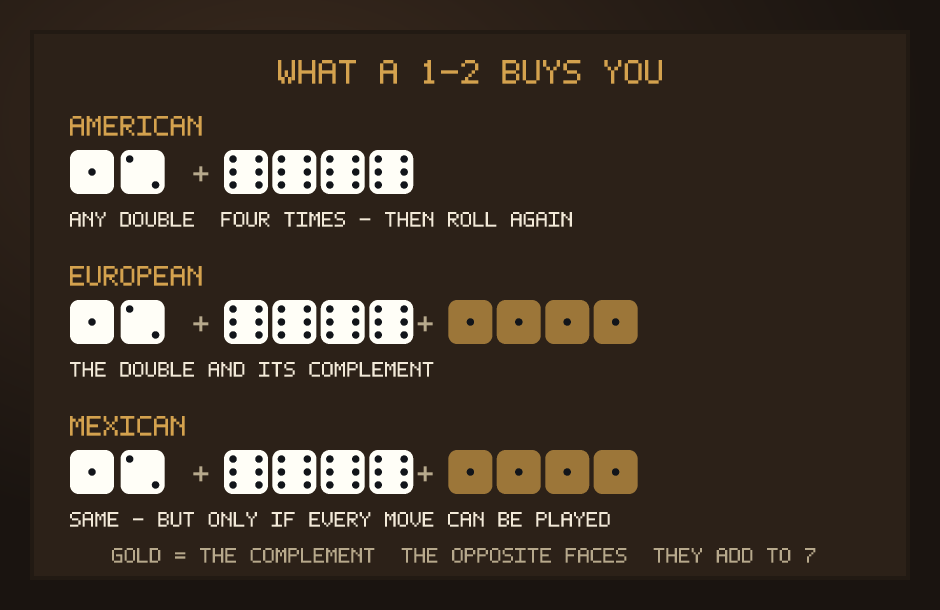
One family, three rule sets
All three versions share the same skeleton, and it is what makes them acey-deucey rather than backgammon:
- every checker starts off the board and enters in the opponent's home board,
- a roll of 1 and 2 is the special roll and buys a double of your choice,
- bearing off needs an exact number,
- there is no doubling cube and there are no gammons.
What differs is what exactly the 1-2 pays out, and — in the Mexican version — two extra restrictions that change how the whole board is used.
The differences at a glance
| American | European | Mexican | |
|---|---|---|---|
| Start | all fifteen checkers off the board | ||
| Entering | in the opponent's home board | ||
| A played 1-2 | name any double, play it 4×, roll again | name a double, play it and its complement, roll again | name a double, play it 4× and the complement 4×, roll again |
| Ordinary doubles | 4 moves, then roll again | the number and its complement | 4 moves, then roll again |
| Bonus can be lost | if both 1 and 2 cannot be played | same | same — and, by most descriptions, if any of the bonus moves cannot be played |
| Checkers per point | no limit | no limit | five |
| Order of the dice | free | free | lower number first, or the turn is lost |
| Bearing off | exact number only | ||
| Cube / gammons | none / none | ||
American acey-deucey
The version of the U.S. Navy, and the one almost everyone means online. A played 1-2 lets you name any double from 1-1 to 6-6, play it four times, and then roll again. Every ordinary double also earns another roll. Entering is optional — a checker already on the board may move while others wait in hand.
It is the best documented of the three and the one played on this site; the full rules are on the acey-deucey page, the tactics in the strategy guide, and the measured odds here. Its history is worth a page of its own: how the Navy made it its own.
European acey-deucey
The European game keeps the same frame and changes the payout: when you name a double, you play it and its complement — the opposite faces of the die. Name 6-6 and you play four sixes and four ones. Most descriptions extend the same idea to ordinary doubles: the numbers on top are played, then the numbers underneath.
That single change makes the European bonus both larger and less free. Larger, because it is always 28 pips rather than up to 24; less free, because you cannot simply take the biggest number — you are always taking a big number and a small one together, and the small one has to go somewhere.
Mexican backgammon
Mexican backgammon — where the 1-2 is called a Mexican — takes the complement rule and adds two restrictions that no other version in this family has:
- At most five checkers on a point. A sixth may not land there, so you cannot park a stack out of harm's way.
- The lower number must be played first. If it cannot be played, the turn is lost — even when the higher number had a perfectly good move.
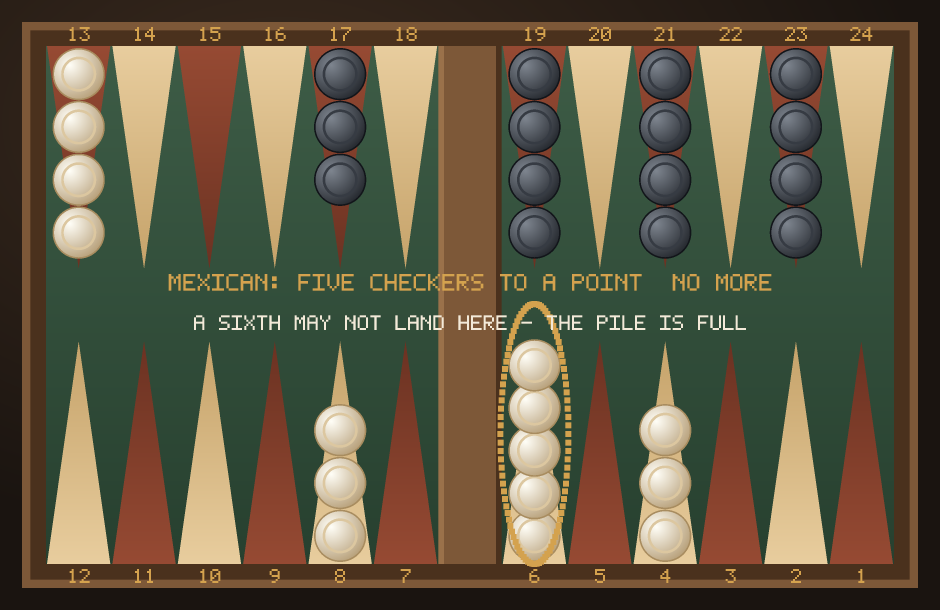
Both rules push in the same direction: they take away hiding places. You cannot bury spare checkers on a tall point, and you cannot choose the order that keeps you safe. Most accounts also say the bonus is only paid if every move of it can be played, which makes it far easier to lose than the American one.
The 28-pip quirk
Here is something the rule pages never point out, and it changes how the European and Mexican bonus should be played. Opposite faces of a die always add to seven. So four of your chosen number plus four of its complement is:
4 × n + 4 × (7 − n) = 4 × 7 = 28 pips
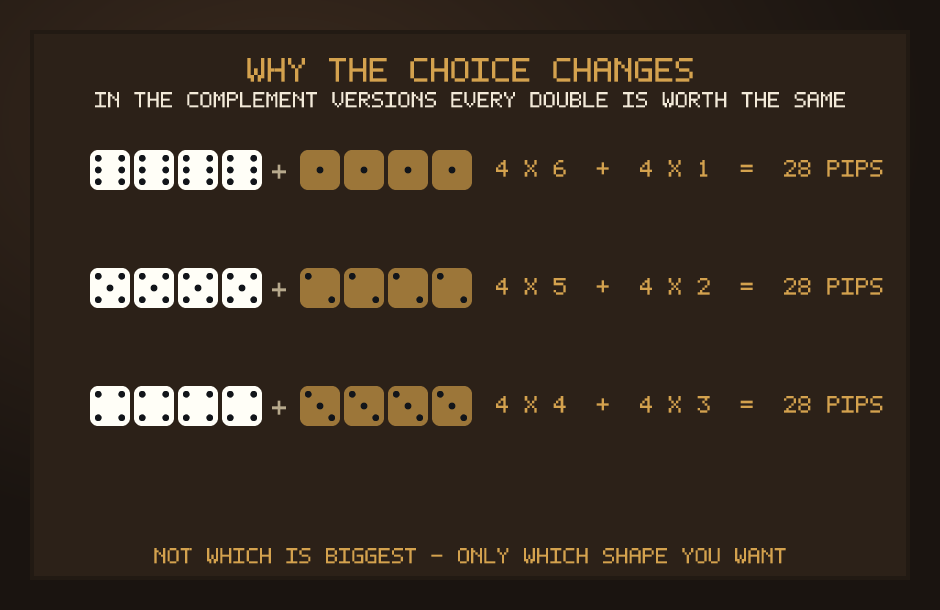
Every choice is worth the same. Naming 6-6 in the European or Mexican game gains you nothing in distance over naming 4-4; you are simply choosing between four long moves and four short ones, or something in between. The question stops being "which is biggest" and becomes "which shape do I want" — which points can I make, which checkers can I free, which numbers fit the board in front of me.
In the American game the opposite is true: the choice is about size, but only up to how much of it you can actually play. Our own measurement over 500 games found the chosen double moved 18.4 pips on average, not 24 — the board eats the difference.
Where the sources disagree
We would rather show you the seams than pretend there are none. Writing this page, the available sources conflicted on three points:
- Whether the European complement applies to ordinary doubles or only to the bought one. Some descriptions say every double is played as the number plus its complement; others mention the complement only for the double bought after a 1-2.
- Whether the extra roll survives a partly playable bonus. Mexican descriptions say the roll follows only if every move can be made; the American rule is only that the 1 and the 2 must both be played.
- How much of this is codified at all. The American version appears in reference works and in a 1951 U.S. Naval Institute article; the European and Mexican versions live almost entirely on hobby sites, without an authority behind them.
Practical consequence: agree the rules before the first roll. If you are playing someone who learned the game elsewhere, the two of you may be playing different games without noticing until a 1-2 lands.
Which one should you play?
American if you want the version most people mean, the one with a documented history and the one you can play here against the computer or a friend. It has the freest bonus and the fewest special cases.
European if you like the idea that the bonus is always the same size and the skill is entirely in placement. It rewards players who think in shapes rather than pips.
Mexican if you want the sharpest version: no tall stacks to hide behind, a forced order of play, and a bonus that is easy to lose. It is the least documented and the most demanding.
Questions people ask
What is the difference between American and European acey-deucey?
The bonus. In the American game a played 1-2 lets you name any double and play it four times, then roll again. In the European game you also play the complement of that double — the opposite faces of the die, which always add to seven — so naming 6-6 means four sixes and four ones.
What is Mexican backgammon?
A cousin of acey-deucey in which a 1-2 is called a Mexican. It uses the complement rule, allows at most five checkers on a point, and requires the lower die to be played first — if it cannot be played, the turn is lost. Bearing off needs an exact roll, and there is no doubling cube and no gammon.
What is the complement in acey-deucey?
The number on the opposite face of the die. Opposite faces of a standard die add up to seven, so the complement of 6 is 1, of 5 is 2 and of 4 is 3. In the European and Mexican versions you play the double you name and then its complement four times each.
Which double should you name in European or Mexican acey-deucey?
Not the biggest one — because there is no biggest one. Four of any number plus four of its complement is always 4 x 7 = 28 pips, whichever you choose. The decision is purely about shape: which numbers make points, escape, or fit the board in front of you.
Is Mexican backgammon actually Mexican?
The connection is thin. The rules are an acey-deucey variation, the documentation is sparse and mostly on hobby sites, and no source we could find ties the game to Mexico beyond the name. Treat it as a house version of acey-deucey rather than a national game.
Which version does BackgammonWorld play?
The American one, as it is most consistently documented: everything starts off the board, entering is optional, a played 1-2 buys any double plus another roll, doubles earn another roll, bearing off needs an exact number, and there is no cube and no gammon.
More on this board: the rules and a free game, the strategy guide, the measured odds, the Navy history, and a walk-through of a first game and what else the name means.
← Back to the gameWhich version of acey-deucey is the most common?
The American one, by a wide margin, and it is the one nearly every English-language description means. It is also the version played here: enter from off the board, a 1-2 buys any double plus another roll, and exact numbers are needed to bear off.
Can you play acey-deucey with a doubling cube?
The standard American game has no cube, and neither does ours: every win is one point, so there is nothing for a cube to multiply. Some house rules add one. If you meet a table that uses a cube, ask before the first roll rather than after.
Do gammons count in acey-deucey?
Not in the version played here — a win is a win, worth one point. That is a real difference from backgammon, where a gammon doubles and a backgammon triples, and it changes how you play when you are far behind: there is no gammon to save.
What is the Navy stake rule?
A convention rather than a rule: the loser pays one unit for every checker still not borne off. It turns a heavy loss into an expensive one and is why sailors bore off doggedly in lost games. It is a house rule, it is not part of the game as we ship it, and you should agree it before you start.
Why do the versions disagree so much?
Because the game spread by being played rather than by being written down. Every rule that varies — the complement double, whether an exact roll is needed to bear off, whether a checker in the home board may still move — is a point where one group's habit became another group's rule. Our versions table lists the specific contradictions.
Can I play the European or Mexican version online here?
Not at the moment. BackgammonWorld plays the American version, which is the one the rules and diagrams on this site describe. The others are documented here because the sources contradict each other and somebody has to write down what actually differs.