How to Play Acey-Deucey: Your First Game
One real game, photographed at the five moments that teach it
Last updated
The quickest way to learn acey-deucey is not to read the rules twice — it is to watch one game happen. So we let the computer play a full game against itself and photographed the board at the five moments a beginner needs: entering the first checkers, making a point, a hit, the 1-2 bonus, and bearing off. Every position below is from that game, in the order it happened. When you are ready, the same game is one click away.
Before the first roll
Acey-deucey starts with nothing on the board. Each player holds fifteen checkers beside it and brings them in during play, so there is no starting position to learn — the first thing you will ever do is enter a checker.
Both players roll one die; the higher number starts and plays those two numbers. Everything else about the board — the 24 points, the bar, which direction you move — is ordinary backgammon. If any of that is new, read the board setup first; the full rules of this variant are on the acey-deucey page.
Turn 1 — entering the first checkers
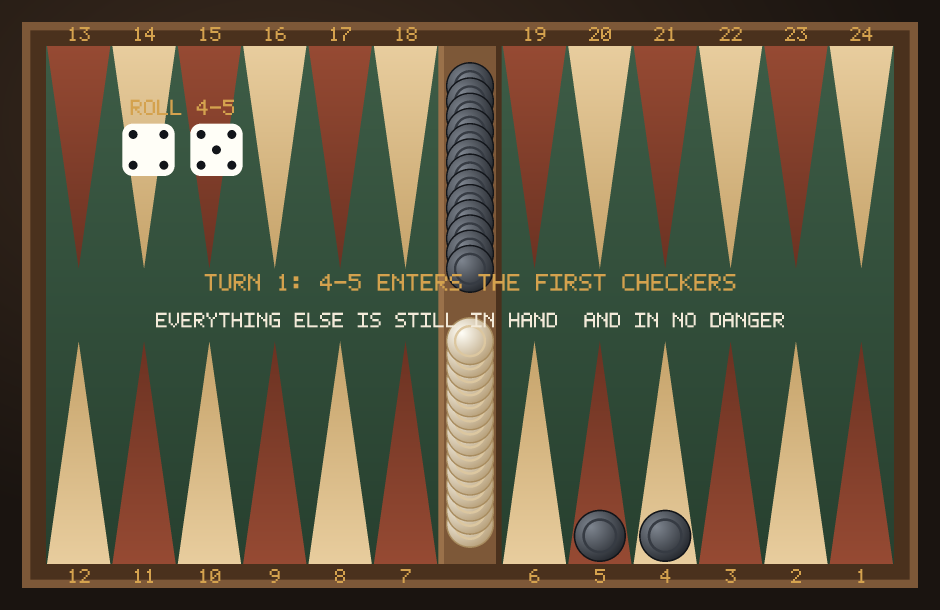
Black wins the opening roll with 4-5 and enters two checkers: the 4 brings one in on the 4-point of the entry board, the 5 on the 5-point. That is the whole entering rule — a die of n comes in on the n-point of the opponent's home board, exactly as a checker enters from the bar in backgammon.
Look at what is not happening in the picture. Thirteen black checkers are still stacked beside the bar, and they are in no danger there. Entering is optional in this game: you never have to bring a checker in, and a checker in hand cannot be hit. That single rule is the biggest difference from backgammon, and the one beginners waste most often by rushing everything onto the board.
Turn 3 — making a point
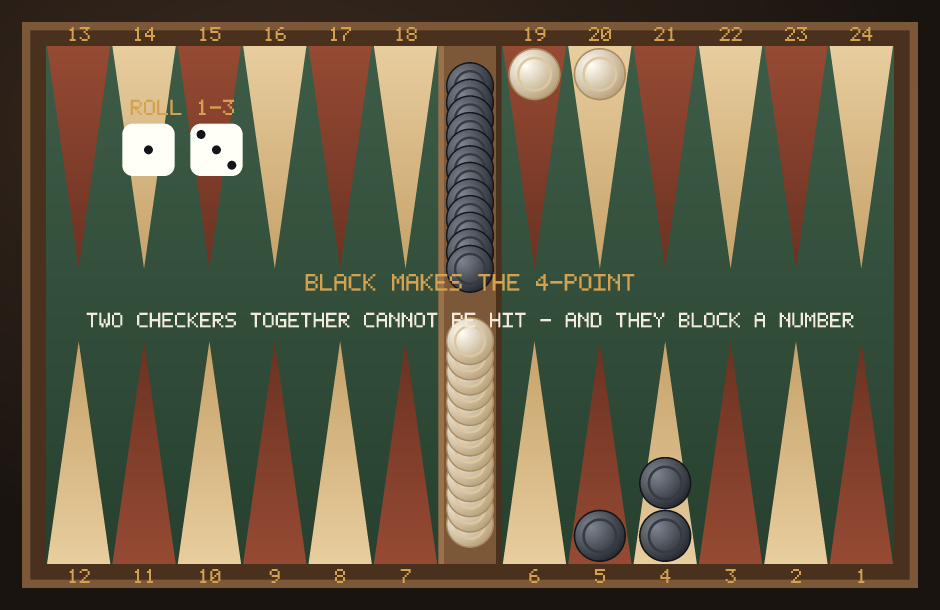
Two turns later Black plays 1-3 and puts a second checker on the 4-point. Two checkers on a point are a made point, and it does two jobs at once: they cannot be hit, and the opponent may no longer enter or land there.
In acey-deucey that second job is worth much more than it looks. White still has most of an army to enter, and every point Black holds in that quarter is an entry number White does not have. Making points in your own home board early is the backbone of acey-deucey strategy.
Turn 6 — a hit, and the bar
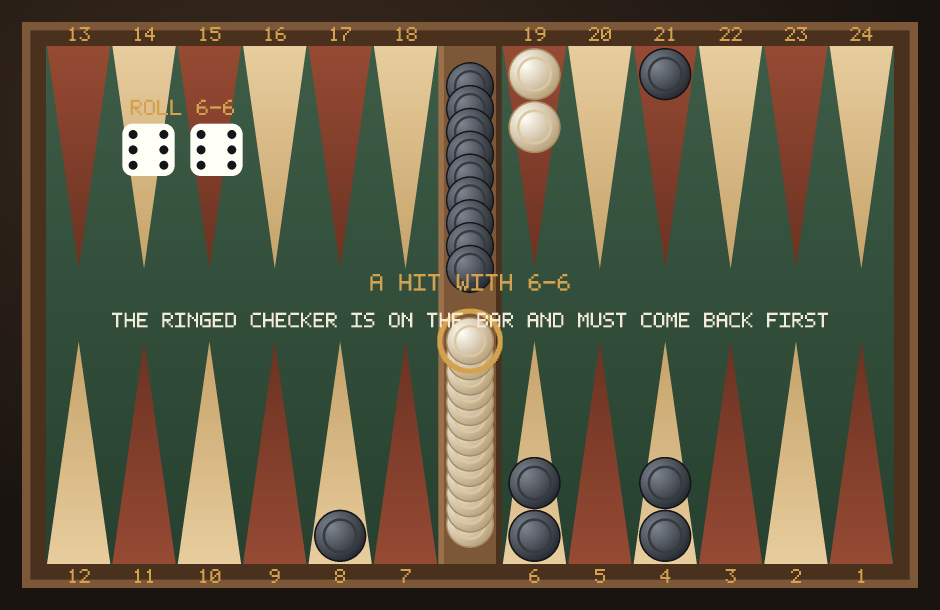
Black rolls 6-6 — four sixes — and one of them lands on a lone White checker. A single checker on a point is a blot; landing on it sends it to the bar (ringed in gold in the picture).
Now the difference between the bar and your hand matters. Checkers in hand are patient: you enter them when it suits you. A checker on the bar is an emergency — until it is back on the board, its owner may not move anything else at all. And because Black has been making points in that quarter, White has fewer numbers to come back with.
Turn 11 — the 1-2 bonus
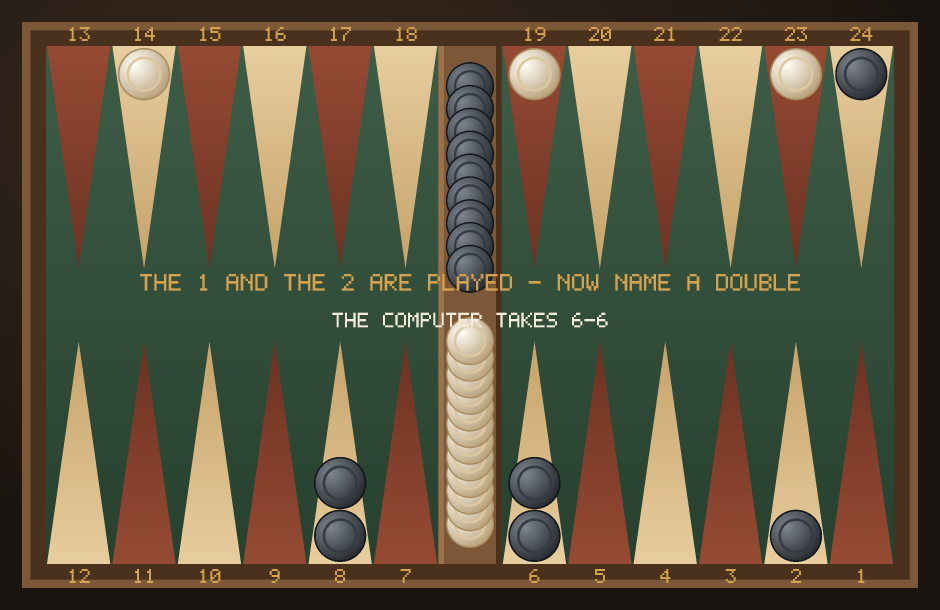
The roll the game is named after. A 1 and a 2 is played like an ordinary roll first — and only if both numbers can be played does the bonus follow. Then the player names any double from 1-1 to 6-6, plays it four times, and rolls again.
The computer takes 6-6 here, which is the most common choice — it picked sixes in 45% of the bonuses we measured — but not an automatic one. Four ones that make two points are often worth more than twenty-four pips of running, and 1-1 is chosen more often than 2-2 or 3-3 for exactly that reason.
Put together, an acey-deucey is worth roughly 21 pips plus another turn, against 7 for an ordinary turn. It is the single biggest thing that can happen to you in this game, and it arrives about seven times per game.
Turn 111 — bearing off
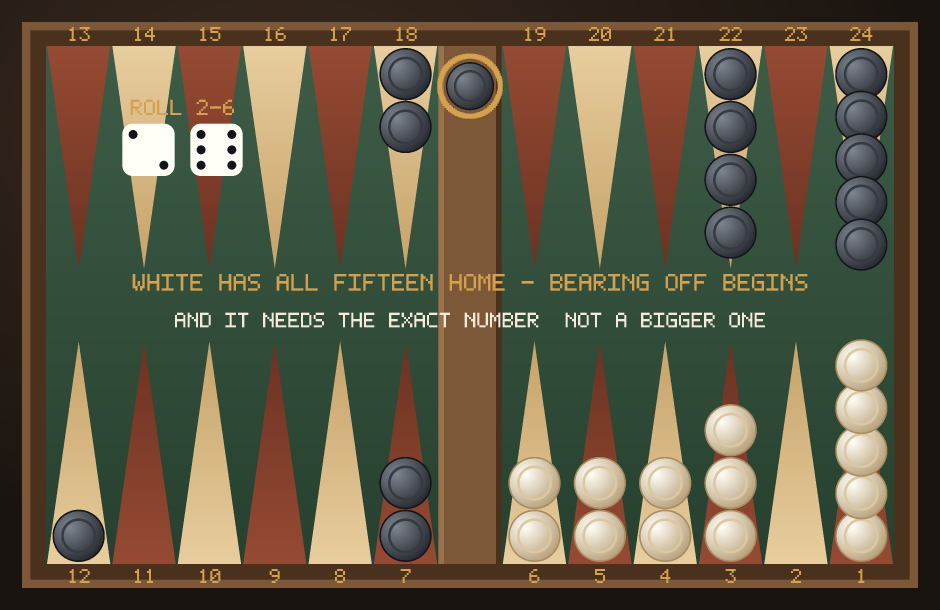
Much later, White finally has all fifteen checkers home and starts bearing off. Here acey-deucey differs from backgammon one last time: you need the exact number. A 6 does not take a checker off the 4-point; if nothing sits on the number you roll, that die does nothing.
That is why a home board spread across all six points beats a comfortable pile on the 1- and 2-points. It is also why the bear-off in this game takes so long once it starts.
How it ended
White reached the bear-off first, at turn 111 — and lost. Black finished the race and bore off all fifteen on turn 150. That is worth sitting with for a moment: being first to the last stage decided nothing, because in acey-deucey there is always another double, another bonus and another roll.
The win was worth one point. There are no gammons in acey-deucey and no doubling cube — every game is worth exactly the same, however it ends.
What to do in your own first game
- Enter in pairs. Two checkers on a point are safe and block a number; one checker alone is a target.
- Do not rush. Checkers in hand cannot be hit. Bring them in when you can cover them.
- Make points in your own home board. Every one of them is an entry number your opponent loses.
- Take the 1-2 seriously. Play both numbers if you possibly can — no bonus otherwise — and think before naming the double.
- Spread your home board. The exact bear-off punishes stacks long before you get there.
- Do not resign. Seven bonuses a game and an extra roll after every double means the position you are losing is not the position you will be losing in three turns.
When those feel natural, the strategy guide goes further: blocking the entry board, holding a checker back on purpose, and which double to buy.
▶ Play Acey-Deucey nowQuestions people ask
How do you start a game of acey-deucey?
With an empty board. Each player rolls one die, the higher number starts and plays those two numbers, and the first move is always about entering checkers: a die of 4 brings a checker in on the fourth point of the opponent's home board, a 5 on the fifth, and so on.
Do you have to enter all your checkers first in acey-deucey?
No. Entering is optional in the American game: once a checker is on the board it may move while the rest are still waiting in hand. A checker in hand is completely safe, which is why bringing everything in quickly is usually a mistake.
What do you do when you roll a 1 and a 2?
Play the 1 and the 2 as an ordinary roll, then name any double from 1-1 to 6-6 and play it four times, and then roll again. If the board will not let you play both the 1 and the 2, you get nothing extra.
What happens when you are hit in acey-deucey?
Your checker goes to the bar, and it must re-enter in the opponent's home board before you may move anything else. That is the difference between the bar and your hand: checkers in hand are optional and safe, a checker on the bar is an emergency.
How does a game of acey-deucey end?
Once all fifteen of your checkers are home you bear them off, and you need the exact number — a 6 does not take a checker off the 4-point. The first player to bear off all fifteen wins one point; there are no gammons in acey-deucey.
How long does a game of acey-deucey take?
The game shown on this page ran 150 turns, which is typical: acey-deucey games take about 131 rolls against 56 for standard backgammon, because doubles and the 1-2 bonus both hand the roller another turn. In real time that is a few minutes online.
More on this board: the rules and a free game, the strategy guide, the measured odds, American vs European vs Mexican, and the Navy history and what else the name means.
← Back to the gameShould I bring all my checkers in before doing anything else?
No, and this is the mistake most new players make. Entering is optional, not compulsory like coming off the bar — if a roll makes a point or hits, that is usually better than adding another checker to the pile. Checkers still off the board are also safe from being hit.
Which points should I aim for first?
The ones in your home board, and then a wall in front of your opponent's entry. Everything your opponent owns has to come in through your home board, so every point you make there is a door closed on their whole army — a much larger effect than in backgammon, where only checkers on the bar have to enter.
What happens if I cannot use both numbers?
The same as in backgammon: play what you can, and if only one number is playable, play it. If either could be played alone but not both, you must play the higher one. The rules of movement are unchanged — only the starting position and the 1-2 are different.
Can I be hit while my checkers are still off the board?
No. A checker that has not entered is not on the board and cannot be touched. Once it enters it is a normal checker: alone on a point it is a blot, and it can be sent to the bar like any other.
Do I have to use the whole bonus?
You must play as much of it as is legal, the same as any roll. If the double you named cannot be played at all, you lose it — which is why naming the biggest double is not automatically right when your board is crowded. In our measurements the bonus is fully paid about 89% of the time.
How do I know when I am winning?
Count pips as usual, but late. Until both sides have their checkers on the board the count is meaningless, because a checker off the board carries the whole journey. Once everyone is in, it is an ordinary race and the pip count means what it always means.