Acey-Deucey Odds
What the 1-2 roll is really worth — measured over 500 games
Last updated
Everybody who plays acey-deucey knows the 1-2 is the big roll. Nobody seems to have written down how big. So we measured it: 500 complete games played out by our own engine, two equally strong computer opponents, every roll recorded. Here is what an acey-deucey is worth, how often it goes to waste, which double is actually chosen, and whether the player who gets more of them wins.
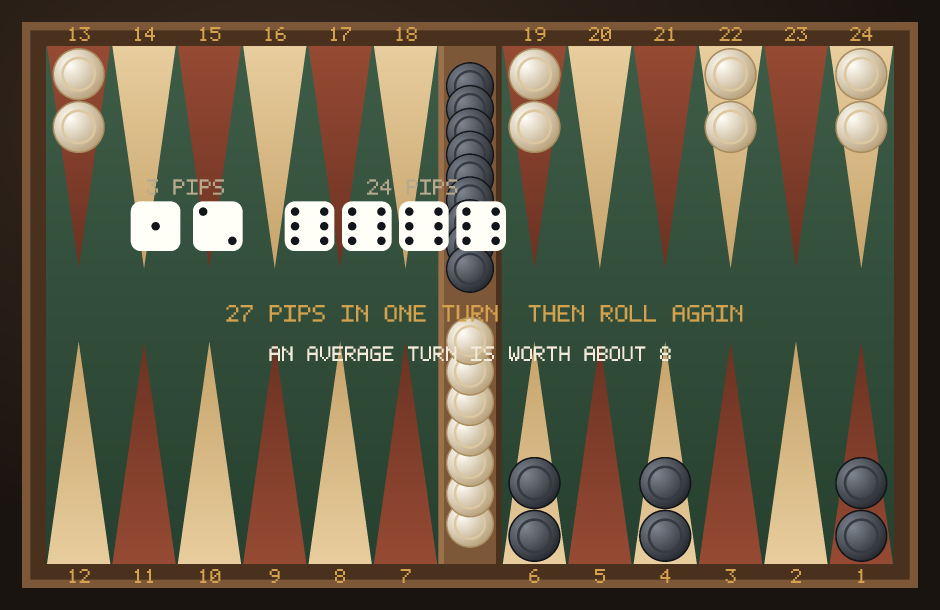
The numbers at a glance
| Acey-deucey | Backgammon | |
|---|---|---|
| Chance of a 1-2 per roll | 2 in 36 = 5.56% (about one roll in 18) | |
| Rolls per game | 131 | 56 |
| Acey-deuceys per game | 7.3 | 3.2 (no bonus) |
| Bonus actually paid | 88.9% of them | — |
| Pips from the 1-2 plus its double | 21.3 | — |
| Pips in an ordinary turn | 7.0 | 7.0 |
| Doubles rolled per game | 22 | 9.5 |
| Extra rolls earned per game | 24.7 | 0 |
| Side with more bonuses wins | 62.1% | — |
How often does a 1-2 come up?
Two dice give 36 equally likely outcomes. Exactly two of them — 1 then 2, and 2 then 1 — are an acey-deucey. That is 5.56%, or roughly one roll in eighteen. It is the same probability as any other non-double combination; what makes it special is what the rules attach to it.
Per game the figure is much larger than people expect, because acey-deucey games are long and full of extra rolls. Our 500 games contained 3,641 acey-deuceys — an average of 7.3 per game, or three or four each. The same measurement on a standard backgammon board produced 3.2 per game, and there the roll is simply a poor 1-2.
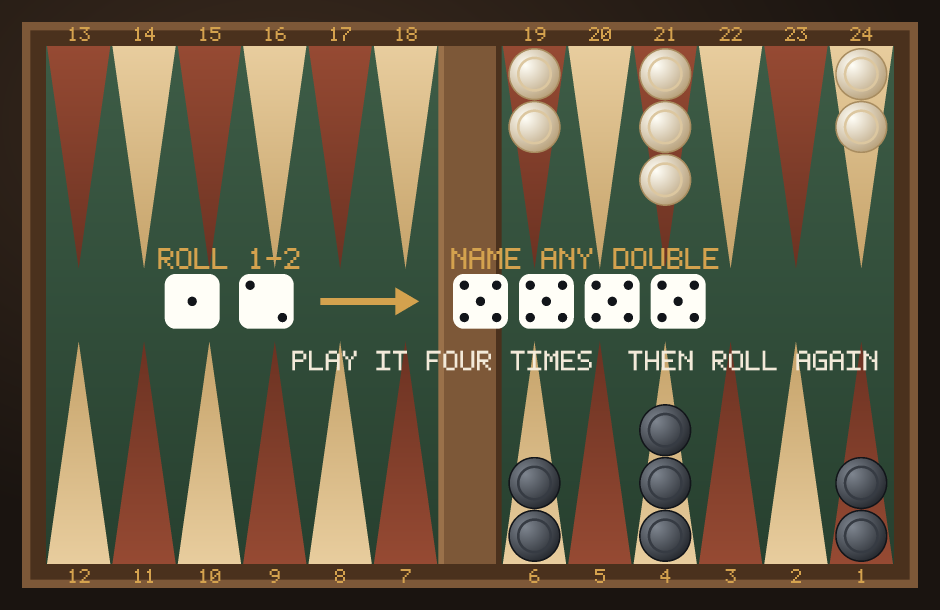
How much is the bonus worth?
An acey-deucey is really three things in a row: the 1 and the 2, then a double of your choice played four times, then another roll. We measured the first two directly, in pips actually moved:
| Part of the turn | Pips moved (average) |
|---|---|
| The 1 and the 2 | 2.9 |
| The double it buys | 18.4 |
| Together | 21.3 |
| An ordinary turn, for comparison | 7.0 |
| And then: another roll | a further 7.0 on average |
So a single acey-deucey is worth about three ordinary turns, plus a fourth for free. Note that the 18.4 pips is well below the theoretical 24 of a 6-6: the double is often played only partly, because the board blocks it or because the best play is a shorter number that makes a point. The measured value is what matters at the table, and it is 18, not 24.
How often is it wasted?
The bonus is only paid if both the 1 and the 2 can be played. That is the rule that catches people out — and it bites more often than you would think:
| Outcome of a rolled 1-2 | Share | Count (of 3,641) |
|---|---|---|
| Bonus paid — both numbers played | 88.9% | 3,238 |
| Only one number playable | 6.5% | 236 |
| Nothing playable at all | 4.6% | 167 |
Roughly one acey-deucey in nine goes to waste. And the situations where it happens are not random: they are the positions where your opponent holds the points a 1 or a 2 would land on — most often a well-made home board while you still have checkers to enter. Another reason to make your own home board early: it does not only stop their checkers, it can rob them of the game's biggest bonus.
Which double gets bought?
When our engine wins a bonus it tests all six doubles, plays out every legal continuation for each, and keeps the one leaving the strongest position. Across 3,238 bonuses it chose:
| Double bought | Share |
|---|---|
| 6-6 | 45% |
| 5-5 | 22% |
| 4-4 | 13% |
| 1-1 | 10% |
| 3-3 | 7% |
| 2-2 | 5% |
The interesting line is not the 45% for sixes — it is that 1-1 is bought more often than 2-2 or 3-3. Four ones make points, fill the gap in front of a blot and enter checkers onto the ace point; four threes usually just move pips. When the biggest number cannot be played in full, the best answer is often the smallest one, not the middle.
Do more bonuses win games?
The question every losing player asks. We counted, for each game, which side collected more acey-deucey bonuses and who won:
- In 422 of the 500 games one side had more bonuses than the other.
- That side won 262 of them — 62.1%.
- The remaining 78 games were level on bonuses.
So the bonus matters — a 62% win rate from a single statistic is a lot — but it is nothing like decisive. Almost four games in ten are won by the player who got fewer acey-deuceys. That is the honest answer to "this game is all luck": the luck is loud, it is worth about 21 pips a time, and it still leaves plenty of room to be outplayed.
Why the games run so long
Both the 1-2 bonus and every ordinary double hand the roller another roll, so a turn is not one roll but a chain. In our games that produced:
- 22 doubles rolled per game (against 9.5 in standard backgammon),
- 24.7 extra rolls earned per game,
- and 131 rolls per game in total, against 56 for backgammon.
That is why acey-deucey feels so different even though the checkers move the same way: you are playing more than twice as many rolls, and any of them can start a chain. It is also why comebacks are ordinary here rather than remarkable — there is simply a lot more game left than the pip count suggests.
How this was measured
Every number on this page comes from the same run: 500 complete games of American acey-deucey and 500 of standard backgammon as a control, played by the engine that runs this site, with the same computer strength on both sides so that no result reflects one player being better than the other. Dice come from the same cryptographic generator the live game uses.
Two caveats worth stating plainly. First, these are computer games: a human plays differently, and the pip figures in particular depend on how well the double is used. Second, the double-choice distribution reflects our engine's judgement, which is strong but not perfect. The probability of a 1-2 (5.56%) is the only figure here that is mathematics rather than measurement — and it is also the one we used to check that the rest of the run was sound.
If you want to see the rules these numbers come from, they are on the acey-deucey page; what to do about them is in the strategy guide.
▶ Play Acey-Deucey nowQuestions people ask
What are the odds of rolling an acey-deucey?
Two of the 36 possible rolls are a 1 and a 2, so 5.56 per cent — about one roll in eighteen. Because acey-deucey games run long, that works out at roughly seven acey-deuceys per game in our measurements.
How many pips is an acey-deucey worth?
In 500 measured games the 1-2 itself moved 2.9 pips on average and the double it bought moved another 18.4 — about 21 pips in one turn, against 7 for an ordinary turn. And the extra roll that follows is worth a whole turn on top.
How often is the acey-deucey bonus lost?
In about one case in nine. Of 3,641 acey-deuceys rolled in 500 games, 88.9 per cent paid the bonus; 6.5 per cent could not play both the 1 and the 2 and 4.6 per cent could not be played at all. The bonus requires both numbers to be played.
Which double should you pick after an acey-deucey?
Our engine, which tests all six and keeps the best resulting position, chose 6-6 in 45 per cent of cases, 5-5 in 22, 4-4 in 13, 1-1 in 10, 3-3 in 7 and 2-2 in 5. Ones beat twos and threes because they make points and fill gaps rather than just moving pips.
Does the player with more acey-deuceys win?
Usually, but far from always. Over 500 evenly matched games the side with more bonuses won 62.1 per cent of the games that were not tied on bonuses — meaning nearly four games in ten were won by the player who got fewer.
How long is a game of acey-deucey?
About 131 rolls, against 56 for a standard backgammon game in the same measurement — because doubles and the 1-2 bonus both hand the roller another turn. There are around 22 doubles and 25 extra rolls in a typical game.
More on this board: the rules and a free game, the strategy guide, and how the U.S. Navy made it its own, American vs European vs Mexican, and a walk-through of a first game and what else the name means.
← Back to the gameIs acey-deucey more luck than backgammon?
More swing, at least. The 1-2 bonus arrives about 7.3 times a game and hands the roller a free double plus another roll, which is a much larger single event than anything in backgammon. Our own games also run 147 turns against backgammon's 57, and a longer game gives skill more chances to show — the two effects pull in opposite directions.
Does the first player have an advantage in acey-deucey?
Less than in backgammon, because the opening does not make a point. Everyone starts with an empty board and the first rolls only bring checkers in, so the structural head start that a 3-1 gives in backgammon simply does not exist here.
How many turns does a game of acey-deucey take?
About 147 in our measurements, against 57 for a standard backgammon game — two and a half times as long. Fifteen checkers each have to be entered before they can even begin the journey, and every bonus adds another roll.
Why are there so many hits in acey-deucey?
Because entering checkers is a slow, exposed business. We measured 25.1 hits per game against 7.6 in backgammon. Everything comes in through the opponent's home board, which means blots in the danger zone for most of the game.
Is it worth holding a checker back deliberately?
It is a known idea — sailors call the kept-back checker an "Oscar" — and the arithmetic behind it is real: a checker still off the board cannot be trapped behind a blockade. It costs tempo, so it is a trade rather than a free option.
Do the odds change in the European version?
The frequency does not — a 1-2 is still 2 of 36 rolls. What changes is the value: in the complement versions every choice is worth exactly 28 pips, because opposite faces of a die always add to seven. The question "which double is biggest" simply does not exist there.