Acey-Deucey: The U.S. Navy's Own Backgammon
Boards screwed to a rolling deck, a shout that costs you a turn, and a century of evidence
Last updated
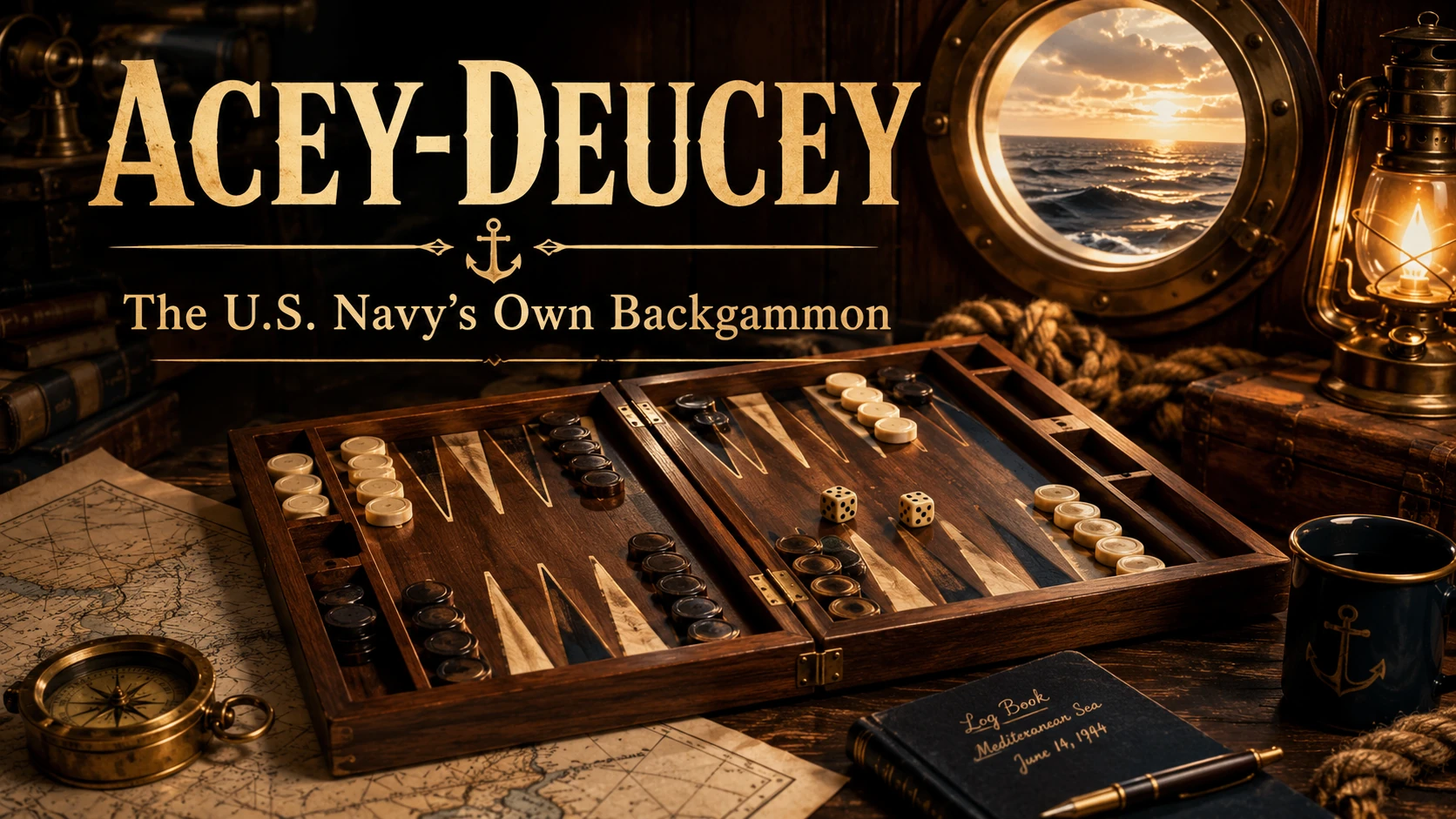
Every navy has its games. The United States Navy has one it made its own: acey-deucey, a backgammon variation played on ships since at least the early 1900s, named after the roll that decides it. It has been on decks, in chiefs' messes and on carrier fantails for more than a century — and it is still the fastest way to understand what sailors did with the hours between watches. Here is where it came from, why the board looks the way it does, and what the shouting was about. If you want the rules first, they are on our acey-deucey page.
A game that went to sea
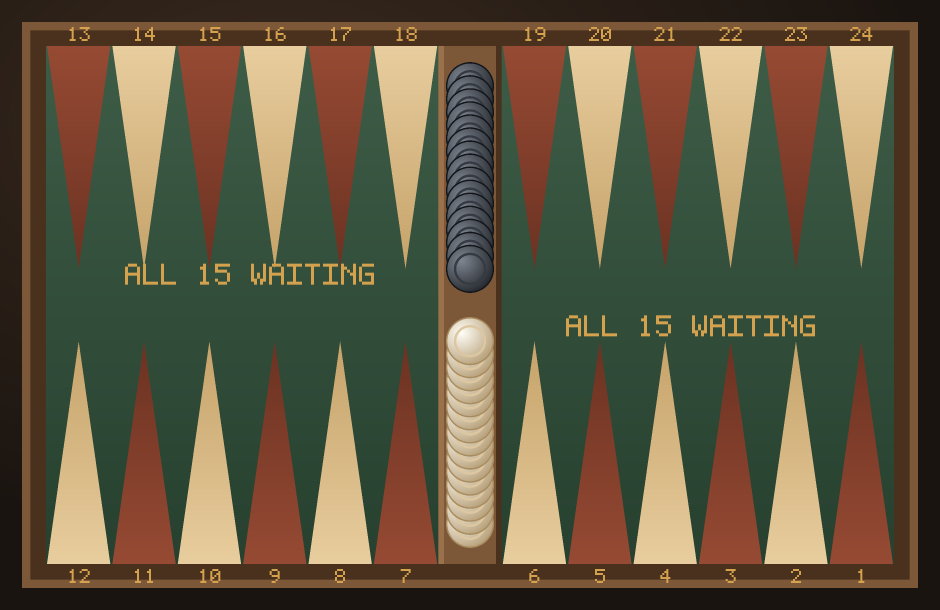
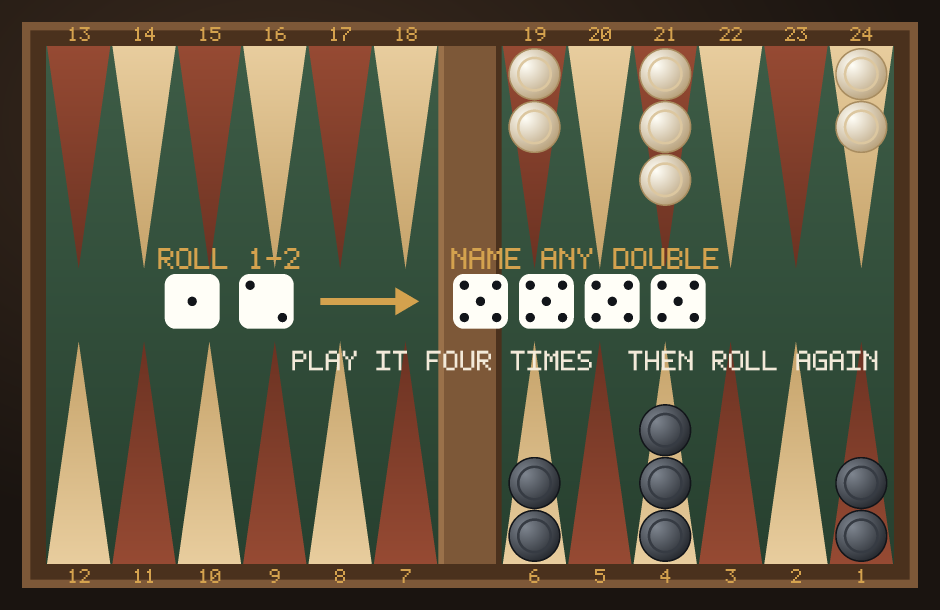
Acey-deucey is backgammon with the handbrake off. All fifteen checkers start off the board and enter in the opponent's home board; a roll of 1 and 2 — the acey-deucey — lets you play both numbers, then name any double you like and play it, then roll again; every ordinary double also earns another roll; and bearing off needs an exact number. There is no doubling cube and there are no gammons.
Two of those differences look like design decisions by someone who had played a lot of backgammon on a moving deck: nothing to set up, and no long grind toward a certain finish.
The evidence: 1904 to 1951
The game is generally described as a Navy fixture since the First World War, and that is where most accounts start. But there is older evidence. A photograph in a Department of the Navy album shows two chief petty officers playing acey-deucey on the deck of USS Baltimore, around 1904 to 1906 — roughly a decade before the war that supposedly introduced it.
By the Second World War it was everywhere the fleet was. One wartime sailor's account describes twenty to twenty-five men gathered on the fantail of an aircraft carrier around canvas boards with metal counters, playing between operations. The same account makes a point that says a great deal about how specific the tradition was: he served twenty-one months in the Army as well, and never once saw or heard of the game there. It was, in his words, distinctly a Navy game.
The institutional seal came in May 1951, when the U.S. Naval Institute published an article in its Proceedings under the title "Acey-Deucy, A Navy Game" — note the Navy's own preferred spelling, which you will also find on the service's museum labels.
A board built for a rolling deck
A shipboard acey-deucey board is not simply a backgammon board that happens to be aboard. The Naval History and Heritage Command holds one in its collection, and the adaptations are exactly what a century of seagoing would suggest:
- The board is screwed down to the table.
- A wooden lip runs around the playing surface, so the men do not slide off when the ship rolls.
- The dice are not cast loose but thrown into a dice chute fastened to the table.
Put those three together and you have a game that survives weather. Anyone who has watched a dice cup slide across a table in a swell will recognise the problem being solved. It also explains the canvas roll-up boards that turn up in wartime photographs: a board that can be tied to a stanchion and stowed in a locker is a board that gets played.
Why this game and not backgammon
Sailors had backgammon available. They chose this. Four reasons show up again and again in the accounts, and all four are consequences of the rules:
- Nothing to set up. The board starts empty. No positions to remember, no arguments about whose 24-point is whose, and nothing to reset if the game is interrupted.
- Short games. Doubles and the 1-2 bonus both hand you another roll, so a game moves fast — and a game you can finish before the watch changes is a game worth starting.
- Nobody is ever out of it. A single acey-deucey is worth about three ordinary turns (we measured it), so a lost position can turn around in one roll. Nobody resigns; everybody keeps watching.
- It plays to a crowd. The bonus roll is loud and public. The game invites advisers, and the record is full of them — shouting "Kick him!", "Run for it!" and "Shut the door!" over the shoulder of whoever holds the dice.
The shouting
The best-documented piece of acey-deucey folklore is not in any rulebook. Aboard ship, a player who rolled a 1-2 was expected to shout "acey-deucey" — and, by the tradition recorded by wartime players, a roller who failed to shout forfeited the bonus turn. The opponent, for their part, was expected to curse the roller and his advisers; an opponent who failed to curse handed over two extra turns.
Treat it as custom rather than rule — it appears in first-hand recollections, not in published rule sets, and no online version enforces it. But it tells you what kind of game this was: not a quiet two-player contest, a piece of deck theatre with an audience.
Where the name comes from
The plain answer is the dice. "Ace" is a one and "deuce" is a two, and the game is named after the roll that makes it what it is. The spellings wander — acey-deucey, acey-deucy, acey ducey — and the Navy's own labels tend to the second and third.
There is a second thread in Navy usage. Navy sources report that "acey" and "deucey" were nicknames for first and second class petty officers, and the Acey-Deucey Club on a naval base was the club for those grades — E-5 and E-6 — sitting between the junior enlisted club and the chiefs' club. Whether the ranks took the name from the game or the game from the ranks is not something the sources settle, and we are not going to pretend otherwise. What is clear is that both meanings were in circulation at once, and that a sailor of the period would have heard the phrase in both senses.
Was it played for money?
Here the record disagrees with itself, which is worth saying out loud rather than picking the version that reads better.
Some rule sets describe acey-deucey as a stakes game, with the loser paying one unit for every checker they had not yet borne off — a scoring rule that makes even a hopeless position worth playing out to the last roll. Against that, at least one first-hand wartime account states plainly that acey-deucey was never played for money aboard his ship, unlike the poker and craps going on elsewhere.
Both can be true — a game spread across a fleet for fifty years does not have one custom — and the stakes rule may well be the later addition that a hobby makes to a pastime. The version played here uses neither: every win counts one point, exactly as most modern rule sets have it.
Where it came from before the Navy
The Navy adopted acey-deucey; it did not invent it. Its ancestors are the tables games of the eastern Mediterranean — Greece, Turkey and the wider Middle East — where variants in which the checkers start off the board are old and widespread. American sailors met those games in port, brought them home, and bent the rules into something faster.
That inheritance is still visible. The entering rule is the family resemblance; the 1-2 bonus and the extra roll after doubles are the American additions. The same eastern Mediterranean tradition gave the world tavla and its cousins, which is why an acey-deucey board feels familiar to anyone who has played backgammon in a coffee house from Athens to Istanbul.
The game today
Acey-deucey outlived the ships it was played on. It is still played in the fleet and in veterans' circles, and it survives online, where a game that takes minutes fits the medium as neatly as it once fitted a watch change.
The version on this site follows the American rules as they are usually written down: everything starts off the board, entering is optional, a played 1-2 buys any double plus another roll, doubles earn another roll, bearing off needs an exact number, there is no cube and every win counts one. No shouting is required, though nobody will stop you.
▶ Play Acey-Deucey nowSources
This page is built on the following; where they disagree, we have said so above rather than choosing quietly.
- U.S. Naval Institute, Proceedings, May 1951: "Acey-Deucy, A Navy Game"
- Naval History and Heritage Command: Acey Ducey Board (artifact)
- Jon Bjornstad, "Acey Deucey" — including a wartime carrier account and the shouting custom
- Wikipedia: Acey-deucey — rules, the USS Baltimore photograph and the eastern Mediterranean origins
- Naval terminology and slang: "acey" and "deucey" as ratings nicknames
Questions people ask
Why do sailors play acey-deucey?
Because it suits life aboard a ship. The board starts empty, so nothing has to be set up or remembered; games are short and can be abandoned at a watch change; the swings are large enough that a hopeless position is worth playing on; and it can be played by a crowd, with everyone shouting advice.
How old is acey-deucey in the Navy?
It is usually dated to the First World War, but a photograph in a Department of the Navy album shows two chief petty officers playing it on the deck of USS Baltimore around 1904 to 1906 — a decade earlier. The U.S. Naval Institute published an article titled "Acey-Deucy, A Navy Game" in its Proceedings in May 1951.
What is an acey-deucey board?
A backgammon board adapted for a moving ship: the board is screwed down to the table, a wooden lip runs around it so the men cannot slide off when the ship rolls, and the dice are thrown into a dice chute fastened to the table rather than cast loose.
Do you have to shout acey-deucey?
Aboard ship you did. By the tradition recorded by wartime players, a player rolling a 1-2 had to shout "acey-deucey" or forfeit the bonus turn — and the opponent was expected to curse in reply, on pain of the roller getting two extra turns. It is folklore rather than a rule of the game, and no online version enforces it.
What is the Acey-Deucey Club?
A club on a naval base for first and second class petty officers — the E-5 and E-6 grades. Navy sources report that "acey" and "deucey" were nicknames for those two ratings, which is how the club, and by extension the game, picked up the name in Navy usage.
Where does acey-deucey come from?
The Navy adopted it rather than invented it. Its ancestors are the tables games of the eastern Mediterranean — Greece, Turkey and the Middle East — which include variants where the checkers start off the board, exactly as they do in acey-deucey. Sailors would have met those games in port.
More on this board: the rules and a free game, the strategy guide, and the numbers behind the 1-2 roll, American vs European vs Mexican, and a walk-through of a first game and what else the name means.
← Back to the gameIs acey-deucey still played in the Navy today?
Yes, though far less than it was. The boards are still found in wardrooms and clubs, and the Acey-Deucey Club name survives for the E-5 and E-6 mess. What has gone is the setting: a modern ship has screens, and the long empty hours that made a board game the entertainment of choice are fewer.
Who invented acey-deucey?
Nobody knows, and the honest answer is that it was not invented so much as drifted into existence. The earliest hard evidence is a photograph in a USS Baltimore album from around 1904-06. The rules were passed on by playing, not by publication, which is exactly why the versions disagree with each other today.
Why did sailors change the rules of backgammon at all?
The changes all point the same way: they make the game faster to explain and slower to finish. Starting with an empty board removes the setup a newcomer has to memorise, and the 1-2 bonus adds swings that keep a long game interesting. It is a game shaped by an audience that changed constantly and had time to spare.
Is acey-deucey the same as the card game sailors played?
No, and they were often played in the same room, which is where the confusion comes from. The card game — also called In-Between — is a betting game with two cards face up and a bet on whether the third falls between them. Our page on the name sorts out all five meanings.
Was acey-deucey ever official Navy recreation?
It was never a regulation, but it was recognised: the U.S. Naval Institute's Proceedings ran a piece titled "Acey-Deucy, A Navy Game" in May 1951, and the Naval History and Heritage Command holds a purpose-built board in its collection. That is institutional acknowledgement without ever being a rule.
What made a Navy board different from a normal one?
It was built for a moving deck. The exhibit board is screwed down, has a raised wooden lip so checkers cannot slide off with the roll of the ship, and a well for the dice. Nothing about the game changed — only the furniture.