Acey-Deucey Strategy
How to win the U.S. Navy's backgammon — seven ideas that decide games
Last updated
Acey-deucey looks like a dice game and plays like a knife fight. Every checker starts off the board, every one of them has to enter through your opponent's home board, and a single 1-2 can hand someone three turns' worth of pips out of nowhere. The rules are on our acey-deucey page — this one is about what to do with them. Everything below follows from four rule differences, and you can try it against the computer while you read.

What actually changes
Four rules separate acey-deucey from backgammon, and all the strategy below comes out of them:
- Everything starts off the board, and entering is optional.
- A played 1-2 buys any double you like, plus another roll.
- Every double is followed by another roll.
- Bearing off needs an exact number, and there is no cube and no gammon.
Notice what that does to the shape of a game. Both armies funnel through the same two quadrants, nobody can be raced out early, and the swings are enormous. In 500 games played out by our own engine, an acey-deucey game took 131 rolls against 56 for standard backgammon — more than twice as many chances for something to go wrong.
1. Block your own home board first
This is the single most valuable idea in the variant, and it is the opposite of what backgammon teaches beginners. In backgammon your home board matters at the end. In acey-deucey it matters from the first roll, because every one of your opponent's fifteen checkers has to enter through it.
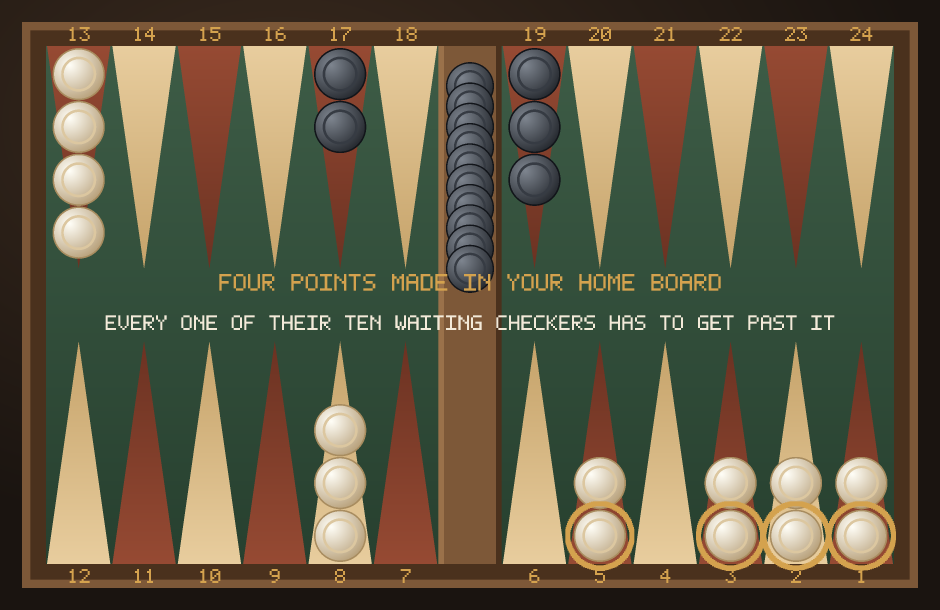
A four-point home board closes four of the six entry numbers. Your opponent does not lose a turn — they can move what is already on the board — but their reinforcements stop arriving, and the checkers they do have get thinner and easier to attack. A five-point home board is close to decisive, and it does not even need a prime: the points do not have to be consecutive.
2. Do not bring everything in at once
New players enter checkers as fast as the dice allow, because that is what "getting started" feels like. It is usually wrong. Entering is optional, and a checker in hand cannot be hit.
Every checker you enter lands in the most dangerous quarter of the board for you: your opponent's home board, where their builders are. Bring in more than you can pair up and you leave a row of blots for someone who is aiming at them anyway. Bring in two at a time and make a point, and you have an anchor that costs your opponent numbers instead.
The rule of thumb that survives contact: enter in pairs, or enter onto a point you already own. A single checker entering alone should have a reason — a hit, or a number your opponent cannot easily cover.
3. Oscar: the checker you keep back
Sailors gave the idea a name. "Oscar" is a checker deliberately held in hand, sometimes deep into the game, so it can enter at the moment it does most damage: onto a blot, or onto a point your opponent has just been forced to open.
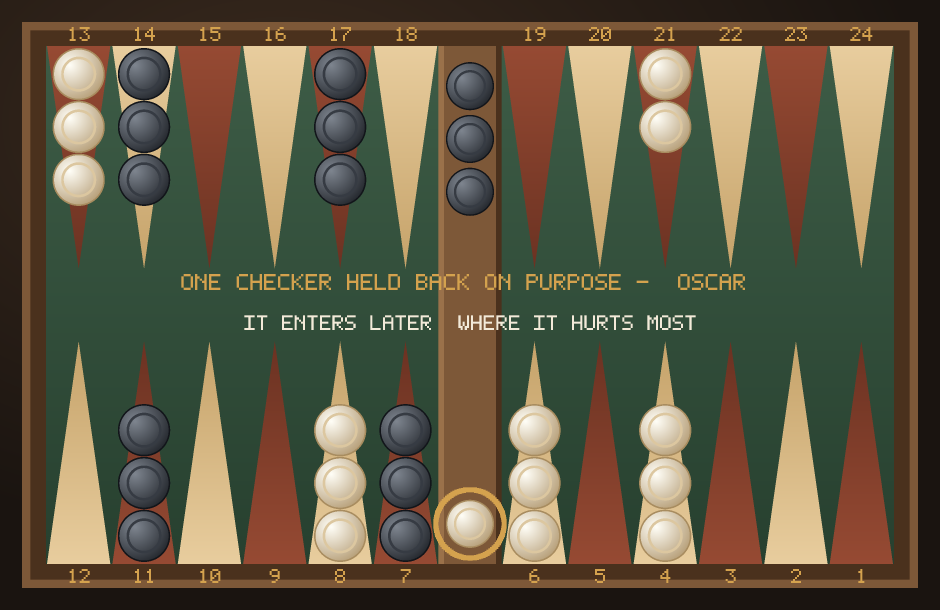
It works because of two rules pulling together: entering is optional, so the checker is never forced out; and there is no gammon, so being one checker behind in the race costs you nothing extra if you lose. The price is real, though — that checker is 24 pips from home, and it is not helping you win the race.
When to hold one back: when your opponent's home board is strong and yours is not, when you are behind and need a target to shoot at, or when a blot is sitting in the entry quadrant. When not to: when you are ahead in the race and the game is turning into a run home — then Oscar is just a checker you will have to bring 24 pips later.
4. Which double should you buy?
Roll a 1-2, play both numbers, and you may name any double from 1-1 to 6-6 and play it four times. The instinct is to take 6-6 for the 24 pips. That is often right and regularly wrong.
Ask three questions, in this order:
- Can I make a point with it? Two checkers landing together on an open point — especially in your home board — beats raw distance almost every time.
- Am I stuck? On the bar, or behind a wall, take the number that gets you out, however small.
- Am I ahead in the race? Then take the biggest number you can play in full. Four sixes that only play twice are worth twelve pips, not twenty-four.
There is a fourth question worth adding once you have played a few games: what does it leave? Four sixes that strip your home board and leave three blots have handed the initiative straight back.
5. Play for the exact bear-off from move one
Acey-deucey bears off on exact numbers only. A 6 does not take a checker off the 4-point. If nothing sits on the number you roll, that die does nothing at all.
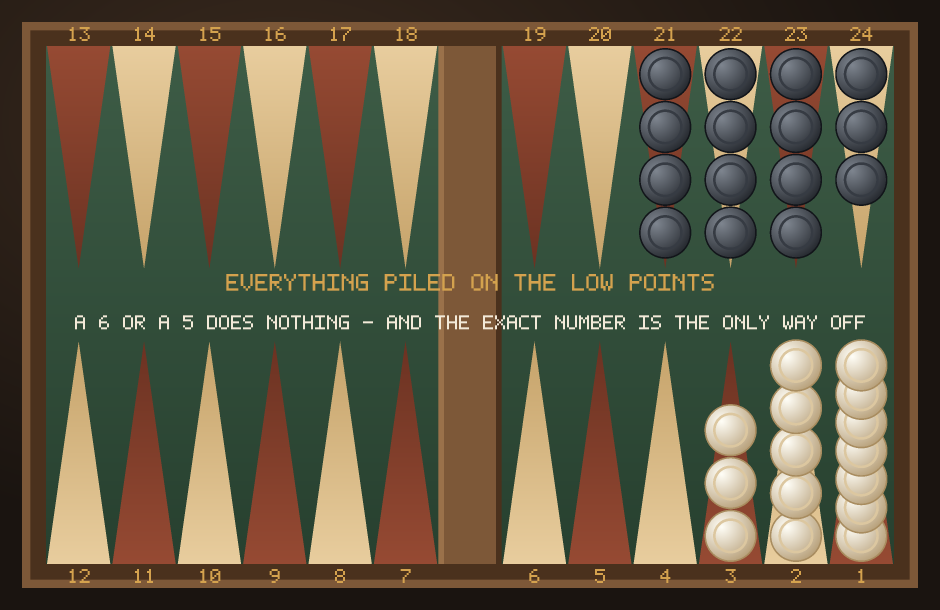
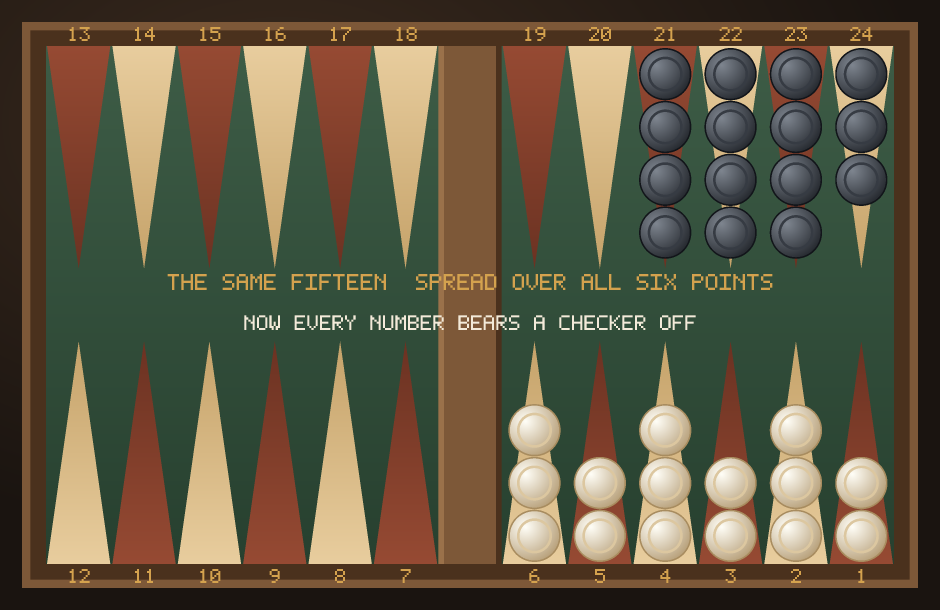
The mistake is made long before the bear-off: players run every checker as deep as it will go, because deep feels safe. In this variant deep is slow. When you have a spare pip in the middle game, use it to fill the 5- and 6-points rather than to stack the 1-point.
6. Hitting: when it pays
Hitting works exactly as in backgammon — a blot goes to the bar and must re-enter — but two differences change the maths.
It is worth more early, because a checker sent back has to re-enter through a home board you are busy closing. Hit a checker when you hold three or four home points, and you may have taken it out of the game for several turns rather than sent it 24 pips backwards.
It is worth less as a race play, because there are no gammons. Sending someone back when you are already winning does not buy you an extra point the way it does in backgammon — it only reduces the chance they catch up.
And remember the asymmetry: a checker on the bar must come back before its owner may do anything else, while a checker in hand is patient and safe. That is why hitting an entering checker is so much stronger than it looks.
7. The last checker home
Most acey-deucey games are lost by one straggler. The bear-off cannot begin until every checker is home, so a single checker still crossing the board holds up the entire endgame — and while it crosses, it is a target.
Two habits fix it. First, bring the back checkers in company: two checkers moving together can make a point when they land, one cannot. Second, use the bonus rolls for the awkward one. A bought 6-6 is the cheapest way to move a lone checker across two quadrants in a single turn, and unlike a normal roll it does not cost you your turn.
Common mistakes
- Entering everything as fast as possible. Speed is not the goal; a covered position is.
- Always taking 6-6. The biggest number is the best number only when you can play all four of it.
- Stacking the low points. Comfortable, and it throws away the exact bear-off.
- Playing the cube. There is no cube in acey-deucey — if your opponent offers one, you are playing a different game.
- Giving up when behind. With roughly seven 1-2 rolls per game and doubles earning another roll, comebacks are ordinary rather than remarkable.
- Forgetting the bar has priority. Checkers in hand are optional; a checker on the bar is not.
Practise it against the computer
Pick Acey-Deucey above the board and play it here — three computer levels, or a private link to a friend, free and with no account. The board enforces every rule for you, including the ones this page is built on: the optional entry, the double you buy after a 1-2, and the exact bear-off.
▶ Play Acey-Deucey nowQuestions people ask
How do you win at acey-deucey?
Make points in your own home board early, because every one of your opponent's fifteen checkers has to enter through it; keep more checkers in hand than feels natural so you are not leaving blots in the most dangerous quarter; buy the double that makes a point rather than the biggest number; and spread your home board evenly, because acey-deucey needs an exact roll to bear off.
What double should you take after rolling an acey-deucey?
Not automatically 6-6. Ask three questions in order: can I make a point with it, am I stuck behind a wall or on the bar, and am I ahead in the race? Our engine, choosing the double that leaves the strongest position, takes 6-6 in 45 per cent of cases, 5-5 in 22 per cent and 1-1 in 10 per cent — more often than 2-2 or 3-3, because ones make points.
What is Oscar in acey-deucey?
Oscar is the old Navy name for a checker deliberately kept off the board, in hand, so it can enter later where it does most damage — usually to hit a blot or to anchor in the opponent's home board. Because entering is optional in acey-deucey, a checker in hand is perfectly safe, which is what makes the idea work.
Should you bring all your checkers in quickly in acey-deucey?
No. Entering is optional, and a checker still in hand cannot be hit. Bringing in more checkers than you can cover creates a row of blots in the opponent's home board, which is the most dangerous quarter on the board for you.
Why does the exact bear-off change acey-deucey strategy?
Because a number bigger than your highest occupied point does nothing at all. A home board with everything piled on the 1- and 2-points wastes every 5 and 6 you roll, so the game rewards spreading checkers across all six points long before the bear-off starts.
Is acey-deucey mostly luck?
There is more swing than in backgammon: a single 1-2 is worth about three ordinary turns plus another roll. But in 500 evenly matched computer games the side that collected more 1-2 bonuses won only 62 per cent of the decided games — so a third of the time the player with fewer bonuses still won on play.
More on this board: the rules and a free game, the numbers behind the 1-2 roll, and how the U.S. Navy made it its own. For the general game, see our backgammon strategy guide, American vs European vs Mexican, and a walk-through of a first game and what else the name means.
← Back to the game